What the Little Finger Symbolizes! A Cultural Look at Personality and Identity
The human quest for self-understanding is an ancient and tireless journey. While modern society typically relies on the rigors of psychology, the nuances of upbringing, and the impact of life experiences to define personality, humanity has a long and storied history of seeking meaning in physical form. We often scan the face for character or the gait for confidence, but one of the most intriguing and subtle areas of symbolic study lies in the palm of the hand—specifically, the often-underestimated little finger. Despite its diminutive size, the “pinky” has occupied a significant space in the cultural imagination for centuries, serving as a silent metaphor for how we communicate, how we observe the world, and how we relate to the people around us.
To understand the symbolic weight of the little finger, it is helpful to first acknowledge its physical indispensable nature. In terms of sheer mechanics, the pinky is far more than a minor accessory to the hand; it provides nearly fifty percent of the hand’s total gripping strength. It acts as a stabilizer, a silent partner to the more dexterous thumb and forefinger, providing the balance and coordination necessary for everything from wielding a heavy tool to the delicate artistry of playing a violin. It is this very duality—being the smallest in stature yet vital to the hand’s power—that has inspired various cultures to view it as a symbol of the “inner voice” or the “hidden engine” of the human personality.
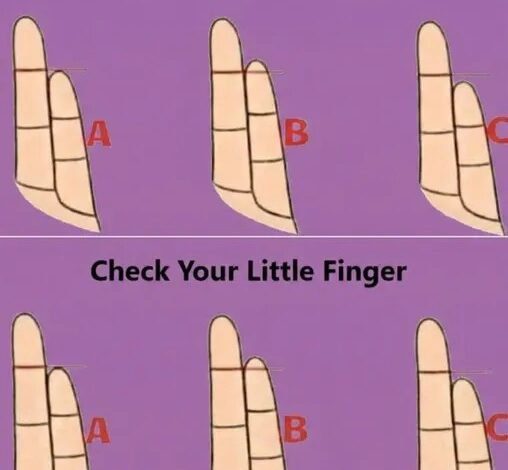
Across many traditions, particularly in Eastern folklore and Western palmistry, the little finger is inextricably linked to the planet Mercury, the mythological messenger of the gods. Consequently, the pinky has become a cultural shorthand for communication, eloquence, and social intelligence. In these interpretive frameworks, the length and shape of the finger are seen as reflections of how an individual projects their thoughts into the world. A longer little finger—one that reaches or surpasses the top joint of the neighboring ring finger—is often symbolically associated with a natural gift for language. It represents the “extrovert’s engine,” suggesting a person who is comfortable in the limelight, articulate in their expression, and possessing a magnetic charm in social situations.
In a cultural context, this longer finger is celebrated as the mark of a “bridge-builder.” These are the individuals who can navigate complex social hierarchies with ease, using their words to soothe conflict or inspire action. The symbolism here is not about a literal prediction of talent, but rather a metaphorical acknowledgment of the value of open expression. It invites us to appreciate the “articulators” among us—those who have the confidence to speak their truths and the charisma to ensure those truths are heard. For communities that prize storytelling and public discourse, the long little finger became a badge of honor for the orators and the diplomats.
Conversely, cultural narratives have found equal beauty and depth in the symbolism of the shorter little finger. Far from being seen as a deficit, a more modest pinky is often connected to the “power of the observer.” In folklore, these individuals are seen as the quiet anchors of society. They are the listeners who process information deeply before offering a response, favoring substance over speed and sincerity over flair. Symbolically, the shorter little finger represents a preference for internal reflection and a high degree of emotional reliability. These are the people who offer strength through their presence rather than their proclamations, providing a steady hand to those in crisis.
This perspective celebrates the “introvert’s integrity.” In a world that often prizes the loudest voice, these cultural interpretations serve as a necessary reminder that patience, empathy, and loyalty are the quiet virtues that keep a community together. The shorter finger symbolizes a person who may not seek the center of the room but will always be the first to notice when someone else is suffering in the corners. It is a metaphor for the “deep well”—the person whose character is revealed not through a flurry of words, but through a consistent history of supportive actions and thoughtful observations.
As we move deeper into the nuances of identity, the symbolism of the little finger also touches upon the concept of balance. Just as the physical pinky balances the hand, its symbolic counterpart encourages a balance of the self. Many traditions suggest that the way we hold or move our hands can reveal our level of inner peace. For example, the “pinky out” gesture, popularized in various cultures as a sign of refinement or high social standing, can be viewed symbolically as a desire for grace and a separation from the mundane. Even the act of “pinky swearing”—a cross-cultural ritual of childhood—elevates this small finger to a vessel of sacred trust and unbreakable promises. It suggests that the smallest part of us is capable of holding the weight of our most significant commitments.
Ultimately, these cultural lookouts remind us that the human character is far too vast and complex to be contained by a single physical trait. Appearance can be a gateway to curiosity, but it is never the destination of understanding. Our identities are built through a million choices, a thousand heartbreaks, and the steady accumulation of wisdom over a lifetime. However, the reason these small symbolic traditions persist—even in an age of scientific reason—is that they offer us a creative language for self-reflection. They provide a framework through which we can pause and consider our own unique makeup: Are we the bridge-builders or the deep wells? Are we the orators or the anchors?
The modest little finger, sitting at the edge of the hand, serves as a gentle reminder that every part of us has a purpose. It tells a story of hidden strength, suggesting that we should never mistake smallness for weakness or silence for a lack of thought. In the intricate dance of human connection, we need both the loud and the quiet, the expressive and the supportive, the long-reaching and the steady-holding. Whether we find ourselves aligned with the confidence of the “Mercury finger” or the reliability of the “silent observer,” we are reminded that even the smallest details of our existence can inspire meaningful reflection on who we are and who we might become.
In the end, the symbolism of the hand is a celebration of individuality. It encourages us to look at our own palms not just as tools for labor, but as maps of our potential. By finding meaning in the small, we learn to appreciate the complexity of the whole. The little finger stands as a testament to the fact that every person—no matter how they express themselves or how they move through a room—contributes something essential to the collective human tapestry. It is a symbol of the modest yet essential qualities that make the hand, and the soul, complete.