Your Subconscious Is Betraying You The First Animal You See Reveals Your Darkest Personality Flaw
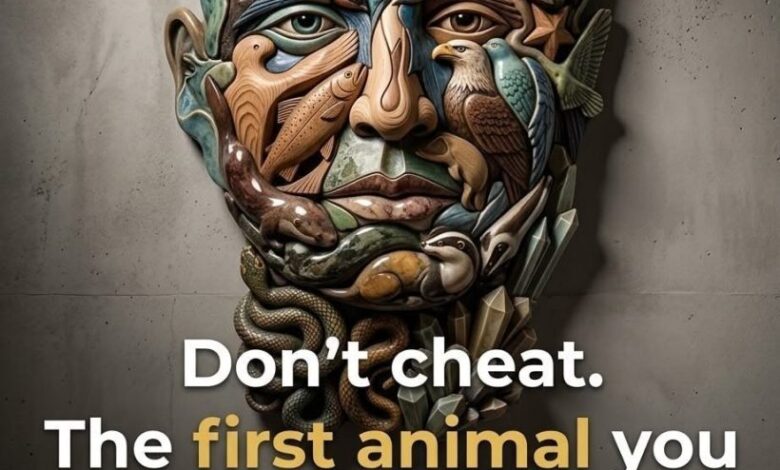
Have you ever wondered why you repeat certain patterns in life, struggle with relationships, or feel controlled by hidden traits you can’t quite name? Viral “psychological illusion” tests claim these patterns can be revealed in seconds through simple visual choices.
One of the most popular formats is the “first animal you see” image test. You’re shown a complex illustration and asked to identify the first animal that stands out. The idea is that your brain reveals subconscious tendencies through instinctive perception.
These tests are often compared loosely to Rorschach-style exercises. When faced with ambiguous images, the human brain naturally imposes order on chaos, prioritizing certain shapes and details based on attention, memory, and bias.
Different interpretations are said to reflect different personality traits. For example, seeing a lion may be linked to pride or dominance, while a rabbit is associated with sensitivity or anxiety. A bird can symbolize independence, a snake mistrust, and an elephant strong memory or attachment to the past.
However, these interpretations are not scientifically validated. They are typically built on symbolic associations rather than clinical psychology and should be understood as entertainment rather than diagnostic tools.
Much of their popularity can be explained by the Barnum Effect, where people relate to vague or general statements because they feel personally accurate. This is why many quiz results seem meaningful even when they are broadly applicable to almost anyone.
Despite this, such tests can still encourage self-reflection. They may prompt people to consider their habits, emotions, or reactions more thoughtfully, even if the underlying mechanism is not scientifically rigorous.
Ultimately, the value of these viral illusions lies not in accuracy but in perspective. They highlight how differently people perceive the same image and remind us that self-understanding often comes from reflection, not quick answers.
The animal a viewer notices first is only the starting point of the exercise. One person may immediately recognize a familiar outline, while another may focus on a different part of the illustration. Those differences can make the conversation interesting without establishing that either person has a fixed psychological flaw. The image provides a prompt, and the meaning attached to that prompt comes from the interpretation offered afterward.
A useful way to approach the result is to ask which parts of the description feel familiar and which do not. Someone who recognizes a tendency toward pride, worry, independence, or mistrust can reflect on particular experiences that brought that feeling to mind. That reflection is more specific than accepting an entire personality label simply because an animal appeared first in a picture.
The broad wording of many results also deserves attention. Descriptions involving memory, sensitivity, or a desire for independence can apply to people in many different circumstances. Feeling understood by such a description does not, by itself, establish that the illustration measured anything. It can instead show how readily a general statement connects with a personal memory.
The exercise can remain an enjoyable comparison of perspectives. Friends may disagree about what they see, discuss the details that caught their attention, and recognize how differently the same picture can be interpreted. Keeping the activity in that context allows curiosity and self-reflection without turning a casual visual puzzle into a diagnosis or a judgment about someone else.