Trumps lowercost beef imports have arrived heres how to know if youre purchasing US meat
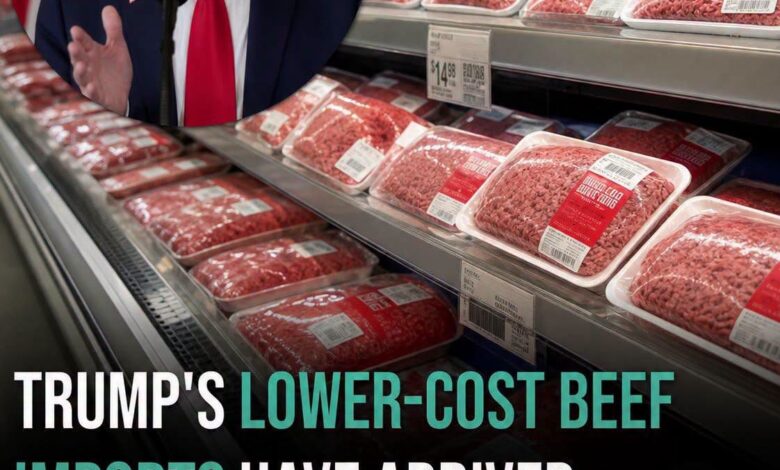
A USDA mark on a package of ground beef does not, by itself, tell you where the cattle were raised. That distinction matters as shoppers compare prices and try to understand the arrival of lower-cost imported beef. Inspection, quality, processing location, and national origin answer different questions, even when all those details appear together on the same crowded label.
The Trump administration’s effort to expand beef imports has drawn attention to a supply chain that is often invisible at the supermarket. Lean trimmings can be used in ground beef alongside other beef, and the finished product may look familiar regardless of where the animals originated. Appearance is not a reliable way to separate domestic beef from imported or mixed-origin beef.
The practical question for someone who wants American-raised meat is therefore not whether the package looks American. It is whether the wording makes a specific claim about the animals and the production process. A familiar brand, an American business address, or a label describing a local processing facility does not automatically answer that question.
“Product of USA” and “Made in the USA” are particularly important phrases. Under the federal requirements applying from January 1, 2026, these voluntary claims on single-ingredient meat products mean that the animals were born, raised, slaughtered, and processed in the United States. The claim covers the full chain, rather than merely the last stage before a product reaches the shelf.
Voluntary is an important part of that description. A package without one of those claims is not automatically proof that its contents came from abroad. It may simply lack a voluntary origin statement. Absence of the wording leaves a question unanswered; it does not supply an answer in the opposite direction.
A more limited statement, such as “processed in the USA,” describes a particular activity. It should not be read as a promise that the animal’s entire life and every production step took place domestically. Processing and origin can overlap, but they are not interchangeable ideas.
Quality grades create another possible source of confusion. Labels such as USDA Prime or USDA Choice concern quality characteristics. They are not a substitute for a country-of-origin claim. A shopper comparing grades is making a different comparison from someone trying to establish where cattle were born and raised.
It helps to read the whole package rather than stopping at the largest words on the front. Additional wording may appear near the nutrition information, handling instructions, or manufacturer details. If an origin statement lists more than one country, that is information worth noticing when domestic sourcing is part of your buying preference.
Ground beef can be especially difficult to judge at a glance because the final mixture does not reveal its history. The same general appearance can accompany different sources and processing arrangements. Neither a bright display nor a familiar price sticker can provide the traceability that a clear, supported label claim offers.
The discussion about cheaper imports also needs to be separated from an assumption that every shopper will see an identical discount. Import policy affects the conditions under which beef enters the market. The price on a particular package is still shaped by the seller, the product, and the wider supply chain. Compare the actual price per pound rather than treating a headline as a guarantee.
At the counter, a useful question is simple: does this product come from cattle born, raised, slaughtered, and processed in the United States? Asking about all four stages avoids an answer that covers only the packing plant or distributor. If the retailer cannot establish that information, it is reasonable to compare another product with a clearer claim.
Origin preferences do not replace ordinary food-safety practices, and a domestic label is not a promise that handling no longer matters. The point is to make an informed purchasing choice, not to assume that nationality alone establishes quality or safety.
Before putting the next package in your cart, distinguish what the label actually says from what its design encourages you to assume. Inspection, grade, processing, and origin each have a place. Reading those details separately makes a busy supermarket label much more useful—and gives you a clearer basis for choosing the beef you want.
Sources: USDA origin labeling requirements.