TOTAL CHAOS AS MASSIVE TRUCK SLAMS INTO OVERPASS SHATTERING MORNING COMMUTE
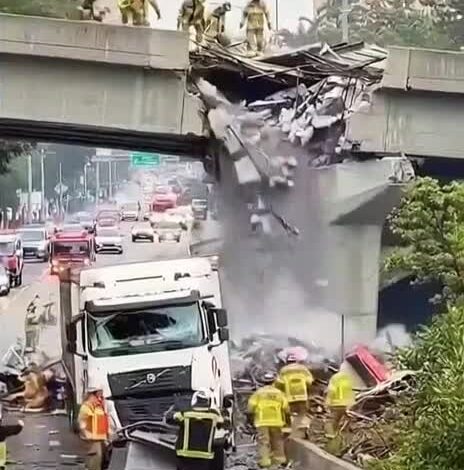
Richmond’s Friday morning commute descended into chaos when a commercial truck hauling a dump trailer struck the Cambie Road overpass on the Knight Street corridor. The trailer bed had remained raised, leaving the vehicle far too tall to pass beneath the structure. At approximately 7:15 a.m., it hit the bridge with enough force to tear the cab away and leave twisted metal lodged against the concrete span.
Despite the violence of the collision, authorities reported no injuries. The physical damage, however, forced officials to close southbound traffic immediately. Drivers were diverted to alternate routes while police, engineers, and recovery crews worked around the wreckage. Congestion spread rapidly through Richmond and surrounding routes, delaying commuters and disrupting commercial deliveries.
The first priority was determining whether the overpass remained structurally safe. Provincial and municipal engineers inspected the bridge for cracks, displaced joints, damaged reinforcement, and other problems that might not be visible from the roadway. A bridge can appear intact after an impact while still carrying internal damage that affects its long-term ability to support traffic.
Removing the trailer also required caution. Heavy wreckage pressed against a potentially weakened structure cannot simply be pulled away without a plan. Crews had to stabilize the area, control traffic, and coordinate the recovery so that one mistake did not create additional damage.
The Richmond Road Safety Unit opened an investigation with support from British Columbia’s transportation authorities. Investigators needed to establish why the dump bed was raised, whether the driver completed required checks, and whether mechanical failure, inadequate training, or another factor contributed.
The crash was not an isolated event. British Columbia has recorded repeated truck strikes involving overpasses in the Lower Mainland and Fraser Valley. Many occur when dump boxes or other equipment are not fully lowered before travel. Incorrect load measurements, unfamiliar routes, clearance errors, and poor communication within fleets can also play a role.
Trucking organizations and safety advocates have pushed for stronger prevention. Over-height detection systems use sensors to identify a vehicle that cannot safely clear an upcoming bridge and activate visible or audible warnings. Updated clearance databases in commercial GPS systems could keep large vehicles away from unsuitable routes. Regular driver training and mandatory equipment checks remain essential.
Infrastructure conditions matter as well. Clearance signs must be accurate, visible, and maintained. Road resurfacing can slightly reduce the space beneath an overpass, while older bridges may not reflect the dimensions of modern freight equipment. Authorities need reliable data on repeated collision points to decide where technology and upgrades are most urgent.
The shutdown demonstrated how one oversight can affect an entire region. Richmond is a major connection between Vancouver, Delta, and the Fraser Valley. Closing a key corridor increases travel times, fuel use, delivery costs, and pressure on smaller roads.
The truck’s destroyed trailer became a dramatic image, but the larger lesson was practical. Preventing another strike requires drivers, fleet operators, regulators, and infrastructure agencies to treat vehicle height as a critical safety issue. Inspections after a crash protect the public for the moment. Better training, detection systems, and route planning are what keep the next impact from happening.