The Monster Under the Bed How a Dusty Pistachio Shell Taught Me About Fear, Laughter, and the Human Brain
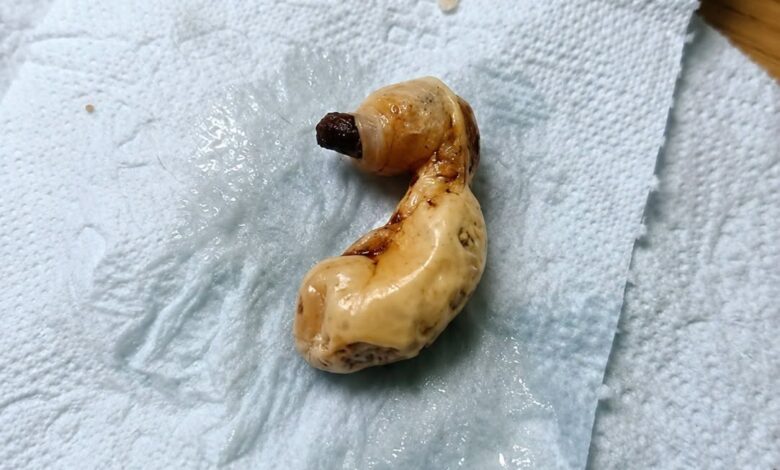
For a moment, I was convinced there was something alive under the bed.
I had been cleaning when I found it: small, curved, oddly shaped, and difficult to identify in the dusty space where it had been lying. Once I pulled it into view, the uncertainty became worse rather than better. It seemed to have a darker end that could have been a head, markings that resembled veins, and a surface that looked unpleasantly damp.
Then someone suggested it might be alive.
That was all it took. An unidentified object became a possible creature, and every feature seemed to support the idea. The curve looked like a body. Dust and residue became something more alarming. We were no longer simply looking at what was there; we were searching for evidence of the frightening explanation we had already started to believe.
The strange part was that nobody had actually seen it move.
We had a shape, a bad angle, a little grime, and one another’s reactions. Yet those pieces felt remarkably convincing when put together. A nervous look made the next person more nervous. Someone’s alarm made everyone else stare harder. Before long, the room’s shared reaction seemed like proof that the object deserved it.
Looking again, more carefully, suggested a much less dramatic possibility: an old pistachio shell.
A curved fragment of shell, changed by dust, moisture, and residue, could account for the features that had looked so biological a moment earlier. The supposed head could simply be the darker end of the shell. The lines did not have to be veins. A dirty surface did not have to be mucus.
That explanation fit what I could see far better than the little monster my imagination had supplied. It was not a laboratory identification, but it was enough to make me question how quickly I had leapt from “I do not recognize this” to “something is living beneath the bed.”
Our brains are not passive cameras. They interpret what our eyes collect, drawing on expectations and familiar patterns. Once a possibility becomes emotionally important, it can shape the next thing we notice. Instead of patiently assembling an answer from every detail, we can start filtering the details through an answer that arrived first.
That is why clouds can seem full of faces and an ordinary shadow can briefly look like a person. Recognizing a pattern can happen before checking whether the pattern really belongs there. In my case, a curved scrap in an unfamiliar setting was enough to set the process going.
The setting mattered too. I would probably have recognized a fresh pistachio shell beside a bowl of nuts without giving it a second thought. Under a bed, covered in debris and separated from anything that explained it, the same shape became mysterious. Context had disappeared, and fear was happy to take its place.
Other people’s reactions added another layer. Nobody needed to invent an elaborate story deliberately. We simply watched one another and treated alarm as information. The more uneasy the group became, the harder it was to be the person who stepped back and asked what had actually happened.
Eventually, the tension gave way to laughter. The object had not transformed. Our interpretation had. Something that moments earlier seemed capable of making us recoil now looked like the remains of a snack that had escaped the cleaning routine.
I also understood why a photograph like that can cause such lively arguments online. A close-up removes size and surroundings. Lighting emphasizes odd textures. A caption suggests danger before the viewer has formed an opinion. The dramatic explanation travels easily, while the ordinary one can feel strangely disappointing.
The experience left me with a useful pause to remember. An unfamiliar object does not need to be touched immediately, and uncertainty does not require a frightening conclusion. Better light, another viewing angle, and a little distance can provide more information than a room full of guesses.
If something genuinely might be dangerous, keeping away and getting appropriate help makes more sense than testing it with bare hands. But this particular scare reminded me that caution and panic are not the same thing.
What I found under the bed seemed to be a dusty shell. What I discovered about myself was how quickly a suggestion, a shape, and a few nervous reactions could turn it into something else. The laughter afterward was partly relief and partly recognition: the monster had owed a great deal to our own imaginations.