The Highway 99 Landslide Near Lillooet and the Lives Lost
CHAPTER 1: THE MOUNTAIN THAT CHANGED EVERYTHING
The stretch of Highway 99 near Lillooet, British Columbia, is known for its dramatic mountain scenery, winding roads, and breathtaking views. For travelers, it can be a memorable route through the rugged landscape of the province. But following a period of extreme rainfall, a section of this highway became the scene of a devastating landslide that would leave families waiting for answers and an entire community confronting an unimaginable tragedy.
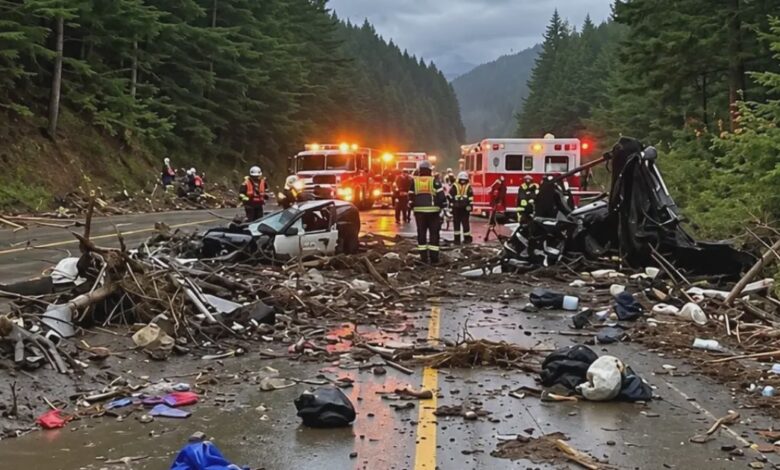
On November 15, a massive slide struck Duffey Lake Road, affecting Highway 99 near Lillooet. The disaster occurred after an episode of extreme rainfall that had already placed parts of British Columbia under significant pressure. The heavy precipitation contributed to dangerous conditions, and the resulting landslide and flooding created a situation in which people traveling through the affected area were caught in a life-threatening emergency.
What initially emerged as a serious natural disaster soon developed into a heartbreaking search-and-recovery operation.
Four people were reported missing in connection with the incident. As emergency crews and investigators worked to determine what had happened, families were left facing the most difficult kind of uncertainty: knowing that someone they loved had disappeared, but having no confirmation of their fate.
The first confirmed death was announced after a woman's body was recovered on Monday. Her recovery marked a devastating turning point in the response. Until then, relatives and members of the public had been hoping that those missing might still be found alive. The discovery made the scale of the tragedy painfully real.
But the search was far from over.
Authorities continued working through the affected area, facing the difficult task of locating the remaining missing individuals. The landscape had been altered by the force of the slide and the flooding. Debris and unstable ground made the operation challenging, while the uncertainty surrounding the missing people placed enormous emotional pressure on those waiting for news.
Then came another series of heartbreaking developments.
According to British Columbia Chief Coroner Lisa Lapointe, one body was recovered on Wednesday, followed by two more on Thursday. These discoveries brought the number of confirmed deaths to three additional recoveries? No: combined with the woman found Monday, four people had been located in total, while one person was still reported missing in the latest account.
The distinction mattered. Each recovery provided families with information they had desperately needed, but it also confirmed that another life had been lost.
For the relatives of the missing person who remained unaccounted for, the situation was especially painful. The discovery of the other victims did not bring their own ordeal to an end. Instead, it left them facing another period of uncertainty, waiting for authorities to determine whether any further search efforts could be carried out.
The landslide had transformed a mountain highway into a place of loss. It had disrupted travel, triggered a major emergency response, and left families searching for answers that could not be delivered quickly.
As the days passed, the focus shifted from the initial shock of the disaster to the difficult work of recovery. Officials were now confronting a question that had no easy answer: how much more could be done to locate the final missing person?
And as the search continued, the words of the province's chief coroner would soon reveal just how difficult that question had become.
CHAPTER 2: THREE DAYS OF DISCOVERIES, FOUR FAMILIES IN MOURNING
The recovery of a missing person after a major landslide is never simply a matter of locating someone. It is also the moment when uncertainty becomes reality for families who have been waiting, hoping, and fearing the worst.
For the loved ones of those caught in the November 15 disaster near Lillooet, every update carried enormous emotional weight.
The first confirmed death came on Monday, when a woman's body was recovered from the area affected by the landslide and flooding. Her recovery marked the first confirmed fatality linked to the disaster and confirmed that the event had claimed a human life.
For those still waiting for information about other missing people, the news was devastating.
The search continued, and authorities remained focused on locating everyone who had not yet been accounted for. The operation required patience and careful coordination, particularly because the affected terrain had been changed by the landslide.
On Wednesday, another body was found.
Then, on Thursday, two more bodies were recovered.
Chief Coroner Lisa Lapointe confirmed the discoveries, providing an update that underscored the growing human cost of the disaster. With these recoveries, authorities had located four people in total, including the woman recovered on Monday.
Yet the latest account still identified one person as missing.
Behind those numbers were individual lives, families, friendships, and futures that had been abruptly interrupted. Each recovery represented a person who would not return home. Each announcement brought another family closer to receiving confirmation, but also forced them to confront a loss that no official statement could make easier.
For relatives, the waiting period following a disaster can be agonizing. Before an identification or recovery is confirmed, there may be no clear way to understand what happened. Families can find themselves moving between hope and fear, trying to prepare for the worst while desperately wishing that the next phone call will bring better news.
Even when a body is recovered, the process of informing relatives and handling the necessary procedures takes care and sensitivity. The public may hear a short announcement, but the families involved experience something far more personal and profound.
The authorities' updates also demonstrated how quickly the situation had changed. What began as a search involving several missing people had become a recovery operation marked by a series of discoveries over several days.
The landslide and flooding had created conditions that made the response difficult. Search teams had to work within the limitations of the affected landscape, while officials had to assess what could safely and realistically be done.
The recovery of three additional bodies after Monday's discovery was an important development in accounting for those who had disappeared. But it did not mean the tragedy had reached its final chapter.
One person remained missing.
For that person's family, the news meant that the search was still an unresolved part of their lives. While other relatives had begun the painful process of mourning confirmed losses, another family continued waiting for information that might finally explain what had happened.
The emotional difference between knowing and not knowing can be difficult to describe. Grief after a confirmed death is devastating, but uncertainty creates its own form of suffering. It leaves families unable to make sense of the final moments, unable to say goodbye in the way they may wish, and unable to know whether the search will bring any further answers.
By Thursday, the discoveries had revealed the full seriousness of the disaster. Yet the question that remained was perhaps the most difficult one of all.
Could the final missing person still be found?
CHAPTER 3: THE SEARCH THAT PUSHED AGAINST THE LIMITS
When a landslide strikes a mountain road, the danger does not necessarily end when the initial movement of earth and debris stops.
The terrain can remain unstable. Material displaced by the slide may conceal hazards, and the surrounding environment can make it difficult for search teams to reach every location safely.
These challenges formed part of the wider response to the November 15 landslide affecting Highway 99, also known as Duffey Lake Road, near Lillooet.
The disaster followed extreme rainfall that contributed to landslide and flooding conditions. The resulting damage created a complex environment for emergency responders and recovery personnel.
Their task was not simply to search a road.
They had to work within an area transformed by the movement of the landscape, while balancing the urgency of finding missing people against the need to protect those carrying out the operation.
As the days passed, the recovery of four people brought important information to authorities and relatives. But the fifth person remained unaccounted for in the latest report.
That unresolved disappearance kept the operation focused on one final question.
Where was the missing person?
In ordinary circumstances, a search operation may involve expanding the area, revisiting locations, reviewing information, and considering different ways to locate someone. But a major landslide can impose severe limitations.
The landscape itself may prevent teams from accessing certain places. Debris can make an area difficult to examine, and safety concerns can restrict where personnel can work.
These limitations do not mean that search teams have stopped caring or that the missing person has been forgotten. Rather, they reflect the difficult decisions that must be made when continuing an operation could expose responders to unacceptable danger.
For families, however, understanding those limitations does not make the uncertainty easier to bear.
They may know that teams have been working for days. They may understand that the conditions are difficult. They may have heard that several people have already been recovered.
But when one person remains missing, every update can feel incomplete.
British Columbia Chief Coroner Lisa Lapointe later provided a particularly significant assessment of the operation.
She said that all avenues of search had been exhausted.
The statement marked a painful moment in the response. It indicated that the available search possibilities had been pursued, yet the final missing person had still not been located.
For anyone following the disaster, the words carried a heavy meaning. For the family still waiting, they represented an especially difficult development.
The phrase did not erase the missing person from the story. It did not resolve the questions surrounding their disappearance. It described the limits reached by the search efforts at that point.
And those limits were precisely what made the next stage so complicated.
Even after saying that all search avenues had been exhausted, Lapointe indicated that discussions were continuing about possible next steps.
That distinction was important.
The search had reached the end of the avenues that had been pursued, but authorities were still discussing whether anything further might be possible.
The situation therefore remained unresolved.
The disaster had already claimed confirmed lives. The recovery efforts had provided answers to several families. But one family continued to face the painful absence of confirmation.
As the immediate operation reached its limits, attention turned toward what could happen next.
Could a different approach provide new information?
Would further assessments identify another possibility?
Or had the landscape made recovery impossible for the time being?
No definitive answer had been provided in the account.
For the family waiting, the most difficult part was that the search could no longer be measured simply in hours or days. It had become a question of what was still possible.
CHAPTER 4: THE WORDS THAT NO FAMILY WANTS TO HEAR
“All avenues of search have been exhausted.”
Those words, attributed to British Columbia Chief Coroner Lisa Lapointe, captured one of the most painful moments in the response to the Lillooet landslide.
They were not merely an update about an emergency operation. They described the point at which the search for one missing person had reached its available limits, even though the person's whereabouts remained unknown.
For the families involved, this was an especially difficult reality.
When someone disappears in a disaster, relatives often depend on the search operation as their only connection to the possibility of an answer. Every day of activity offers at least the hope that something may be discovered.
A new recovery can bring confirmation. A new assessment can provide information. Even an unsuccessful day may leave room to believe that the next effort could make a difference.
But when officials say that all avenues have been exhausted, the meaning is different.
It suggests that the available options have been explored and that continuing in the same way may no longer be possible.
The statement did not mean that the family should stop caring, and it did not mean that the missing person's story had become unimportant. It reflected the practical and operational limitations of the search.
The distinction between a completed search effort and a completed recovery is significant.
A search may reach its limits without locating everyone. The operation may have examined the accessible areas and pursued the available leads, yet the natural environment may still prevent a complete resolution.
That is one of the harsh realities of major landslides.
The earth does not move in a predictable or orderly way. Material can be displaced over large areas, and the aftermath can be difficult to assess. Even experienced teams must make decisions based on what can be reached and what can be examined safely.
In this case, the extreme rainfall, landslide, and flooding had created conditions that made the recovery operation challenging.
The recovery of the woman on Monday, followed by the discoveries on Wednesday and Thursday, showed that the search had produced important results.
But the fifth missing person remained unaccounted for in the latest report.
For the family, the absence of an answer may have been more difficult to process than any official statement could explain.
There is a difference between being told that a loved one has died and being told that their fate remains unknown. Both situations bring grief, but uncertainty can make it difficult to begin the process of accepting what has happened.
Families may struggle with practical questions, emotional exhaustion, and the need to understand what comes next.
They may also face the challenge of explaining the situation to children, older relatives, and friends who are searching for information of their own.
The public often sees a disaster through numbers: how many people were missing, how many bodies were recovered, and how many roads were affected.
But families experience it through names, photographs, memories, and empty spaces.
A missing person is not simply an outstanding number in an official report.
They are someone whose absence changes the lives of people who love them.
That is why Lapointe's additional comment was important. Although she said all avenues of search had been exhausted, discussions were continuing about possible next steps.
The statement left open the possibility that authorities might consider whether another approach could be pursued.
It did not promise that the missing person would be found.
It did, however, show that the situation was still being discussed.
And while those discussions continued, one family remained caught between the hope of an answer and the fear that no further discovery would come.
CHAPTER 5: BEYOND THE HEADLINES — THE HUMAN COST OF A NATURAL DISASTER
A landslide can happen in a matter of moments, but its consequences can continue long after the initial movement of earth and debris has stopped.
Roads may be damaged. Travel may be disrupted. Emergency responders may spend days working through difficult conditions. Families may wait for information, and communities may be left confronting the consequences of a tragedy that has changed their understanding of a familiar landscape.
The November 15 landslide near Lillooet demonstrated how devastating extreme rainfall and flooding can become when they trigger a major slope failure.
The incident affected Highway 99, along Duffey Lake Road, and led to a search involving several missing people.
As authorities worked through the affected area, the number of confirmed deaths grew.
A woman was recovered on Monday, becoming the first confirmed fatality from the landslide and flooding. One body was found Wednesday, and two more were recovered Thursday, according to Chief Coroner Lisa Lapointe.
The latest account still identified one person as missing.
These developments placed the tragedy into a wider context: natural disasters are not measured only by the physical damage they cause.
They are also measured by the lives lost, the families affected, and the uncertainty that can remain long after the most visible emergency has passed.
For people who regularly travel through mountain regions, roads such as Highway 99 are part of everyday life. They connect communities, provide access to work and services, and allow people to travel through areas of extraordinary natural beauty.
But mountain environments can also be vulnerable to sudden changes.
Extreme rainfall can saturate soil, increase water pressure within slopes, and contribute to unstable ground. When conditions become severe enough, a slope can fail, sending earth, rocks, and debris across roads or into nearby areas.
Flooding can add another layer of danger.
The exact circumstances of an individual landslide must be established through appropriate assessments, but the wider relationship between heavy rainfall and slope instability is well recognized.
For communities in mountainous parts of British Columbia, events like this highlight the importance of understanding weather warnings, road conditions, and the risks associated with traveling through areas affected by severe weather.
They also demonstrate why emergency planning matters.
Road closures, warning systems, evacuation procedures, and coordinated responses can all play important roles in reducing risk when dangerous conditions develop.
However, even the strongest response cannot eliminate every danger.
Once a major landslide occurs, responders may face conditions that are difficult to predict and even harder to control.
The recovery operation near Lillooet also highlighted the emotional cost carried by those involved in emergency work.
Search and recovery personnel must perform difficult tasks while dealing with the reality that the people they are looking for may not survive.
Their work requires technical skill, coordination, patience, and careful attention to safety.
The public may see the final announcement, but the work leading up to it can involve long periods of uncertainty and challenging decisions.
For the families, the emotional consequences may continue much longer.
A confirmed recovery can provide an answer, but it cannot reverse the loss. For those whose loved one remains missing, the lack of confirmation can make the grieving process even more complicated.
The tragedy therefore extends beyond the location of the slide.
It reaches into homes, relationships, and communities that must find a way to move forward after lives have been lost.
And as the immediate response continues to be assessed, the story of the person still missing remains central to the questions surrounding the disaster.
CHAPTER 6: ONE PERSON STILL MISSING — AND QUESTIONS THAT REMAIN
The latest developments in the Lillooet landslide response brought both answers and uncertainty.
Four people had been recovered following the disaster, including the woman whose body was found on Monday. The subsequent recoveries on Wednesday and Thursday were confirmed by Chief Coroner Lisa Lapointe.
Yet one person remained missing.
For the families of those recovered, the news marked the beginning of an extraordinarily painful period of mourning. For the family of the person still unaccounted for, the situation remained unresolved.
Lapointe's statement that all avenues of search had been exhausted reflected the difficult limits reached by the operation.
But her confirmation that discussions were continuing about possible next steps meant that authorities had not simply closed the subject without further consideration.
There is an important difference between acknowledging the limits of an operation and declaring that every question has been answered.
In this case, the search had reached a point where the available avenues had been exhausted, but the whereabouts of one missing person had not been confirmed.
That unresolved detail remains one of the most painful aspects of the disaster.
The November 15 slide struck Duffey Lake Road, affecting Highway 99 near Lillooet, after extreme rainfall contributed to landslide and flooding conditions.
The incident left several people missing and prompted a major search-and-recovery effort.
Over the following days, the recovery of the woman on Monday, followed by one person on Wednesday and two more on Thursday, revealed the extent of the human loss.
The discoveries also showed the difficult nature of recovery operations in areas affected by severe natural events.
Even after significant efforts, one person had not been found.
The continuing discussions about possible next steps therefore carried importance beyond the immediate operation. They represented the remaining possibility of determining whether anything else could be done.
No further outcome should be assumed until authorities provide additional information.
For now, the confirmed facts are already devastating enough.
Four people lost their lives in the disaster, while one person remained missing in the latest account. Families were left mourning, waiting, and trying to understand the consequences of an event that unfolded with terrible force.
The road itself may eventually return to a more familiar appearance. The landscape may be assessed, repaired, or changed as recovery and restoration work progresses.
But for those who lost someone, the impact cannot be measured in road closures or the number of days spent searching.
It will be remembered through the people who did not come home.
It will be remembered in the families who received confirmation of a death and in the family still waiting for an answer.
And it will be remembered as a reminder that extreme weather can have consequences far beyond the immediate conditions that trigger it.
The Lillooet landslide was not simply a disruption to a highway. It was a human tragedy that left confirmed deaths, an unresolved disappearance, and difficult questions about what could still be done.
As discussions continue over possible next steps, the hope for the final missing person remains part of the story.
For the families affected, the most important thing is not the headline or the official count.
It is the person they are still waiting for.
And until more information becomes available, that unanswered question remains at the heart of the November 15 tragedy.