Scientists Confirm Timeline For Earths Destruction As Predicted By Elon Musk
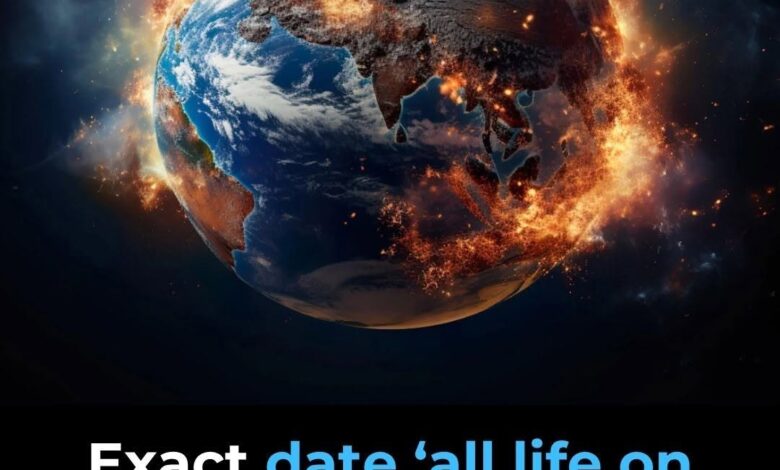
Earth will not remain habitable forever. The Sun is gradually becoming brighter as it ages, and scientific models indicate that this slow change will eventually alter the planet’s climate and atmosphere so severely that complex life can no longer survive. The timeline, however, is measured in hundreds of millions to billions of years rather than in a near-term countdown.
Researchers from Tōhō University in Japan and NASA used mathematical models and supercomputer simulations to examine the long-term future of Earth’s oxygen-rich atmosphere. Their calculations explored how the Sun’s increasing output will affect carbon dioxide, photosynthesis, oxygen production, and the balance of gases that currently supports animals and plants.
The models suggest that Earth’s atmosphere could retain more than one percent of its present oxygen level for roughly 1.08 billion years, with an uncertainty of about 140 million years. After that threshold, oxygen-producing organisms would decline sharply as environmental conditions changed. Anaerobic microbes capable of living without oxygen could persist after most complex organisms disappeared.
This atmospheric transition is separate from the Sun’s much later red giant phase. The Sun is currently less than halfway through its expected lifetime. In about five billion years, it will exhaust the hydrogen in its core and expand enormously. Mercury and Venus are expected to be swallowed, while Earth may also be engulfed or rendered completely unrecognizable.
Elon Musk has frequently cited the Sun’s eventual expansion while arguing that humanity should become a multiplanetary species. He describes a self-sustaining settlement on Mars as collective life insurance: a second home capable of continuing even if supply ships from Earth stop arriving because of a catastrophe.
For Musk, the decisive point is not simply landing people on Mars. A settlement would need local food production, energy, manufacturing, maintenance, and a population large enough to survive without continuous rescue from Earth. Until then, a Mars base would remain dependent on the same planet it was supposed to back up.
The distant scientific forecast does not mean Mars is presently an easy or safe alternative. Mars has a thin atmosphere, intense radiation exposure, low temperatures, reduced gravity, and no open environment where humans can breathe or grow food normally. Building a self-sufficient society there would require technologies and infrastructure far beyond a short exploratory mission.
The billion-year estimate also should not distract from environmental risks unfolding on human timescales. Climate change, biodiversity loss, pollution, war, and resource pressures can affect societies within years or decades. The Sun’s gradual evolution is unavoidable, but many dangers faced by people alive today depend heavily on decisions made now.
Scientists created hundreds of thousands of simulations because long-range planetary systems contain uncertainty. The exact year cannot be treated like an appointment on a calendar. The value of the research lies in identifying the processes that will eventually destabilize the atmosphere and showing that oxygen-rich conditions are not a permanent feature of rocky planets.
The work may also guide the search for life elsewhere. A planet can remain in a star’s habitable zone while its atmospheric signature changes. If oxygen exists only during part of a planet’s lifetime, astronomers must consider timing when interpreting distant worlds and deciding whether the absence of oxygen rules out life.
Earth’s destruction is therefore both certain in the broadest astronomical sense and extraordinarily remote in human terms. The planet’s atmosphere may become unsuitable for complex life in about a billion years, and the expanding Sun will transform the inner solar system billions of years after that. Those numbers offer perspective rather than immediate panic.
Musk’s Mars argument turns that perspective into a challenge about the future of civilization. Whether humanity ultimately settles another world remains unknown. What the science makes clear is that habitability has a lifespan, and preserving life requires understanding both the distant forces we cannot control and the nearer threats that we can.