Nine Dinners One Small Fishing Boat
“It still works fine, Karen.”
My husband said it standing in our driveway on a Saturday afternoon in late April. His hand was resting on the side of a bass boat that had not been there when I left for the grocery store.
It was green and silver metal flake. The kind that sparkles like a bowling ball under the lights at the alley. There was a 150 Mercury motor hung on the back of it, and a trailer underneath with one tire lower than the other.
I had a gallon of milk in one hand and a ten-pound sack of potatoes in the other.
I just stood there holding them. I didn’t know where else to put them.
“What works fine?” I said.
“The kitchen.”
Rick didn’t look at me. He looked at the boat.
“The cabinets close. The stove heats. My mother cooked on worse for forty years.”
That was when I understood exactly where the money had come from.
My name is Karen Schmitz. I’m fifty-three years old. I’ve been a teller at the First State Bank in Cambridge, Iowa, for twenty-two years.
And for six years, I put forty dollars a week from my paycheck into a savings account we called the kitchen account.
Forty dollars. Every single Friday. I set it up as an automatic transfer so I couldn’t talk myself out of it.
Some weeks I had to move the money back out. The fall Tyler was twenty and his transmission went. The winter the water heater died and flooded the basement. But I always caught it back up.
By that April, the balance sat at eleven thousand and twelve dollars.
I knew the number because I’m a bank teller. I count other people’s money for a living. And I’d counted mine every Friday on my lunch break for six years. Sitting in my car in the bank parking lot with a ham sandwich, looking at that number on my phone.
The contractor’s quote was hanging on our refrigerator under a magnet shaped like an ear of corn.
Eleven thousand dollars even.
New oak cabinets. A laminate countertop. A brand-new range where all four burners actually worked. And labor.
Our kitchen was put in when the house was built in 1978. Dark brown cabinets with doors that sagged on their hinges. A stove with exactly one burner that worked, and it only worked on high.
So every pot of gravy I’d made for thirty-two years, I’d made standing over it with a wooden spoon. Stirring and stirring so it wouldn’t scorch.
“Where did you get the money, Rick?” I asked.
I already knew.
“I got a cashier’s check yesterday,” he said. “At the branch over in Nevada.”
He finally looked at me.
“I knew better than to do it at your window.”
At least he was honest about that part.
It was a joint account. He had every right in the world to take that money out. And the girl at the Nevada branch had every reason to hand it to him.
“Who sold it to you?”
“Fella from Story City. He’s moving down by his daughter in Missouri. He had the papers all ready.”
Rick rubbed the back of his neck.
“He’s gone already, Karen. He left this morning.”
So that was that.
There was no taking it back. No one to call. No store to return it to. The man and my eleven thousand dollars were somewhere on Interstate 35, heading south toward Kansas City.
I set the milk down on the hood of my car.
I set the potatoes down next to it.
“Well,” I said. “Thank you for telling me.”
He blinked at me like I’d spoken a foreign language.
I think he’d been ready for me to cry. Or to throw something. Or to march into the house and slam the screen door so hard the glass rattled.
I didn’t do any of that.
I picked my groceries back up, went inside, and started supper.
I made pot roast. Because it was Saturday. And that’s what I make on Saturday.
Carrots and potatoes in the roasting pan with it. Onions underneath. Gravy over the one burner that worked on high, standing there stirring.
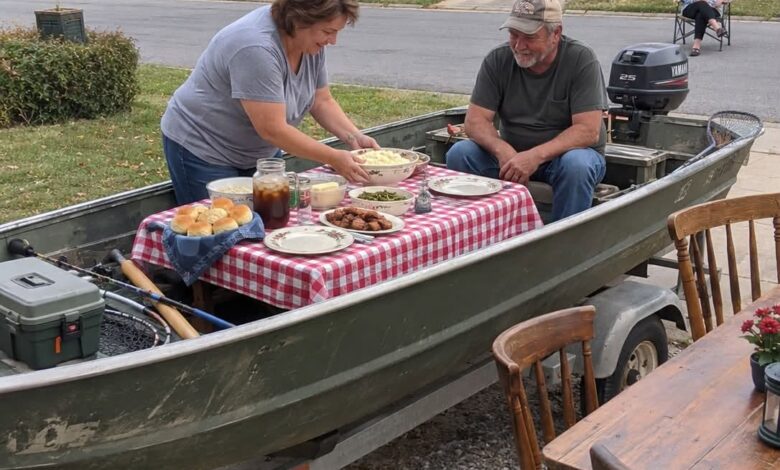
At ten minutes to six, I went to the hall closet and took out a tablecloth.
Not the everyday one.
The good one. Red and white checks. My mother gave it to me as a wedding present in 1994. I only use it on Thanksgiving and Easter.
Rick was out in the garage, digging through the life jackets he’d bought along with the boat. He didn’t see me carry the first kitchen chair out the front door.
He saw me carry the second one.
“What are you doing?” he said.
“Setting the table,” I said.
The new cabinets went in the first week of June.
Light oak. Doors that close all the way. Doors that stay closed.
And the new range has four burners. And every single one of them works on low.
The first time I made gravy on it, I stood at that stove and didn’t have to stir it once. Not once. It just sat there and simmered, slow and even, like gravy is supposed to.
I laughed out loud. All alone in my brand-new kitchen.
That first Saturday, I made pot roast. Carrots and potatoes in the pan. Onions underneath.
And we ate it in the new breakfast nook.
Marlys came over. So did Duane and Lyle. And Tyler and Amber. We were packed in tight on those two benches, elbows bumping, but nobody minded one bit.
My mother’s red-and-white tablecloth was spread over the little oak table.
Marlys sat down. She ran her hand across the bench cushion underneath her.
Then she looked at me.
“Karen,” she said. “Isn’t this the blue vinyl off that boat?”
It was.
When Rick sold the boat to Jeff, he asked for exactly one thing.
He asked if he could keep the bench seat cushions. The blue vinyl ones from between the two consoles. Where I’d spread my mother’s tablecloth for nine nights in a row.
Jeff said sure. He was going to buy new ones anyway.
So Rick cut the foam down to size. And he stretched that same blue vinyl back over it, to fit his new oak benches.
They’re the softest seats in the whole house.
“He asked to keep one thing,” I told Marlys.
Rick was standing at the stove with his back to us, carving the pot roast.
He didn’t turn around.
But I could see his ears going red under his co-op cap.
And I could see that he was smiling.
I sat there on that kitchen floor with six thousand dollars in folded twenties stacked all around me. The floor still gritty from the old linoleum.
And I cried.
Harder than I’d cried in nine nights. Harder than I cried the day the boat showed up.
Because this was the same man.
The man who bought a bass boat with my kitchen money. And the man who slipped a twenty-dollar bill into a coffee can every single Friday for six years, and never once said a word about it.
I’d been married to both of them for thirty-two years.
Rick leaned the pry bar against the wall. He came over and sat down on the floor next to me.
Tyler got up quietly and went out to the driveway.
“I’m sorry I said it works fine,” Rick said.
“I’m sorry I made you eat supper in a boat for nine days,” I said.
“No, you’re not.”
“No,” I said. “I’m not.”
He put his arm around me. And we sat there on the floor of our bare kitchen, surrounded by all those twenties, until Tyler hollered in that Duane was back with the trailer.
With the boat money and the coffee can money together, we had more than the contractor’s quote.
Better than sixteen thousand five hundred dollars. Counting my last two Friday transfers, and a coffee can’s worth of quarters and dimes.
So I called the contractor back and asked if he could put in a breakfast nook.
The corner by the back window had always been dead space. It’s where the mop bucket lived.
He said he could.
Rick asked if he could build the benches himself.
He did.
He spent three weekends on them out in the garage. Duane handed him boards. Lyle sat on the bucket and told him everything he was doing wrong.
Solid oak, to match the new cabinets. Two benches facing each other across a little table. Right under the back window, where I can see Marlys’s front step.
The new cabinets went in the first week of June.
Light oak. Doors that close all the way. Doors that stay closed.
And the new range has four burners. And every single one of them works on low.
The first time I made gravy on it, I stood at that stove and didn’t have to stir it once. Not once. It just sat there and simmered, slow and even, like gravy is supposed to.
I laughed out loud. All alone in my brand-new kitchen.
That first Saturday, I made pot roast. Carrots and potatoes in the pan. Onions underneath.
And we ate it in the new breakfast nook.
Marlys came over. So did Duane and Lyle. And Tyler and Amber. We were packed in tight on those two benches, elbows bumping, but nobody minded one bit.
My mother’s red-and-white tablecloth was spread over the little oak table.
Marlys sat down. She ran her hand across the bench cushion underneath her.
Then she looked at me.
“Karen,” she said. “Isn’t this the blue vinyl off that boat?”
It was.
When Rick sold the boat to Jeff, he asked for exactly one thing.
He asked if he could keep the bench seat cushions. The blue vinyl ones from between the two consoles. Where I’d spread my mother’s tablecloth for nine nights in a row.
Jeff said sure. He was going to buy new ones anyway.
So Rick cut the foam down to size. And he stretched that same blue vinyl back over it, to fit his new oak benches.
They’re the softest seats in the whole house.
“He asked to keep one thing,” I told Marlys.
Rick was standing at the stove with his back to us, carving the pot roast.
He didn’t turn around.
But I could see his ears going red under his co-op cap.
And I could see that he was smiling.