My Son Said I Had Everything I Needed So I Cancelled the 2 800 Monthly Payments Id Been Making for Him His Reaction Changed Everything
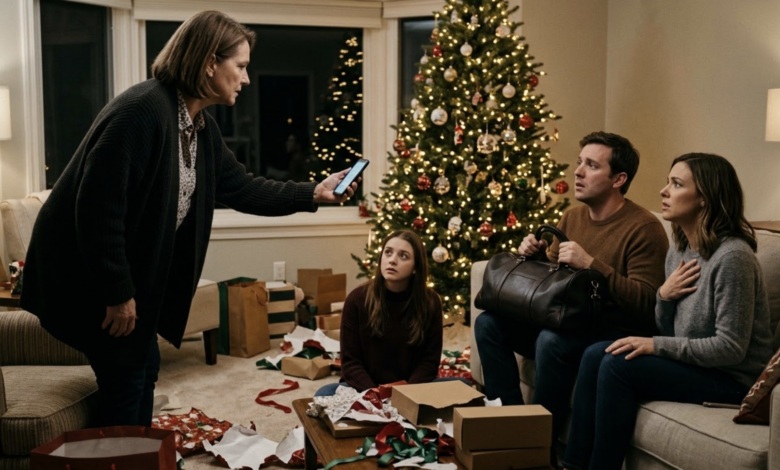
On Christmas Eve, after the last present had been opened, my daughter asked where mine was. My son glanced at the leather duffel on his lap. “Honestly, Mom, you have everything you need. You don’t need us to buy you things.” His wife smiled and said they had to prioritize. I stood up, took out my phone, and opened the two monthly payments I’d been making for them for four years.
I came to their door with four bags of presents and was greeted with the news that I was early.
Renee’s parents were on the couch with drinks.
Apparently whatever time they’d got there had been perfectly all right.
I set my boots on the mat so I wouldn’t spoil the newly cleaned floor, carried the bags to the tree, and went to find Wesley.
He hugged me with his free arm.
In the other hand he had a craft beer. “Roads okay?” he asked.
I told him the 417 had been clear.
He’d already started back toward the kitchen.
His wife had made a seating plan.
All I had to do was find the card with my name on it.
Gerald was my husband.
The money came to me after he died.
Wesley and Renee had wanted to live near good schools for the children they thought they might have someday.
I’d provided the $62,000 down payment, and once they moved in I started helping with the monthly payments.
I’d been doing it for four years by the time I found my name on that little card beside the mudroom.
I did not believe that a place at the head of a table came with the down payment.
I would have hated to be the kind of mother who went into a married son’s house and counted what was owed her in inches from the turkey.
There are all kinds of good reasons to put a particular person in a particular seat.
The draft came in at the back of my neck.
Renee had put her own parents near her and Wesley.
My daughter Cleo arrived a few minutes late, pink from the cold, took one look at my chair, and asked if I could sit somewhere warmer.
Renee told her the arrangement had been designed for the flow of conversation.
“Dorothy is perfectly comfortable.”
I shook my head at Cleo.
I was her mother.
I didn’t want her to have to fight for a chair on my behalf while everybody’s turkey went cold.
Wesley was explaining what they wanted for the bathroom.
Heated floors, a tub for soaking, two sinks.
I’d paid for a replacement furnace in 2023, helped with the backyard fence, and more recently covered what Renee had called an urgent plumbing job.
That one had included new kitchen taps.
I could already hear the way a conversation about this lovely new bathroom might go the next time their mortgage fell due.
After dessert Renee handed out the presents.
Cleo opened the amber earrings I’d found for her on Bank Street in October.
The sight of her hand going to her heart was worth every minute I’d spent choosing them.
Ron and Beverly got an attachment for making pasta.
Wesley unwrapped a leather duffel, and Renee was genuinely thrilled to discover she had a spa weekend coming.
I had liked buying the atlas for Wesley.
He had mentioned hiking in passing, and for once I had been able to do something for him that didn’t involve the date a bill fell due.
A book is an invitation you can decline.
He could take it out in the spring and find a park he’d like to see, or he could leave it on a shelf until he had a little more time.
Either way I had the pleasure of knowing I had listened to him.
That was the part of exchanging presents I liked.
You got to find out what another person had heard in the course of a year when, without giving the matter much thought, you’d told them a little about what interested you.
The earrings in Cleo’s hand had done that job nicely.
Even Beverly’s chocolates had been chosen with her in mind.
I would have been happy with something somebody had picked out while standing in line at the drugstore.
It would have been evidence of a moment in their day when the person they thought of was me.
When Cleo spoke up about there being no gift left for me, Wesley tried talking about property taxes and how expensive the proposed renovation was looking.
There were plenty of things he could have said that would have put an end to that awkward moment.
He chose to explain why his mother didn’t need to have been thought of at all.
There was one part of what my son had said that I didn’t need to argue with.
I had a house warm enough to stay in all winter.
I knew how to shovel my own driveway.
I got myself to Carling Avenue to do my shifts at the food bank.
If I wanted a good charcoal coat I could go to the store with the money I had saved and buy it, and in fact I had.
Nobody had any duty to wrap up the ordinary requirements of my life and put them under a tree for me.
But every adult in that room had most of the things they needed.
Ron and Beverly would have managed supper without the pasta attachment.
My son would certainly have found something to pack a change of clothes in without a leather duffel.
My being able to look after myself had somehow made me the only person for whom an expression of affection would be an extravagance.
That was a rather expensive lesson to learn in a house full of lovely, unnecessary things.
Ron and Beverly studied their laps.
Cleo didn’t move.
She’d already given me one chance to speak for myself that evening, and I had let it go.
I wasn’t going to send my daughter out to do this for me a second time.
“What are you doing?” Wesley asked.
I found the scheduled transfers in my banking app.
The first was for $1,950, due on the first of every month.
Mortgage contribution.
The second was for $850 to help with the car.
Same day.
They’d been on the schedule so long that I barely registered the money leaving anymore.
My son was about to discover just how clearly he’d been registering it coming in.
On the screen the amount for the mortgage had an ordinary little description beside it.
Had I ever promised to keep making those payments for the rest of my life?…
PART 2: Had I ever promised to keep making those payments for the rest of my life? I stared at the screen for a moment. The little description beside the mortgage transfer read, “Wesley and Renee — House Support.” Four years. Forty-eight payments of $1,950. That was $93,600. The car assistance was another $850 every month. Another $40,800 over those same four years. Together, I had sent them $134,400. And that didn't include the $62,000 down payment, the replacement furnace, the backyard fence, or the plumbing work that had somehow turned into a kitchen improvement. I didn't need to calculate the total to know it was a great deal of money. But seeing the numbers together made something inside me settle. For four years, I had told myself I was helping my son get established. I had called it temporary assistance, even when nobody had given me a date when it would end. I had never asked for a thank-you. I had never asked for a special seat. I had never expected Wesley to repay me. I had simply believed that when a mother helped her adult child, there was still a relationship underneath the money… SAY ""YES"" IF YOU WANT TO READ THE FULL STORY 👇
That evening, I began to understand that I might have been the only one thinking about it that way.
Wesley noticed my expression.
“Mom?”
I looked up.
He was standing beside the dining table, holding his new leather duffel by its handles.
“What are you doing with your phone?”
“Checking something.”
He gave a short laugh.
“At Christmas dinner?”
“Yes.”
Renee leaned back in her chair.
“Is everything okay, Dorothy?”
Her voice was pleasant, but there was something impatient underneath it.
I looked at her.
“Actually, I think something is about to become much clearer.”
Wesley put the duffel down.
“Mom, what does that mean?”
I turned the screen toward myself again.
Then I pressed the scheduled payment for the mortgage contribution.
A small menu appeared.
I selected cancel.
The banking app asked whether I was sure.
I pressed yes.
Then I did the same thing with the car payment.
Two scheduled transfers disappeared.
It took less than a minute.
Four years of automatic payments had ended while the Christmas candles were still burning.
Wesley stared at me.
“What did you just do?”
“I cancelled the two monthly transfers.”
His expression changed immediately.
“What transfers?”
“The mortgage contribution and the car assistance.”
For a moment, nobody spoke.
Then Renee put down her wineglass.
“You’re joking.”
“No.”
“Why would you do that?”
I looked at her, then at my son.
“Because apparently I have everything I need, and you have other things you need to prioritize.”
Wesley frowned.
“Mom, that’s not what I meant.”
I nodded slowly.
“I know exactly what you meant. You said I didn’t need you to buy me anything because I had everything I needed.”
“That’s true.”
“Then I think we can agree that you don’t need me to keep buying things for you either.”
His mouth opened, but no words came out.
Renee looked toward her parents.
Ron suddenly became very interested in the remaining piece of pie on his plate.
Beverly reached for her glass.
Cleo finally moved.
She put her napkin down and looked directly at her brother.
“Are you serious right now, Wesley?”
He turned toward her.
“Cleo, don’t start.”
“No. I’m asking a simple question. Mom has been helping you pay for this house and your car for four years, and you just told her she didn’t deserve a Christmas present because she can afford to buy things herself?”
“That’s not what happened.”
“Then what happened?”
Wesley rubbed his forehead.
“Money is tight. We’re trying to renovate the bathroom. We have property taxes, insurance, the kids’ expenses, and everything else. We can’t keep buying presents for everyone.”
I glanced at the leather duffel.
It was a beautiful bag.
I had seen the brand in a shop window downtown. It was not something a person bought because they had no other choice.
But I didn’t say that.
Instead, I asked a quieter question.
“Did you ever think about calling me before Christmas to tell me money was tight?”
He looked confused.
“What?”
“Did you ever think about telling me you were struggling?”
“We are telling you now.”
“No, Wesley. You’re telling me why you didn’t buy me anything. Those are two different conversations.”
Renee crossed her arms.
“Dorothy, I really don’t think we need to turn Christmas into a financial discussion.”
I looked at her.
“You brought financial priorities into the conversation when my daughter asked where my present was.”
“That’s not fair.”
“Perhaps not. But neither is asking one person to keep contributing while making that same person feel like an inconvenience.”
Wesley pulled out his chair and sat down.
“Mom, you can’t just stop the payments without warning us.”
I looked at him for several seconds.
Then I asked, “Why not?”
“Because we depend on them!”
There it was.
The first completely honest sentence of the evening.
Not because they loved me.
Not because they appreciated my help.
Because they depended on the money.
I felt something painful move through my chest.
I had always known they depended on the transfers.
I simply hadn’t understood that they had begun to think of them as something they were entitled to.
“Wesley,” I said gently, “when I started helping you, I thought I was giving you a hand while you got settled. I never signed an agreement saying I would pay your mortgage and car expenses forever.”
“Nobody said forever.”
“Then why are you speaking as though I have broken a promise?”
He looked away.
Renee answered for him.
“Because we have built our budget around your help.”
I nodded.
“That is something you should have discussed with me before building your budget around my retirement savings.”
Her face tightened.
“Your retirement savings?”
“Yes.”
I took a sip of water.
“I don’t work at the food bank because I need somewhere to go in the afternoon. I volunteer because I enjoy helping people. But I also have bills, repairs, insurance, and a future to think about. Gerald and I worked hard to make sure I wouldn’t have to worry about money when I got older.”
Wesley looked at me.
“Dad would have wanted you to help us.”
That sentence hurt more than I expected.
Gerald had been gone for six years.
He had loved Wesley fiercely. He had taught him how to ride a bicycle, helped him with his first car, and attended every school event he could.
But Gerald had also believed that helping someone should make them stronger, not permanently dependent.
I remembered something he had told me once when Wesley was still in university.
“Give that boy a chance to stand on his own feet, Dorothy. Don’t carry him so far that he forgets he has legs.”
At the time, I had laughed.
Now I wished I had listened more carefully.
“Your father would have wanted you to be responsible for your own family,” I said.
Wesley shook his head.
“That’s a pretty convenient interpretation.”
I didn’t answer.
I wasn’t going to argue about what a dead man would have wanted simply because my son needed another reason to keep receiving money.
Cleo stood up.
“I’m going to help Mom with her coat.”
Renee looked surprised.
“She’s not leaving yet. We haven’t even finished dinner.”
Cleo gave her a tired look.
“I think she’s finished.”
I gathered my handbag.
I had brought four bags of presents into that house.
I left with my coat, my handbag, and the little gift bag containing the atlas Wesley hadn’t opened.
He noticed it.
“Mom, you’re taking my present?”
I looked down.
“Oh. I suppose I am.”
He stared at me.
“You bought it for me.”
“I did.”
“Then why are you taking it?”
I thought about the book.
It was a beautiful atlas of Canada’s national parks. I had chosen it because Wesley once told me he wanted to spend more time outdoors.
I had imagined him opening it, turning the pages, and perhaps telling me about a place he wanted to visit.
“I don’t know,” I said. “Perhaps I thought it would be nice to give something to someone who was interested in receiving it.”
I didn’t mean to sound unkind.
But the words landed heavily.
Cleo picked up her coat.
We said goodbye to Ron and Beverly.
They both looked uncomfortable.
Beverly actually stood up.
“Dorothy, I’m sorry about tonight.”
I appreciated that she said it.
“Thank you, Beverly. Merry Christmas.”
Then I walked out.
The cold air hit my face, and I took a long breath.
Cleo followed me down the steps.
“Mom, are you all right?”
I nodded.
Then, for the first time that evening, I cried.
Not loudly.
Not dramatically.
Just a few tears that came without asking permission.
Cleo put her arms around me.
“I’m sorry.”
I shook my head.
“You didn’t do anything wrong.”
“I should have said something earlier.”
“You did say something. I asked you not to make a scene.”
She held me tighter.
We stood there for a moment while the Christmas lights blinked along the roofline.
Then she walked me to my car.
Before I got inside, she asked whether I wanted to come to her apartment.
I told her I wanted to go home.
I needed to think.
And I needed to do something I hadn’t done in a very long time.
I needed to look after myself.
When I arrived home, the house was quiet.
Gerald’s old clock ticked in the hallway.
I hung my coat, put the kettle on, and sat at the kitchen table.
The atlas was still beside my handbag.
I opened it.
On the first page, I had written:
*For Wesley. Maybe one day we’ll take a trip together. Love, Mom.*
I stared at those words.
Then I closed the book.
I didn’t throw it away.
I put it on the shelf beside Gerald’s old travel books.
There was no reason to destroy something simply because the person I had bought it for had disappointed me.
The next morning, Wesley called.
I let the phone ring twice before answering.
“Morning, Mom.”
“Good morning.”
There was a pause.
“About last night…”
I waited.
“Renee is upset.”
I looked out the kitchen window.
Snow had gathered along the fence.
“I’m sorry she’s upset.”
“Mom, this is serious.”
“I know.”
“We have the mortgage coming out on the first.”
“I know.”
“And the car payment is due too.”
“I know that as well.”
He exhaled sharply.
“So what are we supposed to do?”
I held the phone against my ear.
“Make a budget that works without my money.”
“That’s not funny.”
“I’m not joking.”
He lowered his voice.
“Mom, you can’t leave us like this.”
I closed my eyes.
“Your father and I raised you to manage your own life, Wesley. I didn’t raise you to depend on your mother’s bank account.”
“We’re not asking for much.”
I almost laughed.
Not because it was funny, but because I had heard those words so many times.
A little help with the furnace.
A little help with the fence.
A little help with the car.
A little help with the mortgage.
Every request had sounded small when considered separately.
Together, they had become a second household I was paying for.
“I need you to understand something,” I said. “I’m not angry because you didn’t buy me a present. I’m hurt because you treated my help as an obligation and my feelings as an inconvenience.”
He went quiet.
Then he said something I wasn’t expecting.
“Renee thinks you’re doing this to punish us.”
I looked at the clock.
“No, Wesley. I’m doing this because I finally understand that I have been making your life easier while making mine smaller.”
He sighed.
“Can we talk about this later?”
“Of course.”
I ended the call.
For the rest of the day, I didn’t hear from him.
Two days later, I received a message from Renee.
It was longer than I expected.
She explained that they had already planned the bathroom renovation.
The contractor had given them a quote, and they had expected to use some of their savings for the project.
However, without my monthly contribution, they would need to reconsider.
She also mentioned that the children were disappointed because they had been promised a trip during the school holidays.
I read the message twice.
There was no mention of Christmas.
No mention of the empty place at the table.
No mention of the fact that I had gone home without a single present.
Just money.
I placed my phone on the counter.
Then I opened my laptop and logged into my banking records.
I wanted to understand exactly how much I had been giving them.
I printed four years of statements.
The mortgage transfers were easy to identify.
The car payments were there too.
Then I found the additional payments.
The furnace.
The fence.
The plumbing.
A few smaller transfers Renee had requested for school expenses and household emergencies.
I made a simple spreadsheet.
I wasn’t shocked by the amount itself.
I was shocked by how casually I had allowed it to happen.
I had never sat down with Wesley and Renee to establish limits.
I had never told them when the assistance would end.
I had simply kept giving because I thought that was what a loving mother did.
But love without boundaries can become a habit that hurts everyone involved.
That afternoon, I called my bank.
I asked them to review my scheduled payments and confirm that everything had been cancelled.
Then I called my financial adviser.
I had an appointment with him the following week.
For the first time in years, I wanted to discuss my own future without including someone else’s mortgage in the conversation.
And I knew one more thing.
I would never again confuse being needed with being loved.
On December 30, Wesley appeared at my front door.
He didn’t call first.
He stood on the porch wearing the same winter jacket he had worn at Christmas.
I opened the door.
“Hello, Wesley.”
“Can I come in?”
“Of course.”
He stepped inside and looked around.
The house was warm.
The Christmas tree was still standing in the corner.
He noticed the atlas on the shelf.
For a moment, his expression softened.
Then he looked at me.
“Mom, we really need to talk.”
I nodded.
“I think we do.”
He took a breath.
“Renee and I have been discussing everything.”
“All right.”
“We understand that you’re upset.”
I waited.
“But we think you made a decision too quickly.”
I pulled out a chair at the kitchen table.
“Sit down, Wesley.”
He sat.
I put two cups of tea on the table.
Then I placed a folder in front of him.
He looked at it.
“What is this?”
“Four years of financial records.”
His eyes moved over the papers.
“What am I supposed to do with these?”
“Read them.”
He opened the folder.
The first page showed the monthly mortgage contributions.
The second showed the car payments.
The third listed the other expenses I had covered.
He turned several pages.
Then he stopped.
“Mom, why did you print all this?”
“Because I want us to have an honest conversation.”
He leaned back.
“Are you asking us to pay you back?”
“No.”
That seemed to surprise him.
“Then what is this about?”
I folded my hands.
“It’s about understanding what has been happening between us.”
He looked down again.
I pointed to the first page.
“That $1,950 was never a permanent agreement. The $850 wasn’t either. I offered to help because I wanted you to have a good start.”
“We know.”
“Do you?”
He didn’t answer.
I continued.
“I don’t regret helping you. I don’t regret the down payment. I don’t regret helping when the furnace broke. I wanted you to have a comfortable home.”
His eyes lowered.
“But I do regret allowing you to believe that my help would continue without ever having to be discussed.”
Wesley rubbed his hands together.
“Renee says you made her feel embarrassed in front of her parents.”
I nodded.
“I didn’t intend to embarrass her.”
“You could have waited until we were alone.”
“You’re right. I could have.”
He looked surprised that I had agreed.
Then I added, “But I also wish someone had thought about how I felt when everyone received a present except me.”
He looked toward the window.
For a long moment, neither of us spoke.
Then he said, “I didn’t think it mattered that much.”
I felt my throat tighten.
“That’s what hurt, Wesley.”
He looked back at me.
“You didn’t think it mattered.”
I took a breath.
“Your father used to say that the smallest things often tell you the most about a relationship. A phone call. A birthday card. Someone remembering what you like. It doesn’t have to cost anything.”
Wesley stared at his tea.
“I know.”
“Do you?”
He nodded slowly.
Then he said something that made me realize our conversation was only beginning.
“Mom, there’s something else you should know.”
I waited.
He swallowed.
“Renee and I had already planned to ask you for more help.”
I looked at him.
“More help with what?”
“The bathroom renovation.”
I didn’t move.
He continued.
“We thought you might be willing to cover the contractor’s deposit. It was going to be around twelve thousand dollars.”
I looked at the folder between us.
Twelve thousand dollars.
I thought about the Christmas table.
The leather duffel.
The spa weekend.
The empty place at the tree.
“Did you plan to ask me before or after I helped you with the January mortgage payment?”
He looked uncomfortable.
“Before.”
I waited.
He finally admitted, “We were going to ask on Christmas.”
I sat back.
For a moment, I couldn’t find the right words.
Then I asked him a question I had been afraid to ask for a long time.
“Wesley, if I hadn’t cancelled those payments, would you have ever thought to stop and ask whether I was doing all right?”
He looked at me.
His face changed.
And for the first time since Christmas Eve, my son had absolutely nothing to say.
Wesley sat across from me, staring at the folder.
I had asked him a simple question.
If I hadn’t cancelled those payments, would he ever have thought to ask whether I was doing all right?
He didn’t answer.
And somehow, his silence told me more than any explanation could have.
I got up and walked to the kitchen counter. I needed a moment before I said something I might regret.
When I returned, Wesley was still sitting there.
“Mom, I didn’t realize you felt this way.”
I placed my cup on the table.
“That’s because you never asked.”
He looked down.
“I know I’ve made mistakes.”
“Everyone makes mistakes, Wesley. But there is a difference between making a mistake and getting comfortable with someone else’s sacrifices.”
He rubbed his forehead.
“Renee and I have been under a lot of pressure.”
“I understand that.”
“The mortgage has gone up. The kids need things. Everything is expensive.”
“I understand that too.”
“Then why can’t you understand that we needed your help?”
I looked at him for a long moment.
“Because I did help you, Wesley. For four years. I gave you $62,000 to help you buy that house. I contributed $1,950 every month. I helped with the car, the furnace, the fence, and the plumbing. I never asked you to repay me. I never sent you an invoice. I never reminded you of it at family dinners.”
I paused.
“But somewhere along the way, you stopped seeing it as help.”
He looked up.
“You started seeing it as something that would always be there.”
He didn’t disagree.
I continued.
“I am not angry that you have a beautiful house. I’m not angry that you want a new bathroom. I’m not angry that Renee enjoys a weekend at a spa. You are adults. You can spend your money however you choose.”
I looked directly at him.
“But you cannot plan your lifestyle around money that belongs to someone else.”
Wesley nodded slowly.
“I understand.”
“I hope you do.”