My Husband and I Bought a Box of Unclaimed Packages for Fun But the Last One Was Addressed to Him 15 Years Ago, and When He Saw It, He Froze
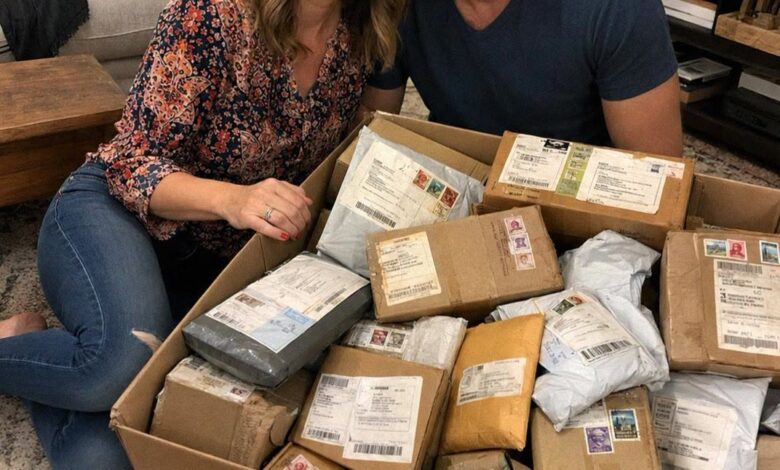
By the time we reached the bottom of our box of unclaimed packages, Caleb had adopted a mug declaring him the world’s okayest dentist. He was not a dentist. He simply liked the idea of taking it to work and leaving people confused.
I was laughing as I added another glittery phone case to the pile between us. There were avocado socks, charging cables, kitchen gadgets, and a shirt large enough for both of us. After fifteen years of marriage, an evening spent enjoying useless things together felt like time well spent.
For weeks, we had watched videos of people opening warehouse-clearance parcels and undeliverable packages. Ordering our own box had been Caleb’s idea. He chose a local warehouse because the shipping cost less.
I did not think that choice mattered until I lifted the last parcel.
It was smaller than a shoebox, with faded cardboard, yellowed tape, and layers of old shipping labels. One marked it undeliverable. A much newer barcode crossed one corner.
Then I turned it over and saw Caleb’s full name, including his middle initial.
Beneath it was Apartment 3B, the tiny one-bedroom where we had lived during the first year of our marriage.
I told him the package was his.
The mug slipped from his hand onto the couch. He stood and asked where I had found it, as though he had not spent the last hour beside the same box.
“Dolly, give it to me,” he said, his voice frightening me. I had known him nearly seventeen years and seen him through anger, illness, fear, and grief. I had never seen him react like that to an object.
I asked what it was. He said it was nothing, then begged me not to open it.
My imagination immediately supplied explanations worse than anything he had said. I made a joke about a secret wife folded inside. When he did not smile, the joke stopped being funny.
He promised to explain, but hesitated when I asked when.
I carried the parcel down the hallway. Caleb followed, asking me to stop. I went into the bathroom and locked the door.
My hands shook as I peeled away the old tape. Inside was brown tissue paper and something black. For an absurd instant, I expected evidence of another woman.
Instead, I found a man’s dress shoe.
A second rested beneath it. Both were black leather, carefully polished but deeply creased. They had been repaired, and one sole looked newer than the other.
I opened the bathroom door. Caleb was sitting on the hallway floor.
He said the shoes were his. I had never seen them before.
Then he told me they belonged to four months of our marriage about which he had never told me the truth. Before my mind could return to another woman, he ruled that out.
He took the shoes and asked me to get my coat. If he was finally going to explain, he wanted to show me something.
I was irritated that a confession apparently required a change of scenery, but ten minutes later we were driving across town.
The shoes sat near his feet. I remembered our early marriage: mismatched dishes, a secondhand couch, and a kitchen drawer that fell out if we opened it too quickly. We had been broke. I had believed we were broke together.
Caleb drove into our old neighborhood, parked, and led me to a bus shelter. He sat down with the shoes beside him and said he used to eat lunch there.
I reminded him that his office had been twenty minutes away.
He told me he had no longer been working there.
Three months after our wedding, his position had been eliminated. For almost four months afterward, he had left home dressed for work without telling me he was unemployed.
I sat beside him while familiar memories rearranged themselves: morning coffee, his tie, the lunches I sometimes packed, our kisses at the apartment door.
He had spent those days in the library, at the employment center, in interviews, and anywhere else he thought he might find work.
Once, we had only twelve dollars until payday. He reminded me that he had claimed his office was providing free lunches. I remembered being pleased that we could save the money.
There had been no free lunch.
Some days, he ate whatever he could afford. Other days, he ate nothing.
I refused to let him make that sound romantic. The problem was not simply the sacrifice; it was that he had let me believe we were facing our circumstances together while hiding the circumstances from me.
Another memory returned. One night, I had made chicken Parmesan and waited until after nine. Caleb barely touched it and said he had already eaten with coworkers. We argued because I thought he cared more about work than coming home.
He had actually spent the day walking between two interviews and a temp agency.
For fifteen years, I had remembered that argument without knowing what it was about.
He admitted there were other lies, then led me two blocks farther to a narrow shop between a pharmacy and a laundromat.
The faded sign read Martin’s Shoe Repair.
An older man behind the counter studied Caleb and recognized him as the walking man. Then he saw the shoes and asked whether they had finally found their owner.
Fifteen years earlier, a sole had split less than an hour before an interview. Caleb entered the shop with barely enough money for bus fare. Martin noticed the résumé folder and repaired the shoe anyway, telling him to return once he found a job.
A few weeks later, Caleb did. He paid Martin and asked him to restore both shoes completely. His new work involved traveling during the week, so he paid to have the finished pair sent to our apartment.
He had planned to wear them on our anniversary and finally tell me everything.
Martin remembered him worrying aloud about that confession. His teasing made me laugh despite myself. When he said Caleb’s love for me had been obvious, I answered that love had never been the problem.
Walking back toward the shelter, Caleb explained why the parcel had gone missing. We moved soon after he ordered the repair. The courier delivered it to the old apartment, where it was marked undeliverable. Years later, the local depot closed, and forgotten stock eventually passed into the warehouse liquidation we had bought from.
The cheap local shipping had been a coincidence. Caleb had assumed the shoes were lost forever.
Their disappearance became another excuse to postpone telling me. He did not need the shoes to confess, he admitted. He needed a way to begin, and when that way vanished, he let the silence continue.
At the bus shelter, I asked what he thought would have happened if he had told me.
He said I would have worried.
Of course I would have. But I would have worried with him.
Then I asked whether there was anything he was afraid to tell me now.
He initially said no. I waited.
His department was being reorganized. He thought his job was probably safe, but cuts were possible. He had known for a week.
Fifteen years later, the same reflex was still there. This time, though, he stayed beside me and explained his fear of interviews, starting over, and having our life changed by a single meeting.
I did not solve it. I listened.
Later, at a diner, a work email arrived. Caleb began to turn his phone facedown, then caught himself. He told me it concerned the restructuring, opened it, and let us read it together.
Nothing had been decided. For once, uncertainty was something we shared.
Outside, he put on the restored shoes and began to limp. He first insisted he was fine, then laughed and admitted they were terrible.
I offered my arm.
Those shoes had once carried him through miles of fear he believed he had to face alone. That evening, he finally let me walk beside him.