My Brother Locked My Children Outside on Thanksgiving and Said They Werent Real Family So I Canceled His 28 000 Wedding and the Truth Destroyed Everything He Had Been Hiding
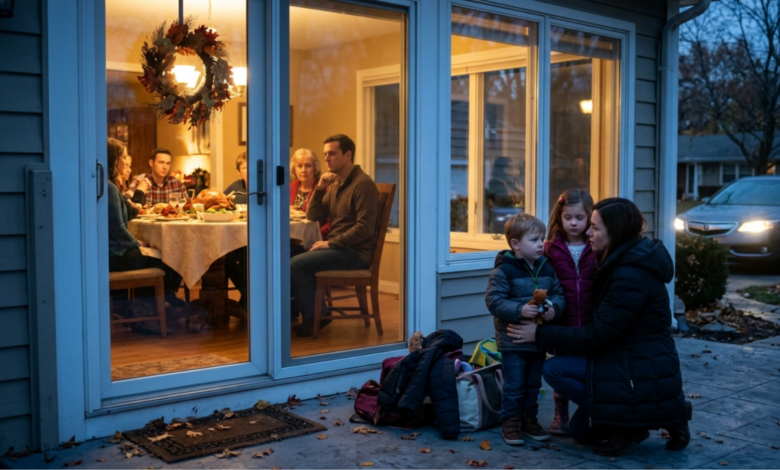
My brother locked my children outside during Thanksgiving and said, “They can eat after the real family is finished.” Mom told me not to cause a scene. I quietly took my kids and went home. That evening, Dad texted, “Your brother wants nothing to do with you. Neither do we.” I answered, “Then he can pay for his own wedding.” By midnight, my brother had called me forty-nine times.
“They can eat when the real family is done,” my brother said as he took another bite of the rolls I had gotten up before sunrise to bake.
My six-year-old son stood on the other side of the sliding glass door, trembling in 38-degree weather. His nine-year-old sister had her arms wrapped around him from behind. Someone had placed a wooden dowel in the inside track, preventing the door from opening.
I yanked it out.
Zach stumbled straight into my arms, his fingers freezing against my neck. Jodie came in after him, her knuckles flushed bright pink from the cold.
“Mom, I knocked a lot,” she whispered. “Uncle Roland saw us. He waved.”
At the dining table, Roland sat back in his chair as if he'd pulled some harmless prank. My mother, Pearl, continued chewing. My father had only just walked in from the garage, where he'd been watching football.
“What happened?” I asked.
“They were being loud,” Roland said. “I couldn't hear Lorie's parents on the video call.”
“So why didn't you let them inside again?”
“They'll survive, Hollis. They can eat after the real family finishes.”
I turned toward my mother, expecting her to get up. To check whether Zach was okay. To say something.
Anything.
Instead, she placed her napkin on the table.
“Stop making a scene. It's Thanksgiving. We'll make them plates afterward.”
Afterward.
After the real family had finished eating.
I was thirty-eight years old and worked as a caterer in Kettering, Ohio. I had spent almost the entire morning preparing the food sitting on that table: turkey, cornbread dressing, gravy, green beans, rolls, and two pies. I had brought all of it over with my children because my husband, Seth, was working an emergency-room shift.
Jodie and Zach were Seth's children from his first marriage. I had been raising them since they were small, and three years earlier, I had legally adopted both of them.
They called me Mom.
Roland continued calling them “Seth's kids.”
That morning, my mother had sent the children outside to play in the backyard. Then she told me to run to Kroger for whipped cream because, according to her, the can in the refrigerator had expired.
Twenty-five minutes later, I returned to find Thanksgiving dinner already being served and my two children locked outside.
Lorie, Roland's fiancée, looked horrified.
“You told me they wanted to stay outside,” she said to him.
“They were playing,” Roland replied. “Kids knock on doors.”
My father looked toward the sliding door, then at Zach's face.
I wrapped both children in my coat.
“Jodie, get your brother's shoes. We're leaving.”
Pearl gave a sharp laugh.
“You're going home? After all this food?”
I glanced at the turkey I'd brought, the gravy she'd criticized, and the rolls Roland was still eating.
“Enjoy it. The real family deserves a good meal.”
I didn't say anything about the wedding.
Roland was scheduled to marry Lorie on December 20 at a restored barn outside Bellbrook. Mom had cried when she asked me to help pay for it because Lorie's family had money and Roland didn't want to appear cheap.
So I had personally signed the $18,400 contract for the venue.
I had already paid a nonrefundable $6,000 deposit, and the remaining $12,400 was due December 1.
My catering business was also providing $9,800 worth of food for 140 guests, entirely at my own expense.
Roland hadn't contributed a single dollar toward the venue.
For years, I had been covering costs for this family.
Yet on Thanksgiving, the children I had legally adopted weren't considered worthy of a place at the table I'd filled with food.
I drove home with the heater turned all the way up.
At a red light, Zach looked at me and asked, “Mom, are we in trouble?”
“No. Nobody inside this car is in trouble.”
Later, while he was warming up, he asked me what “real family” meant.
I told him, “Real family is whoever opens the door when you knock.”
That night, we ate pancakes and pie while sitting on the living-room floor.
When Seth came home from work, I told him everything.
He checked both children over, then sat silently across from me.
That was when I opened the message from my father.
“Your brother wants nothing to do with you. Neither do we. Your mother is very upset. Do not come for Christmas.”
There wasn't a single word asking whether his grandchildren were okay.
Seth watched as I lowered the phone.
“What are you going to say?”
I typed one sentence.
“Then he can pay for his own wedding.”
I opened my laptop.
The venue contract stated that whoever signed it could cancel in writing, even if doing so meant losing the deposit.
I emailed the cancellation to the venue coordinator and copied Roland and Lorie on the message.
Then I removed Roland's wedding from my catering schedule and told my staff they could have the day off with pay.
Two minutes later, my phone started ringing.
By midnight, Roland had called forty-nine times.
In one voicemail, he apologized that the children had gotten cold.
In another, he said they weren't really mine anyway, just kids I had acquired through legal paperwork.
I played that message twice.
And later that night, I remembered something I'd arranged at my parents' house two years earlier after Dad had fallen from a ladder.
I checked my phone, stayed seated at the kitchen table, and made sure I hadn't imagined what was still there.
On Friday, Lorie called me.
Roland had told her the kids had chosen to stay outdoors, and he'd also told her parents that he was personally paying half the cost of the wedding venue.
Neither statement was true.
That afternoon, Roland showed up at my front door demanding that I apologize.
I left the glass storm door closed between us.
“You're just the stepmom with the checkbook,” he snapped.
He had finally said it directly to my face.
“You're fixing this on Sunday,” he continued. “Lorie's parents are going to be there.”
“I'll be there,” I said.
On Sunday, I walked into my parents' living room.
Lorie was seated with both of her parents. Roland stood next to the fireplace. Pearl wore a smile that looked like she'd practiced it beforehand.
“Hollis has something she'd like to say,” she announced.
Instead, I looked at Lorie's father and explained who had actually signed the venue contract and who had paid the money.
Roland's elbow slipped from the mantel.
Pearl immediately jumped into the conversation.
“The children were outside playing. Roland only shut the door because there was a draft.”
I turned toward my brother.
“Is that what happened?”
He crossed his arms.
“Yeah. End of story.”
Lorie's father stared at me without blinking.
My father kept his eyes fixed on the carpet.
And Roland, who had spent the entire weekend ordering everyone around, suddenly had nothing more to say.
I reached into the pocket of my coat.
My mother was still smiling when I pulled out my phone…
PART 2: My mother was still smiling when I pulled out my phone. She seemed convinced I was about to show everyone some emotional message, perhaps another attempt to make Roland look bad. She even folded her hands in her lap. “Go ahead, Hollis,” she said. “If you have something to say, say it. But I hope you've thought about how much damage you're doing to this family.” I looked at her. For thirty-eight years, I had heard variations of that sentence. Whenever Roland made a mistake, I was expected to understand. Whenever my parents needed money, I was expected to help. Whenever someone hurt my feelings, I was expected to forgive them because family was supposedly more important than pride. But that afternoon, something had changed… SAY ""YES"" IF YOU WANT TO READ THE FULL STORY
## PART 3
I wasn’t interested in defending myself anymore.
I unlocked my phone.
“I want everyone here to hear something,” I said. “And I don’t want anyone interrupting until it finishes.”
Roland laughed.
“Oh, here we go. She’s going to play some recording and act like she’s the victim.”
I didn’t respond.
Instead, I opened the voicemail he had left on Thanksgiving night.
Then I pressed play.
His voice filled my parents’ living room.
“Listen, Hollis. I don’t know what kind of game you’re playing, but you need to stop. Those kids aren’t even yours. You married Seth, and now you think you can use those children to control everybody. You should be grateful we let you bring them around in the first place. And if you think canceling my wedding is going to make me apologize, forget it. You’re just the stepmom with the checkbook. That’s all you’ve ever been.”
The recording ended.
Nobody moved.
Lorie stared at Roland.
Her father slowly turned his head toward him.
Her mother pressed her lips together.
Pearl was the first person to speak.
“Why would you play something so private?”
I looked at her.
“Private? He left it on my phone. He wanted me to hear it.”
Roland stepped forward.
“You recorded that to embarrass me!”
“No. You recorded yourself.”
His face turned red.
Lorie stood up.
“Roland, is that how you really feel about Jodie and Zach?”
He rubbed his forehead.
“I was angry.”
“That wasn’t my question.”
“They’re not my children.”
“They’re Hollis’s children,” Lorie replied. “And you knew that when we started planning this wedding.”
I could see her trying to understand how the man she intended to marry could speak about two innocent children that way.
But I wasn’t finished.
I opened another recording.
This one was from two months earlier.
Roland’s voice came through again.
“Hollis, don’t forget the venue payment. Mom says you’re handling it. Lorie’s parents are already asking questions, so just tell them I put down the deposit. It’s easier that way. They don’t need to know every little detail.”
Then my own voice answered.
“Roland, I already paid the deposit. But I’m not going to lie to Lorie’s parents about who is paying for everything.”
He laughed.
“Come on. It’s my wedding. Let me look good for once.”
The recording stopped.
Lorie’s father leaned back.
“Did you tell my daughter you paid the deposit?”
Roland looked at the floor.
“I was going to pay Hollis back.”
“When?”
“After the wedding.”
“With what money?”
Roland didn’t answer.
Lorie’s father looked at me.
“How much have you actually paid?”
I took a breath.
“Six thousand dollars for the venue deposit. The remaining twelve thousand four hundred was due December first. I also agreed to provide the catering, worth approximately nine thousand eight hundred dollars.”
Lorie’s mother slowly removed her glasses.
“That’s almost twenty-eight thousand dollars.”
“Correct.”
Roland immediately jumped in.
“She offered! Nobody forced her!”
I nodded.
“You’re right. I offered because I wanted my brother to have a beautiful wedding. I didn’t offer because I wanted to be treated like an outsider while my children stood freezing outside a locked door.”
Lorie began crying.
“Why didn’t you tell me?”
I looked at her.
“Because I believed Roland would eventually be honest with you.”
She turned toward him.
“You told my parents you had saved money for this wedding.”
“I did save money.”
“How much?”
He hesitated.
“About two thousand.”
Her father let out a quiet breath.
“And you told us you had personally contributed fifteen thousand.”
Roland didn’t answer.
That silence was louder than anything I could have said.
Pearl suddenly stood.
“Enough! This is supposed to be a family discussion. Hollis, you came here to destroy your brother’s relationship.”
I looked at my mother.
“No, Mom. I came here because you told everyone I owed Roland an apology. I wanted them to know what actually happened.”
“You’re exaggerating the situation with the children.”
I felt something tighten in my chest.
“Jodie and Zach were six and nine years old. They were outside in freezing weather. They knocked on the door. Roland saw them and deliberately refused to let them inside.”
“They were only outside for a little while,” Pearl replied.
“How long is acceptable to you? Ten minutes? Twenty? An hour?”
She looked away.
I turned toward Lorie.
“I have something else to show you.”
I opened the photographs on my phone.
The first picture showed Jodie’s hands. Her fingers were red from the cold.
The second showed Zach wrapped in my coat, his cheeks still wet from crying.
The third was a picture I had taken after we got home.
Both children were sitting on the living-room floor, eating pancakes because they had been too upset to eat anything else.
I didn’t need to say anything.
Lorie covered her mouth.
Her mother reached for her hand.
“I’m sorry,” Lorie whispered.
I nodded.
“You don’t owe me an apology for something you didn’t know.”
Then I looked at Roland.
“But you do.”
He shook his head.
“I am not apologizing for a misunderstanding.”
I stared at him for several seconds.
Then I put my phone away.
“Fine.”
My father finally spoke.
“Hollis, perhaps we should all calm down. Your brother made a mistake. We don’t need to ruin a wedding over one Thanksgiving dinner.”
I turned toward him.
“Dad, do you remember what happened two years ago when you fell from the ladder?”
He frowned.
“What does that have to do with anything?”
“Everything.”
Two years earlier, my father had fallen while repairing the gutters on my parents’ house.
He fractured his hip and spent several weeks in the hospital.
My mother was overwhelmed, and Roland was too busy with his new job to help.
I took time away from my catering business.
I drove my father to appointments, organized his medication, arranged repairs around the house, and helped my mother manage the bills.
I also discovered that their homeowners insurance had a problem with an old liability claim.
The house was at risk of losing coverage unless several repairs were completed.
My parents didn’t have enough savings to cover the work.
So I paid for it.
I hired contractors, replaced the damaged porch steps, repaired the railing, fixed the electrical panel, and arranged for a new heating system.
The total came to $31,600.
My father had promised to repay me.
He never did.
But the most important part wasn’t the money.
It was the document I had signed with my parents.
I opened my email and searched for the subject line.
Household Financial Assistance and Repayment Agreement.
My father recognized it immediately.
His expression changed.
“Hollis, don’t bring that up.”
I looked at him.
“Why not?”
“That’s between us.”
“Then perhaps you should have remembered that before sending me a message telling me your family wanted nothing to do with me.”
Roland rolled his eyes.
“What does that old paperwork have to do with my wedding?”
I turned toward him.
“Because you’re about to learn something you never bothered to ask.”
I showed Lorie’s father the document.
It was a signed agreement between me and my parents.
The agreement listed every expense I had covered, the repayment terms, and the additional financial assistance I had provided.
But there was another section.
A section my parents had requested themselves.
If they ever sold the house, the outstanding amount I had paid for necessary repairs and improvements would be repaid from the proceeds before they distributed any remaining money among their children.
My father had insisted on that arrangement.
He had told me he didn’t want me to feel like I was simply throwing money into a house that Roland would eventually inherit.
I hadn’t thought much about it at the time.
I had only wanted my parents to be safe.
Now, however, I realized how little my family remembered about the sacrifices I had made.
“Dad,” I said quietly, “you told me you wanted everything to be fair. You said Roland and I should be treated equally.”
My father looked uncomfortable.
“That’s not what this is about.”
“Then what is it about?”
He didn’t answer.
I continued.
“Over the last five years, I’ve paid your property taxes twice, covered the emergency plumbing repairs, helped Mom with her medical bills, and paid for the work after your fall. I’ve never asked you to choose between your children. I’ve never asked you to love me more.”
My voice began to shake.
“But yesterday, my children were standing outside your house, and nobody opened the door.”
Pearl wiped her eyes.
“Oh, Hollis. Don’t make this into something it isn’t.”
I looked at her.
“You’re right. It isn’t about money.”
Then I turned toward Roland.
“It’s about the fact that you believe you can treat people badly as long as somebody else pays your bills.”
He took a step toward me.
“You think you’re better than everyone because you have a business?”
“No. I think I’m finally tired of paying for people who don’t respect me.”
Lorie’s father cleared his throat.
“Roland, I think we need to talk privately.”
Roland looked at him.
“About what?”
“About whether this marriage should happen.”
The entire room went silent.
Lorie started crying harder.
“Dad, please.”
He put his arm around her.
“Sweetheart, I love you. But I won’t watch you marry someone who lies to you about money and treats children like they don’t belong.”
Roland’s face went pale.
“You can’t cancel my wedding!”
Lorie looked at him.
“It’s my wedding too.”
For the first time that afternoon, Roland seemed genuinely frightened.
He turned toward my mother.
“Mom, say something!”
Pearl looked between him and Lorie.
“Everyone is upset. Let’s not make decisions today.”
But Lorie had already made hers.
She took off her engagement ring.
She placed it on the coffee table.
“I need time to think.”
Roland stared at the ring.
“You’re seriously doing this because of her?”
“No,” Lorie said quietly. “I’m doing this because of you.”
I watched her pick up her purse.
Before leaving, she approached me.
“Can I ask you something?”
“Of course.”
“Are Jodie and Zach okay?”
I nodded.
“They’re home with Seth.”
She swallowed.
“Please tell them I’m sorry.”
“I will.”
Then she left with her parents.
Roland stood in the middle of the living room, looking like someone had suddenly removed the floor beneath him.
And Pearl?
She turned toward me with an expression I had seen many times throughout my childhood.
Disappointment.
But this time, I didn’t feel guilty.
I picked up my coat.
“I’m leaving.”
My father called after me.
“Hollis, we’re not finished discussing this.”
I stopped near the doorway.
“Dad, we finished discussing it when you told me not to come for Christmas.”
Then I walked out.
I thought that would be the end of it.
I was wrong.
At 8:17 that evening, Roland sent me a message.
You have until tomorrow morning to call Lorie and fix this. Tell her you exaggerated everything.
I didn’t respond.
At 8:24, another message arrived.
You ruined my life.
At 8:31:
You better not think you’re getting away with this.
Then my mother called.
I let it ring.
My father called next.
I let that ring too.
Finally, at 9:06, Seth came downstairs carrying his phone.
“Hollis, you need to see this.”
He showed me a message Roland had sent to our extended family group chat.
It was a photograph of the Thanksgiving dinner table.
Underneath it, he had written:
Some people would rather destroy their own family than accept that they aren’t the center of attention. My sister has canceled my wedding and is now threatening our parents over money.
Within minutes, relatives started replying.
Some asked what had happened.
Others defended Roland.
One aunt wrote that I had always been too controlling.
Another said I should remember that my parents were getting older and shouldn’t have to deal with unnecessary family drama.
I stared at the messages.
Then I noticed something strange.
My cousin Melissa had written:
Roland, are you sure you want everyone discussing who actually paid for the wedding? Because I remember something you told me last month.
I immediately called her.
She answered on the second ring.
“Hollis?”
“What did Roland tell you?”
There was a pause.
Then she sighed.
“He told me you had promised to give him twenty thousand dollars as a wedding gift. He said the money was already set aside.”
I closed my eyes.
“I never promised him that.”
“I know that now.”
“What else did he say?”
Melissa hesitated.
“He said you were going to cover the venue and catering because you wanted your parents to be proud of you. He also told me he had borrowed money from your father to pay for the wedding.”
I sat down.
“Borrowed money from Dad?”
“That’s what he said.”
I looked at Seth.
He immediately understood that something else was happening.
“Melissa,” I asked, “how much?”
“Ten thousand dollars, I think.”
I thanked her and ended the call.
Then I opened my banking records.
I had been helping my parents with their finances for years.
Dad had given me permission to manage several household payments after his accident.
I knew exactly which accounts were involved.
And something about Melissa’s statement bothered me.
I started looking through the transfers.
One payment caught my attention.
$10,000.
It had been transferred from my father’s household account to Roland’s personal account three months earlier.
The description said:
Emergency roof and home repair.
I stared at the screen.
There had been no roof repair.
I knew because I had arranged the contractor myself.
I checked the date again.
Then I checked the following month.
Another transfer.
$2,500.
Then another.
$1,800.
I called my father.
He answered after four rings.
“What?”
“Dad, did you give Roland ten thousand dollars for a roof repair?”
Silence.
Then he said, “That’s none of your business.”
My stomach tightened.
“It’s from the household account I manage.”
“I told you, don’t interfere.”
“Dad, where did the money go?”
He hung up.
Seth sat beside me.
“What are you thinking?”
I looked at the screen.
“I’m thinking there’s something else I don’t know.”
I wasn’t going to accuse anyone without evidence.
But I wasn’t going to ignore what I had just found either.
The next morning, I called my accountant.
Then I called my parents’ bank.
I explained that I wanted to review the authorized transactions on the household account and make sure no additional payments were being made without my father’s informed approval.
I also requested that my own business accounts be completely separated from any family-related arrangements.
I wasn’t going to allow another wedding, emergency, or family disagreement to put my business at risk.
By lunchtime, I had received an email from the venue coordinator.
The cancellation had been processed.
The $6,000 deposit was nonrefundable.
The venue would not accept further payments from me.
That was the end of my financial involvement in Roland’s wedding.
Or so I thought.
At 2:40 p.m., Lorie called.
Her voice sounded exhausted.
“Hollis, I’m sorry to bother you.”
“It’s okay. Are you all right?”
“Not really.”
She explained that Roland had been calling her parents all morning.
He had told them the recordings were taken out of context.
He claimed the children had been outside for only a few minutes and that I had deliberately waited until everyone was seated before bringing them inside.
Then she told me something that made my hands go cold.
“Roland said you were planning to take money from your parents’ house because you’re angry about the wedding.”
I frowned.
“What?”
“He said you have access to their accounts and that you could make them lose their house.”
I looked at Seth.
That was when I understood.
Roland wasn’t simply trying to save his wedding.
He was trying to make everyone believe I was dangerous.
And suddenly, I remembered the transfers.
The ten thousand dollars.
The smaller payments.
The false roof-repair description.
I asked Lorie one question.
“Did Roland ever tell you what happened to the money your father gave him?”
She went quiet.
Then she whispered:
“Hollis, I think you need to talk to my father.”
I didn’t know what she was about to reveal.
But when I heard the next sentence, I realized Thanksgiving had only been the beginning.
Because Roland hadn’t just lied about paying for his wedding. He had apparently been telling two different families two completely different stories about where the money was coming from.
## PART 4
For several seconds, I couldn’t speak.
Lorie was still on the phone.
“Hollis?”
“I’m here.”
“My father wants to meet you. He says there’s something you should know before Roland has a chance to change the story again.”
I looked at Seth.
He nodded.
“Tell him we’ll meet.”
That afternoon, we drove to a small restaurant in Bellbrook. Lorie was already there with her parents.
Her father, Richard, had brought a folder.
He didn’t waste time with small talk.
“Hollis, I owe you an apology. We believed Roland when he told us he was paying for most of the wedding himself. We thought you were simply helping with the catering as a wedding gift.”
I nodded.
“I understand.”
He opened the folder.
Inside were copies of several bank transfers, printed messages, and a handwritten repayment agreement.
Richard pointed to one page.
“Three months ago, Roland approached me asking for a $15,000 loan. He said he needed to cover some wedding expenses because his sister had temporarily delayed her contribution.”
I frowned.
“My contribution?”
“He said you had promised to pay him $20,000, but that you were having cash-flow problems with your catering business.”
I stared at him.
“I never said that.”
“I know. That’s why I asked him for proof. He showed me a message that he claimed came from you.”
Richard handed me a printed screenshot.
The message read:
I’ll cover the remaining wedding expenses. Don’t worry about the money. I want you and Lorie to have a beautiful day.
My stomach turned.
I had never sent it.
I looked closely at the screenshot.
The wording sounded vaguely familiar, but I couldn’t remember writing it.
Then I noticed the date.
It was a day when Roland had borrowed my phone while helping me move some catering equipment.
I didn’t know whether he had fabricated the message or manipulated an old conversation.
But one thing was certain.
It wasn’t a promise to give him twenty thousand dollars.
Richard continued.
“I transferred five thousand dollars to him. He signed an agreement promising to repay it by January.”
Lorie lowered her head.
“I didn’t know about the loan.”
Richard nodded.
“Yesterday, when I asked him about the repayment, he told me the wedding had been canceled because Hollis had stolen money from your parents.”
I looked at Richard.
“That’s ridiculous.”
“I know. But there’s something else.”
He turned another page.
It showed a transfer of $10,000 from my father’s account to Roland.
The description was listed as a home repair expense.
Richard pointed at it.
“Roland showed me this transaction as proof that your father was helping him pay for the wedding. He said it was a family gift.”
I felt sick.
My father had told me the money was for a roof repair.
And Roland had apparently used the same transaction to convince Lorie’s parents that he was financially responsible.
I leaned back.
“Does he know you’ve shown me this?”
“No,” Richard replied. “And I’d prefer that you don’t confront him until we understand everything.”
I agreed.
For the first time, I realized that my brother’s behavior wasn’t just about arrogance or jealousy.
There was a pattern.
He lied.
He borrowed.
He shifted responsibility.
And whenever someone questioned him, he blamed the person who had discovered the truth.
I had spent years rescuing him from the consequences.
Perhaps that was why he believed he could continue.
But I wasn’t rescuing him anymore.