Iranian Missile and Drone Strikes Target US Installations Across the Gulf
EXECUTIVE SUMMARY
Iran has launched waves of ballistic missiles and drones at U.S. military installations across Bahrain, Qatar, Kuwait, and the UAE.
Iran launched aggressive waves of ballistic missiles and one-way attack drones targeting locations hosting United States military forces across the Persian Gulf, forcing regional allies to activate emergency air defenses. This escalating confrontation highlights how quickly regional tensions can expand beyond contained borders. The United States maintains a powerful strategic presence throughout the Gulf, making critical installations in Bahrain, Qatar, Kuwait, and the United Arab Emirates immediate targets for Tehran.
In the United Arab Emirates, security forces activated high-alert protocols following explosions and reports of incoming threats near vital facilities. Al Dhafra Air Base remains a primary focus due to its integration with American regional flight operations. Although authorities are still conducting comprehensive damage assessments from the latest barrage, historical precedents show that critical Gulf infrastructure faces immense pressure during such retaliatory surges.
Bahrain continues to occupy a vulnerable yet strategic position as the host of Naval Support Activity Bahrain, which serves as the headquarters for the U.S. Navy’s Fifth Fleet. Iranian forces have frequently claimed strikes against facilities in the kingdom, prompting local air defense units to intercept numerous projectiles in defense of their airspace.
Qatar and Kuwait share the same precarious reality as regional hosts to crucial American assets. Al Udeid Air Base in Qatar, one of the most prominent U.S. military hubs in the Middle East, has repeatedly faced direct threats and past infrastructure damage from hostile fire. Meanwhile, Kuwaiti air defenses have similarly engaged incoming projectiles aimed at logistics networks supporting American troops.
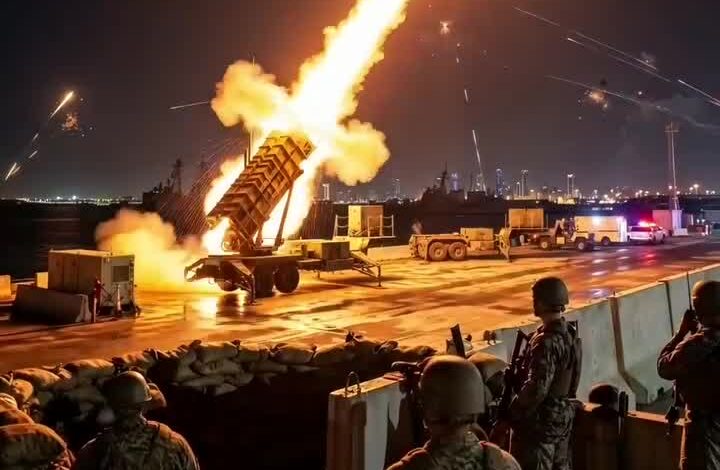
The unmistakable pattern of coordinated strikes exposes the severe vulnerability of foreign military infrastructure across the Gulf corridor. Local governments find themselves forced to neutralize incoming aerial threats to protect their own populations from a widening conflict they did not start. Intense interception operations continue to illuminate night skies as land-based batteries and naval vessels work urgently to secure regional installations.
The geography described in the report is central to the situation. Bahrain, Qatar, Kuwait, and the United Arab Emirates are separate countries hosting different American military facilities. The account describes threats against installations in those countries; it does not establish that those four governments jointly launched the attack suggested by the circulating caption.
The facilities also have different functions. Naval Support Activity Bahrain is associated with the Fifth Fleet, while Al Udeid and Al Dhafra are important to regional air operations. That distribution helps explain why an escalation involving American forces can place several host countries on alert at once. A threat aimed at a military facility can also create concern for people living and working nearby.
The report leaves damage assessments unfinished. Interceptions, explosions, and claims of strikes should therefore be distinguished from an independently established account of losses at each location. The information supplied does not provide a verified casualty list or a complete installation-by-installation damage report. Its immediate focus is the pressure on regional defenses and the effort to protect the Gulf's military and civilian infrastructure while officials assess the consequences.