If You Have These Two Dimples on Your Lower Back Heres What They Mean
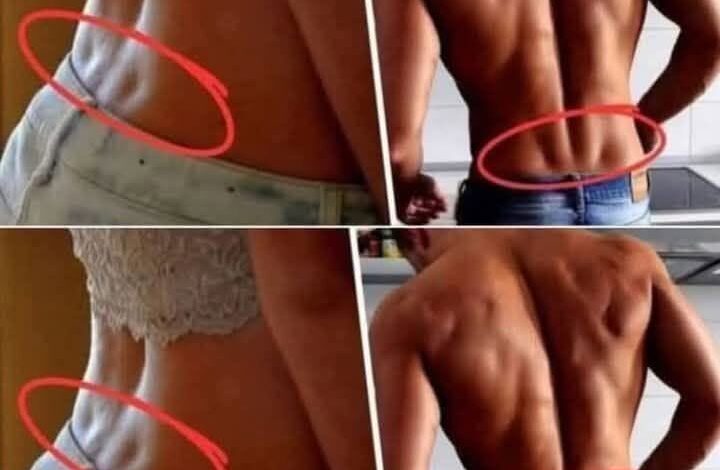
Two small indentations sometimes appear on the lower back, positioned symmetrically just above the buttocks. They are commonly called Venus dimples, a name borrowed from the Roman goddess associated with beauty. On men, the same feature is sometimes described as Apollo holes. They may stand out clearly on one person and be barely visible on another.
The dimples form where short ligaments connect the skin to the bony points at the rear of the pelvis known as the posterior superior iliac spines. Because the skin is tethered more closely in these spots, the surface dips inward. The feature is simply part of the way a person’s bones, connective tissue, skin, and body composition come together.
Genetics plays the largest role. A person may inherit a pelvic shape and ligament arrangement that makes the indentations visible, just as families can share facial dimples, hair texture, or other physical traits. Someone who does not have the underlying structure cannot create true Venus dimples through a particular exercise routine.
Fitness can affect how noticeable the dimples look without creating them from nothing. Changes in muscle tone or the amount of tissue covering the lower back may reveal indentations that were already present. The effect differs widely between individuals, so comparing one body with another is not a useful measure of effort or health.
Online posts often attach dramatic meanings to the two marks. Some claim they prove exceptional circulation, a powerful core, greater athletic ability, or a particular level of sexual health. The appearance alone does not provide that kind of medical information. A person can have visible lower-back dimples and be inactive, or have no dimples while being strong, healthy, and physically fit.
Their popularity comes largely from aesthetics. Artists have emphasized the curve of the lower back for centuries, and modern fitness and fashion photography often treats the indentations as an attractive detail. That cultural attention can make an ordinary anatomical variation feel rare or mysterious even though many people have it.
There is no special care routine required for normal, painless dimples. They are not openings in the skin, and they do not need to be cleaned differently from the surrounding area. They should also not be confused with a sacral dimple, which is a single indentation near the crease between the buttocks and is usually noticed in infancy. A clinician can evaluate any mark that is unusually deep, painful, draining, swollen, or accompanied by neurological symptoms.
Trying to force the appearance through extreme dieting is unnecessary and can be harmful. If exercise and nutrition are part of a health goal, they should support strength, energy, mobility, and well-being rather than chase one inherited detail. A body does not become healthier simply because two small shadows become visible in a photograph.
People who already have Venus dimples may notice that lighting, posture, clothing, and camera angle change how prominent they appear. Standing with the lower back arched can deepen the shadows, while relaxed posture can make them seem to disappear. This is another reason photographs should not be used to judge health or fitness.
The simple answer is that the two holes are usually natural lower-back dimples created by anatomy and inheritance. They can be admired as a distinctive feature, but they are not a secret medical test or a requirement for attractiveness. Whether they are obvious, subtle, or completely absent, they are only one small example of the normal variety found in human bodies.
Curiosity about an unfamiliar feature is reasonable, especially when online captions promise a hidden meaning. In this case, the explanation is reassuringly ordinary. The marks usually reflect structure, not a condition that must be treated or a special advantage that others lack. Confidence does not depend on having them.