BREAKING Former US President to Be Arrested for Treason and Espionage Rumor Examined
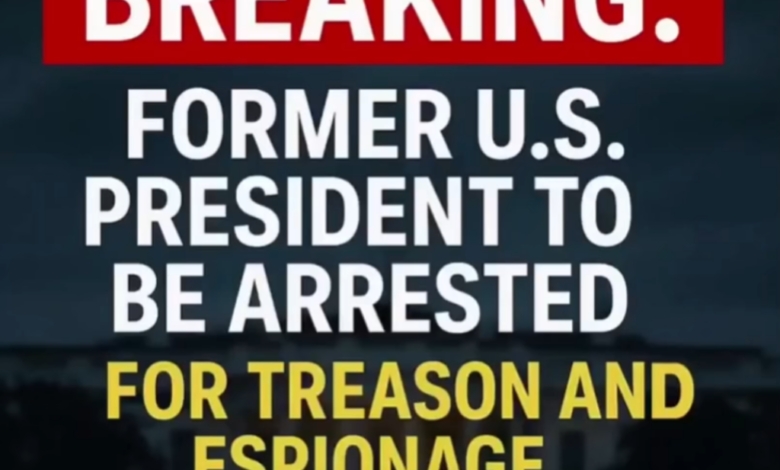
Claims that former President Barack Obama was about to be arrested for treason and espionage spread rapidly through political pages and social media accounts. The language was dramatic, suggesting that federal agencies were coordinating in secret and that an announcement capable of shaking the country could arrive at any moment.
No official charge accompanied the claim. The Department of Justice had not announced an arrest, and no public court filing accused Obama of treason, espionage, or seditious conspiracy. Without those basic forms of evidence, the allegation remained a rumor rather than a confirmed legal development.
The distinction matters because the offenses named are among the most serious in federal law. Treason has a narrow constitutional definition connected to levying war against the United States or giving aid and comfort to its enemies. Espionage cases depend on specific conduct involving protected national-defense information. Seditious conspiracy also requires evidence of an agreement to use force against the government or its laws.
Attaching those terms to a former president creates an instant emotional reaction. Supporters may feel anger and fear, while political opponents may experience satisfaction before any evidence has been examined. That intensity helps the story travel, even when the original post offers only unnamed insiders and promises of information still to come.
A genuine federal prosecution would produce verifiable records. An indictment would identify the charges, the court, and the factual allegations supporting them. Attorneys would respond, officials would speak on the record, and major news organizations would obtain documents that readers could examine independently.
None of those signals appeared with the viral claim. Repetition across multiple accounts did not create confirmation because many posts traced back to the same unsupported statement. Ten websites copying one rumor still represent one unverified source.
The allegation gained power from the broader political climate. Years of investigations, accusations, and distrust have encouraged audiences to expect secret plots from institutions they oppose. When people already believe a public figure must be guilty of something, a sensational headline can feel like proof rather than an invitation to ask for proof.
That reaction is understandable but dangerous. Legal accountability should apply to former presidents as it applies to other citizens, yet accountability requires evidence and due process. Treating a rumor as a verdict weakens the standards that make a legitimate prosecution credible.
Readers can test claims of this kind by looking for a case number, named court, charging document, official statement, or on-the-record attorney. They can also compare reporting from organizations with independent access to federal agencies. A headline that relies only on anonymous “Washington insiders” should not be presented as a completed event.
Political misinformation has consequences beyond embarrassment. It can deepen hostility, convince people that institutions are hiding a major action, and create expectations that turn into anger when the promised arrest never occurs. The emotional cycle benefits pages that attract clicks while leaving the public more distrustful.
As of the account described in the source, there was no credible public evidence that Obama faced an imminent arrest for treason or espionage. That conclusion does not require anyone to approve of his presidency or dismiss legitimate criticism. It simply reflects the absence of the legal evidence necessary to support an extraordinary accusation.
If authentic documents or an official announcement emerge, they can be evaluated on their merits. Until then, the responsible description is straightforward: a rumor circulated, people reacted, and the promised proof did not accompany it. In a divided country, refusing to turn whispers into facts is not political loyalty. It is the minimum standard required for truth and justice.
The same standard protects everyone. It prevents political power from being mistaken for evidence and ensures that accusations are judged through records, testimony, and lawful proceedings rather than the speed of an online reaction.