Amazon cargo plane crashes after overshooting Miami airport runway at least 5 killed see more
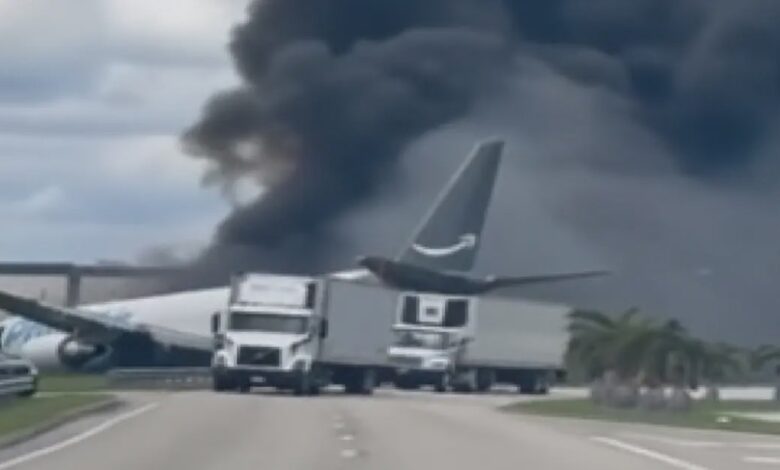
A routine cargo flight ended in tragedy when a Boeing 767 ran beyond the runway at Miami International Airport, struck vehicles, and erupted into flames. Five people lost their lives, while others suffered serious injuries. As thick black smoke rose above the airport, emergency crews raced against time to rescue survivors. But the most disturbing questions concern what happened during the aircraft's final moments before impact.
It was supposed to be another ordinary afternoon at one of America's busiest international airports. Aircraft were arriving and departing, airport workers were carrying out their daily duties, and cargo operations continued as usual. Then, shortly before 2 p.m. on September 6, 2026, a commercial cargo aircraft approaching Miami International Airport failed to stop within the runway boundaries.
Within moments, the situation became catastrophic.
The Boeing 767 operating as Amazon Prime Air Flight 7598 overran Runway 30 after arriving from San Juan, Puerto Rico. Instead of remaining on the paved runway, the aircraft continued beyond its end, crossed the surrounding area, and struck vehicles near the airport.
A massive fire followed. Thick black smoke rose into the sky, creating a frightening scene that could be seen from nearby roads. People who had been going about their daily activities suddenly found themselves close to a major aviation emergency.
Emergency responders rushed toward the wreckage. Firefighters faced intense flames, damaged vehicles, and concerns about leaking aviation fuel. Rescue teams had to assess multiple victims while also working to secure the aircraft and prevent the situation from becoming even more dangerous.
The final confirmed toll was devastating: five people died and five others were injured.
But the tragedy did not end with the initial rescue operation. Investigators were left with difficult questions about the aircraft's approach, the decisions made inside the cockpit, the weather conditions, and why the plane continued beyond the runway.
The aircraft was operated by 21 Air on behalf of Amazon. That distinction is important because the flight involved a cargo operator carrying out an Amazon-related service rather than an aircraft directly operated by Amazon's own airline operations.
And as investigators began examining the flight recorders, an even more troubling detail emerged: preliminary flight data suggested that the aircraft approached the runway at excessive speed and touched down much farther along the runway than expected.
What happened in those final seconds? Why did the aircraft fail to stop? And how did a landing emergency turn into a disaster involving people on the ground?
The answers reveal not only the seriousness of the Miami accident but also the importance of runway safety, cockpit communication, emergency response, and the protection of people working around major airports.
The Flight That Ended in Disaster
The aircraft involved in the accident was a Boeing 767-33A, registered as N1997A. It was operated by 21 Air, a cargo airline based in North Carolina, on behalf of Amazon.com Services LLC.
The flight was identified as 21 Air Flight 7598, operating within Amazon's cargo transportation network.
According to the National Transportation Safety Board (NTSB), the aircraft had departed Luis Muñoz Marín International Airport in San Juan, Puerto Rico, and was scheduled to arrive at Miami International Airport.
The aircraft was not making its first journey of the day. It was completing its third flight, while the two pilots were undertaking their second flight together.
The captain was the pilot flying, and the first officer was responsible for monitoring the aircraft and supporting the landing process.
The aircraft was cleared to land on Runway 30 at approximately 1:49 p.m. local time. At that point, it was about 12 nautical miles from the runway's displaced threshold.
Initially, the approach appeared to be progressing toward an ordinary landing. But the flight data later examined by investigators revealed a sequence of events that raised serious concerns.
As the Boeing 767 crossed the runway threshold, it was traveling at approximately 177 knots over the ground. It touched down at around 160 knots, approximately 3,750 feet beyond the runway threshold.
That touchdown location would become one of the most important details in the investigation.
A runway is designed to provide an aircraft with sufficient distance to decelerate and come to a complete stop. However, the available stopping distance becomes increasingly limited when an aircraft touches down much farther along the runway than expected.
The aircraft continued moving forward at considerable speed.
According to the preliminary NTSB report, it crossed the departure end of the runway at approximately 113 knots. It then struck airport navigation and approach lighting equipment before leaving the paved surface and entering the grass.
The aircraft did not stop immediately.
It continued across the surrounding area, traveling approximately another 1,200 feet beyond the end of the paved runway before eventually coming to rest near a parking lot.
During that path, it struck two ground vehicles.
The first was a Ford Econoline passenger van traveling along an airport perimeter road. The second was a Toyota Corolla Cross SUV traveling on Northwest 67th Avenue.
These impacts transformed an aircraft runway excursion into a tragedy involving airport workers and members of the public.
The NTSB's preliminary report confirmed that five of the seven people inside the van died. The other two occupants suffered serious injuries. The sole occupant of the SUV also sustained serious injuries.
The two pilots managed to escape the aircraft and suffered minor injuries.
The findings established a clearer picture of the accident than the first photographs and social media videos could provide. They also showed why investigators were focusing so closely on the final approach and landing sequence.
A Terrifying Scene as Black Smoke Filled the Sky
One of the most heartbreaking aspects of the Miami accident was that the five people who died were not passengers aboard the cargo aircraft.
They were inside a van carrying workers associated with an aircraft-cleaning company.
The van was traveling along an airport perimeter road when the Boeing 767 struck it during the runway overrun.
According to the NTSB, seven people were inside the vehicle. Five suffered fatal injuries, while two sustained serious injuries.
The aircraft later struck an SUV on Northwest 67th Avenue, injuring its sole occupant.
These details are important because the initial reports and photographs did not immediately establish where all the victims were located.
The aircraft itself was a cargo flight, not a passenger service carrying travelers in conventional airline seating. Nevertheless, the accident affected people working and traveling on the ground.
Airport environments are complex places.
Behind every arriving or departing aircraft are hundreds of people whose work supports the movement of passengers, cargo, aircraft, and equipment.
Cleaning crews, maintenance technicians, fuel workers, baggage handlers, security personnel, drivers, and logistics employees all contribute to the operation of a major airport.
Many of these workers must move between buildings, aircraft stands, warehouses, and service roads.
The van involved in this accident was part of that working environment.
The tragedy illustrates how an aircraft emergency can place people at risk even when they are nowhere near the passenger cabin.
For the families of those who died, the accident was not an aviation statistic. It was the sudden loss of loved ones who had been carrying out their daily responsibilities.
The three people on the ground who suffered serious injuries also faced a difficult recovery following the collision.
The NTSB's preliminary report recorded five fatalities, three serious injuries on the ground, and two minor injuries among the flight crew.
It is important to distinguish this official breakdown from some of the earliest reports, which used different descriptions of the injury severity while emergency crews were still assessing victims.
The final confirmed death toll in the preliminary investigation remained five.
The accident also raised questions about how airport perimeter roads and nearby industrial areas are protected against an aircraft that overruns a runway.
These questions are not limited to Miami. They are relevant to airports around the world, particularly those where runways are located near public roads, cargo facilities, and commercial buildings.
Emergency Crews Faced a Complicated Rescue Operation
The emergency response began immediately after the aircraft left the runway.
Airport rescue and firefighting personnel were among the first teams involved. Their responsibility was to reach the aircraft, control the fire, and make it possible for other responders to assess the injured.
Miami-Dade Fire Rescue also dispatched additional units to assist with the operation.
The scene presented several simultaneous challenges.
First, firefighters had to control the fire around the aircraft. Second, rescue personnel needed to reach people trapped inside the damaged vehicles. Third, crews had to ensure that the fuel leak and other hazards did not create additional danger.
The aircraft's final resting position made the operation more complicated.
The Boeing 767 had traveled beyond the paved runway, crossed a public road, and reached a grassy area beside a parking lot.
This meant that emergency teams were dealing with an incident extending beyond the immediate runway environment.
Aircraft rescue and firefighting teams are trained to respond to emergencies involving large aircraft, including fires, evacuation problems, and structural damage.
However, every accident presents different circumstances.
The location of the wreckage, the condition of the aircraft, the number of vehicles involved, and the possibility of leaking fuel can all affect the rescue strategy.
The Miami incident required coordination among airport emergency services, Miami-Dade Fire Rescue, law enforcement, and other agencies.
The pilots also had to escape from the damaged aircraft.
The preliminary NTSB report stated that the captain exited through the aircraft's left forward door, while the first officer escaped through the right cockpit window.
Both sustained minor injuries.
Their survival was an important part of the emergency response, although the investigation would later focus on their actions during the landing sequence.
Once the immediate rescue operation was underway, investigators also had to begin preserving evidence.
This included documenting the aircraft's final position, identifying the points where it left the runway, examining the damaged vehicles, and recovering the flight recorders.
The first hours after an aviation accident are especially important because weather, firefighting operations, and rescue activities can change the physical scene.
Investigators must therefore collect evidence carefully while ensuring that rescue and safety remain the highest priorities.
The NTSB arrived at Miami International Airport on September 7, 2026, to document the accident site and collect evidence.
Miami International Airport Was Forced Into Emergency Operations
The accident also had an immediate effect on one of the United States' most important aviation hubs.
Miami International Airport serves a large number of domestic and international passengers. It is also an important center for cargo operations, particularly because of Miami's connections with Latin America and the Caribbean.
The airport's cargo activity supports businesses, retailers, logistics companies, and international supply chains.
When the aircraft overran Runway 30, airport authorities had to prioritize emergency operations and secure the affected area.
The disruption was significant.
Airport operations were temporarily suspended while emergency crews dealt with the accident and investigators began examining the scene.
Flights scheduled to depart or arrive faced delays, cancellations, and operational changes.
For passengers, the situation meant uncertainty about their travel plans.
For airlines, it meant adjusting aircraft movements, crew schedules, and flight routes.
For cargo operators, the disruption also affected the movement of goods through an important logistics center.
The immediate closure of affected runways was necessary because aircraft could not safely operate while emergency vehicles and investigators were working around the wreckage.
Even after the initial emergency was brought under control, operations could not simply return to normal.
Airport authorities needed to inspect affected areas, coordinate with investigators, and ensure that the remaining operating surfaces were safe.
The incident demonstrated how a single aircraft accident can affect a much larger transportation network.
Miami is an especially important cargo gateway because of its geographical position. Goods arriving from the Caribbean and Latin America can be transferred to other destinations through its extensive logistics connections.
A disruption at the airport can therefore affect more than the people physically present at the scene.
It can influence delivery schedules, commercial operations, and connecting transportation services.
The airport eventually resumed operations after the emergency response, but the incident remained a major subject of investigation.
For many travelers, the most visible sign of the disaster was the sudden disruption to their flights. For airport employees, however, the event represented something much more serious: the loss of colleagues and the need to work in an environment where an ordinary shift had turned into an emergency.
The Most Disturbing Detail: The Aircraft Was Traveling Too Fast
As investigators began examining the flight recorders, attention shifted from the dramatic images of the wreckage to what had happened inside the cockpit.
The cockpit voice recorder and flight data recorder were recovered from the aircraft and successfully downloaded by the NTSB.
These devices are among the most important sources of evidence following a major aviation accident.
The flight data recorder provides information about the aircraft's movements and systems. It can reveal speed, altitude, engine settings, braking activity, landing gear status, and numerous other parameters.
The cockpit voice recorder captures conversations and sounds inside the cockpit, allowing investigators to reconstruct how the pilots communicated during the final stages of a flight.
In this case, the recordings revealed a particularly concerning sequence.
According to the NTSB's preliminary report, the first officer repeatedly warned that the aircraft was traveling too fast.
The warnings began approximately one minute and 42 seconds before the end of the cockpit recording.
The captain, who was flying the aircraft, continued calling for additional flap settings as the approach progressed.
The first officer's concerns about excessive speed continued, but investigators reported that there was no consistent verbal response to those warnings.
This detail became one of the most important elements of the investigation.
In commercial aviation, the pilot monitoring has an essential responsibility to observe the aircraft's performance and communicate concerns to the pilot flying.
Both pilots are expected to work together to maintain a safe approach and landing.
When something does not appear right, clear communication is critical.
An approach that becomes unstable may require the crew to abandon the landing attempt and perform a go-around.
A go-around is a standard safety procedure in which the aircraft increases power, climbs away from the runway, and prepares for another approach or alternative action.
It is not automatically a sign of failure.
In fact, deciding not to land when conditions are unsuitable is an important part of aviation safety.
The Miami accident has drawn attention to this principle because the preliminary recording indicates that the aircraft was still experiencing concerns about speed shortly before touchdown.
The cockpit voice recorder also captured automated warnings related to sink rate and terrain proximity.
These warnings included repeated alerts indicating that the aircraft was too low relative to the surrounding terrain.
The captain eventually called for a go-around approximately 15 seconds before the recording ended.
However, the aircraft had already touched down.
The recording ended shortly after the aircraft departed the paved surface.
These details do not, by themselves, establish the cause of the accident or determine individual responsibility. They do show why investigators are carefully examining the decisions made during the final moments of the approach.
What the Flight Data Revealed About the Final Landing
The preliminary flight data provides a remarkably detailed picture of the aircraft's movement.
When the Boeing 767 crossed the runway threshold, it was traveling at approximately 177 knots over the ground.
It then touched down at approximately 160 knots.
The touchdown occurred about 3,750 feet beyond the runway threshold.
This location is significant because it reduced the remaining distance available for the aircraft to slow down.
The runway used by the aircraft, Runway 30, measured approximately 9,360 feet in length according to the airport information included in the NTSB report.
Although that is a substantial distance, an aircraft needs an appropriate touchdown point and sufficient deceleration performance to stop safely.
The aircraft continued moving forward.
It crossed the end of the runway at approximately 113 knots and struck airport navigation equipment at about 100 knots.
It then entered the grass beyond the paved surface.
The NTSB's preliminary report also identified several details about the braking and engine systems.
The speed brakes remained stowed during the landing and subsequent rollout.
The thrust reversers did not deploy.
Wheel brakes were manually applied when the aircraft was traveling at approximately 146 knots.
About eight seconds later, the brake pedals were released when the aircraft was traveling at approximately 120 knots.
At that moment, the flight data showed that both engines were increased to go-around thrust values.
The aircraft had approximately 930 feet of runway remaining.
Around four seconds later, engine power was reduced to idle, and the wheel brakes were applied again.
By that point, the aircraft had only about 415 feet of runway remaining.
It eventually departed the runway at approximately 113 knots.
These details are especially important because they allow investigators to examine what happened during the final landing rollout rather than relying solely on witness accounts or video footage.
However, they should not be interpreted as a complete explanation of the accident.
The NTSB has to evaluate the recorded information alongside aircraft performance calculations, physical evidence, weather conditions, maintenance records, operational procedures, and the testimony of the flight crew.
The purpose of a preliminary report is to establish what investigators have found so far.
It is not the same as a final determination of probable cause.
The difference matters.
Aviation accidents can involve several interacting factors. A late touchdown, an unstable approach, weather conditions, cockpit coordination, aircraft configuration, and runway safety features may all need to be examined.
Investigators must determine how those factors relate to one another before drawing conclusions.
The Miami accident is therefore not simply a story about a plane that failed to stop.
It is an investigation into a sequence of decisions and physical events that unfolded over a very short period.
Why Did the Aircraft Touch Down So Far Along the Runway?
One of the most important questions is why the Boeing 767 touched down approximately 3,750 feet beyond the runway threshold.
A landing aircraft normally aims to touch down within a designated area that provides sufficient runway remaining for deceleration.
Touching down farther along the runway reduces the distance available for braking.
This can become particularly dangerous when the aircraft is also approaching at high speed.
The landing process involves several factors, including aircraft weight, airspeed, wind conditions, runway surface, aircraft configuration, and the performance of braking systems.
Pilots must consider these factors before and during the approach.
The aircraft's speed is particularly important because kinetic energy increases with the square of velocity.
In simple terms, an aircraft traveling faster carries substantially more energy that must be managed during landing.
A relatively small increase in speed can therefore create a much larger increase in the energy that needs to be dissipated.
When an aircraft touches down later than expected, the available runway becomes shorter at precisely the moment when the aircraft needs enough distance to slow down.
The preliminary NTSB findings indicate that the Miami aircraft crossed the runway threshold at approximately 177 knots over the ground and touched down at around 160 knots.
Those figures are part of the ongoing investigation into the approach and landing performance.
Investigators will need to consider the aircraft's actual configuration, weight, wind conditions, and other factors before determining whether the approach met the applicable operating requirements.
They will also examine why the speed concerns raised in the cockpit did not result in an earlier decision to discontinue the approach.
That question is particularly important because the first officer's warnings were recorded before the aircraft touched down.
The investigation will also need to consider whether the aircraft's configuration affected its ability to decelerate.
The NTSB reported that the speed brakes remained stowed and the thrust reversers were not deployed during the landing and rollout.
However, investigators must examine the full operational context before deciding why those systems were in those positions.
A preliminary report provides evidence, not a complete verdict.
Weather Conditions May Have Played an Important Role
Weather was another major area of interest.
The photograph accompanying the article shows a dark and cloudy sky above the aircraft, although a photograph alone cannot establish the actual weather conditions at the moment of the accident.
The NTSB's meteorological information provides a more precise account.
Weather observations recorded thunderstorms in the Miami area during the period surrounding the accident.
At approximately 1:37 p.m., the airport's automated weather system reported a wind shift.
The peak hourly wind occurred around 1:52 p.m., with winds from approximately 180 degrees reaching 26 knots.
At 1:53 p.m., when the accident occurred, the recorded wind was approximately 190 degrees at 17 knots, with gusts reaching 26 knots.
Visibility was at least 10 miles.
Thunderstorms and scattered cumulonimbus clouds were also reported.
These conditions are important because wind direction and speed can affect the aircraft's approach and landing.
Strong or changing winds can make it more difficult for pilots to maintain a stable approach, particularly when gusts occur close to the ground.
A crosswind can affect the aircraft's alignment with the runway, while a tailwind component can increase the aircraft's groundspeed and influence the distance required to stop.
The NTSB's report also identified a potentially important communication issue.
The air traffic controller issued the landing clearance but did not provide the wind information to Flight 7598.
According to the preliminary report, FAA procedures required wind direction and velocity to be stated when authorizing use of a runway when a tailwind component existed.
Approximately four minutes earlier, the same controller had provided another aircraft with wind information of 190 degrees at 19 knots, gusting to 22 knots.
Flight 7598 was not on that controller's frequency at the time.
Investigators will need to examine the circumstances surrounding this communication and determine its relevance to the accident.
It is important not to conclude that the missing wind advisory alone caused the crash.
The relationship between weather, aircraft performance, cockpit decision-making, and air traffic control procedures must be examined together.
The preliminary findings simply identify an issue that deserves further investigation.
A Runway Safety Question: The Absence of an EMAS System
Another important detail emerged from the NTSB's examination of Miami International Airport.
The report confirmed that Runway 30 did not have an Engineered Materials Arresting System, commonly known as EMAS, installed at its end.
EMAS is a specialized runway safety system designed to help stop aircraft that overrun a runway.
It generally consists of specially engineered materials that crush under the weight of an aircraft, absorbing energy and helping bring the aircraft to a controlled stop.
The system is particularly useful where the area beyond a runway is limited or where an aircraft could otherwise travel into roads, buildings, or other hazardous locations.
It is not a replacement for proper landing procedures, sufficient runway length, or effective braking systems.
Instead, it provides an additional layer of protection when an aircraft cannot stop within the available paved distance.
The absence of EMAS at the end of Runway 30 does not automatically mean the airport violated any safety requirement.
Airport design depends on many factors, including geography, runway layout, surrounding infrastructure, and applicable regulatory standards.
However, the accident makes the question of runway overrun protection particularly relevant.
After the aircraft left the paved surface, it continued into a grassy area, crossed a perimeter road, and struck vehicles.
An arresting system, where installed and appropriately designed, may help reduce the consequences of certain runway overrun events.
Whether such a system would have changed the outcome in this particular accident is a question that cannot be answered from the preliminary findings alone.
The NTSB will need to examine the airport environment and the aircraft's path as part of its broader investigation.
This issue also raises a wider question for airport operators.
How should airports protect surrounding roads and businesses when runways are located near areas used by employees and the public?
Runway safety is not limited to the aircraft itself.
It includes the entire area beyond the runway, the location of airport infrastructure, and the potential consequences when an aircraft travels outside its intended operating area.
The Miami accident provides a particularly painful example of why those considerations matter.
The Aircraft Was More Than 30 Years Old
The aircraft involved in the accident was manufactured in June 1994.
It was originally delivered as a passenger aircraft before being converted into a cargo configuration in June 2016.
At the time of the accident, the Boeing 767 had accumulated approximately 110,077 flight hours and 24,505 flight cycles.
Its engines were GE CF6 models.
The aircraft's age has attracted attention because the incident involved a freighter that had spent much of its operational life in commercial aviation.
However, an aircraft's age alone does not establish that it is unsafe.
Aircraft can remain in commercial service for decades when they are maintained, inspected, and operated in accordance with applicable safety requirements.
Many older aircraft have been converted from passenger service to cargo operations because their size and performance characteristics remain useful for freight transportation.
The Boeing 767 is a widebody twin-engine aircraft capable of carrying substantial quantities of cargo.
Its design has made it a common choice for long-distance cargo operations.
A passenger-to-freighter conversion involves modifications to the aircraft structure and interior to accommodate freight operations.
These changes may include a large cargo door, reinforced floor structures, and systems designed for the demands of cargo loading.
The NTSB's investigation will examine the aircraft's maintenance history and technical condition as part of determining what happened.
Investigators will also examine the aircraft's systems and engines.
The preliminary report records the damage to the right wing and engine, including substantial heat damage caused by the postcrash fire.
The nose landing gear was found displaced aft beneath the aircraft's belly, while the main landing gear assemblies were found in an extended and locked configuration.
The investigators also examined the aircraft's braking components.
The measurements of the brake wear pins showed remaining service life across all eight wheels.
That finding is relevant because it provides information about the condition of the braking components at the time of the accident.
But it does not, by itself, determine whether the entire braking system functioned as intended during the landing.
A complete assessment requires the examination of the recorded flight data, physical components, maintenance records, and operational history.
The investigation must also consider whether any mechanical or system-related issue contributed to the sequence of events.
The age of the aircraft is therefore one part of a much larger investigation, not proof of a particular cause.
Amazon Takes Action After the Fatal Accident
The consequences of the Miami crash extended beyond the airport and the investigation.
Amazon announced on September 13, 2026, that it was pausing operations with 21 Air, the company that operated Flight 7598.
The decision came after Amazon reviewed the circumstances surrounding the accident and considered its response to the tragedy.
Amazon spokesperson Kelly Nantel said the company had spent time supporting the investigation and those affected before deciding to suspend its operations with the carrier.
The company also reiterated that safety remained a priority in its own operations and when working with transportation partners.
The decision was significant because 21 Air had been providing cargo services for Amazon since 2024.
Amazon uses multiple partner airlines to transport packages through its air cargo network. These companies help move shipments between major distribution centers and support the wider delivery system.
The suspension meant that Amazon would need to adjust some of its cargo operations and rely on other transportation partners to fill the gap.
For 21 Air, the decision represented an important commercial development while the company was cooperating with investigators.
The airline expressed condolences to the victims' families and said it remained focused on supporting those affected by the accident.
It also stated that it was cooperating with the NTSB and other partners involved in the investigation.
The company expressed confidence in its safety policies, procedures, and training.
It is important to understand that Amazon's decision to pause operations was not the same as a final determination of responsibility.
The NTSB had not yet completed its investigation, and the full causes of the accident remained under examination.
A commercial decision made while an investigation is ongoing should not be interpreted as a final finding about what caused the crash.
Nevertheless, the suspension demonstrated how seriously the accident affected the relationship between a major retailer and its cargo transportation partner.
It also highlighted the importance of safety oversight when companies depend on outside operators to carry out essential parts of their logistics networks.
The accident was not simply a matter of damaged aircraft or delayed deliveries.
Five people had died, families had lost loved ones, and the aviation industry was facing difficult questions about how the accident could have happened.
The Wider Impact on America's Cargo Transportation Network
Air cargo has become an essential part of modern commerce.
Consumers increasingly expect products to arrive quickly, businesses depend on reliable transportation, and retailers must coordinate complicated networks of warehouses, aircraft, trucks, and delivery vehicles.
Amazon is one of the companies that has invested heavily in developing its own logistics infrastructure.
Its cargo network connects distribution centers and transportation hubs across the United States and internationally.
Miami plays an important role in that network because of its geographical position and connections with Latin America and the Caribbean.
The city is a major gateway for international trade, with extensive air cargo operations serving businesses throughout the region.
The accident therefore attracted attention not only because of the loss of life but also because it involved an aircraft operating within a major commercial transportation network.
When a cargo airline experiences a serious accident, the consequences can affect several parts of the logistics system.
Other operators may need to take over scheduled flights. Cargo may be redirected through alternative airports. Warehouses may need to adjust their schedules, and delivery operations may experience delays.
Companies must also review their operational relationships and ensure that safety requirements are being followed.
Amazon's decision to pause its relationship with 21 Air demonstrated how quickly a major aviation accident can affect commercial arrangements.
However, the broader cargo industry cannot simply stop operating.
Businesses still need to move goods, medical supplies, electronics, food products, and countless other items.
The challenge is to maintain transportation services while ensuring that safety remains the highest priority.
The Miami accident serves as a reminder that behind every cargo flight is a network of people whose work supports the movement of goods.
Pilots, dispatchers, mechanics, airport employees, warehouse workers, and road transportation teams all contribute to that system.
When an aircraft accident occurs, the consequences can reach far beyond the people inside the plane.
What Investigators Still Need to Establish
As of November 14, 2026, the NTSB investigation remains ongoing.
The agency's public investigation page lists the case as an active investigation and records an update dated October 1, 2026.
The preliminary report provides substantial information about the flight, the aircraft, the weather, the runway, and the final moments before the accident.
However, a preliminary report is not the final accident report.
Investigators still need to evaluate multiple areas before determining the probable cause.
These include:
Aircraft performance: Investigators must reconstruct the aircraft's approach, touchdown, braking performance, and movement after leaving the runway.
Cockpit communication: The voice recording shows that the first officer repeatedly raised concerns about speed. Investigators must examine the full communication sequence and the decisions made by both pilots.
Weather conditions: The changing winds and thunderstorms need to be considered alongside the aircraft's approach and landing performance.
Air traffic control: The NTSB identified an issue involving the absence of wind information in the landing clearance. Investigators must determine its relevance and whether procedures were followed.
Aircraft systems: The braking system, speed brakes, thrust reversers, engines, and other components must be evaluated to determine whether any technical issue contributed to the accident.
Airport safety: The layout of Runway 30, the absence of an EMAS system, and the surrounding road infrastructure are also relevant to understanding the consequences of the overrun.
Human factors: Investigators must consider workload, communication, operational decision-making, training, and the circumstances affecting the flight crew.
These areas are interconnected.
For example, an aircraft approaching too fast may create a difficult landing situation. However, the reasons for the excessive speed and the decisions made during the approach must be examined separately.
Similarly, the absence of an arresting system may affect the consequences of an overrun without necessarily explaining why the aircraft left the runway.
This distinction is essential when discussing aviation accidents.
The purpose of an investigation is not to find the most dramatic explanation. It is to reconstruct the sequence of events using reliable evidence.
The NTSB also invited several organizations to participate in the investigation, including the FAA, Boeing, GE Aerospace, 21 Air, Miami-Dade Aviation Department, and representatives of the pilots' association and air traffic controllers.
Specialist groups were formed to examine aircraft structures, systems, engines, airline operations, human performance, air traffic control, airport safety, hazardous materials, and survival factors.
This broad approach reflects the complexity of a major commercial aviation accident.
A final report may take considerable time because investigators must analyze technical information, review evidence, and consider the findings of multiple specialist groups.
Until that work is completed, it would be premature to declare that one particular factor was solely responsible.
Lessons the Aviation Industry Cannot Ignore
The Miami accident raises several important questions about aviation safety.
The first concerns the importance of recognizing an unstable approach.
Commercial aircraft are designed to operate within defined performance limits. Pilots receive training to recognize when an approach is no longer suitable for landing.
When necessary, they can perform a go-around rather than continuing toward an unsafe touchdown.
This is a normal safety procedure and an essential part of modern aviation.
The second lesson concerns cockpit communication.
The first officer's recorded warnings about excessive speed demonstrate why clear communication between pilots is so important.
Both members of a flight crew must be able to identify concerns, communicate them effectively, and follow established procedures when a situation becomes unsafe.
The third concerns runway protection.
Airports must consider what could happen if an aircraft travels beyond the end of a runway.
Runway length, surrounding roads, terrain, buildings, and additional safety systems all form part of the wider airport safety environment.
The fourth lesson concerns emergency response.
The rapid arrival of airport firefighting units and local rescue teams was essential in managing the aftermath.
The ability to coordinate aircraft rescue operations, vehicle rescues, fire suppression, and medical assistance can make a significant difference during a complex emergency.
Finally, the accident highlights the importance of safety oversight in commercial aviation partnerships.
A company that relies on outside airlines must maintain effective systems for evaluating operational safety and responding when serious incidents occur.
Amazon's decision to pause operations with 21 Air illustrates how commercial relationships can change following a major safety event.
These lessons are relevant well beyond Miami.
Cargo aircraft operate around the clock at airports throughout the world. They often arrive during busy periods, operate under changing weather conditions, and share airport environments with passenger aircraft and ground vehicles.
Every landing requires careful coordination.
The Miami accident demonstrates what can happen when a sequence of events develops beyond the point where the aircraft can be safely stopped within the available runway.
Remembering the People Behind the Headlines
When photographs of the accident began circulating, much of the attention naturally focused on the aircraft and the enormous cloud of smoke.
The damaged Boeing 767 was a striking image.
It was easy to see why the photograph attracted attention. A large commercial aircraft had left the runway, flames had damaged its structure, and emergency vehicles were working around the wreckage.
But the most important part of the story was not the aircraft itself.
It was the people whose lives were affected.
Five people who were traveling in a van near the airport never returned home.
Two other occupants of that vehicle survived with serious injuries. Another person in an SUV was also seriously injured. The two pilots survived with minor injuries.
For the families of those who died, the accident will always be remembered as a devastating personal loss.
For the injured survivors, recovery may involve physical and emotional challenges long after the emergency vehicles have left the scene.
For airport employees, the incident serves as a painful reminder of the risks that can exist around busy aviation facilities.
For investigators, the responsibility is to establish what happened and identify whether changes are needed to prevent a similar accident in the future.
And for the aviation industry, the findings may help improve procedures, training, operational oversight, and runway safety.
The accident at Miami International Airport was not simply an unusual landing or a dramatic aviation video.
It was a serious tragedy involving a cargo aircraft, airport workers, public roads, and a chain of events that investigators are still working to understand.
The preliminary findings have already revealed troubling details about the approach speed, touchdown location, cockpit warnings, and the final landing sequence.
But the complete explanation must wait for the investigation to establish how those elements fit together.
Five people lost their lives in an accident that began with an aircraft approaching a runway. Their stories deserve to remain at the center of the discussion, while the investigation works toward answers that may help protect others in the future.