A Tattooed Father Changed His Appearance for His Baby Daughter
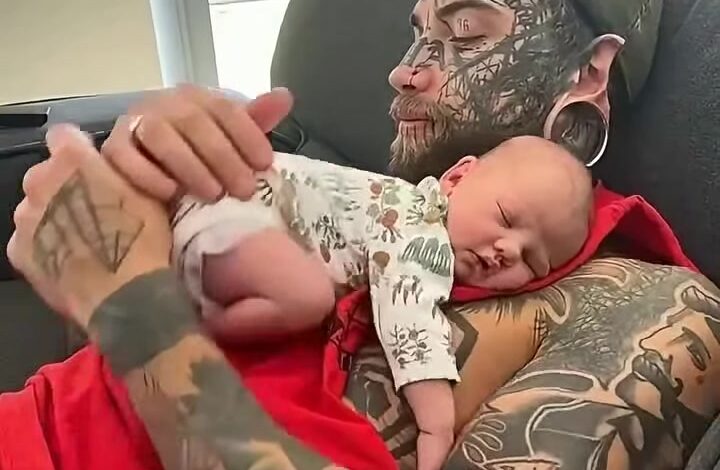
A 24-year-old father became widely recognized because tattoos covered almost every visible part of his body. More than 200 individual designs extended across his face, head, neck, torso, arms, and legs, making his appearance impossible to ignore. For years, the tattoos were not decoration added casually; they were a central part of the identity he presented to the world.
The arrival of his baby daughter changed the way he viewed that identity. Parenthood did not instantly make him ashamed of his past, nor did the child ask him to look different. She was too young to understand the public attention surrounding his appearance. The decision came from him as he began imagining the future they would share.
He thought about ordinary family moments: taking his daughter to school, appearing in photographs with her, meeting her teachers, and being present at events that would matter to her. He also considered how strangers might react before learning anything about him as a father.
That reflection led him to begin removing the tattoos. The process was presented as something he chose for his daughter, a visible sign that becoming a parent had changed his priorities. It was not a declaration that every tattooed parent should do the same, and it did not suggest that body art prevents someone from loving a child.
Removing extensive tattoos is not an instant transformation. Laser treatment typically requires repeated sessions, and heavily tattooed skin may need a long period of care. Different colors and depths can respond differently. The work can also be uncomfortable and expensive, especially when tattoos cover such a large portion of the body.
For this father, the commitment involved more than sitting through one dramatic makeover. Each session represented another step away from the appearance he had spent years building. The contrast between earlier photographs and his later look attracted attention online, but the emotional meaning came from the reason he gave for making the change.
Parenthood often forces people to examine decisions that once seemed permanent. Some change their work schedule, leave unhealthy habits, repair family relationships, or reconsider the way they want to be seen. His decision happened to be written across his skin, so the internal reassessment became unusually visible.
The story should not be interpreted as proof that tattoos make a person dangerous, irresponsible, or unfit to raise a child. Appearance alone does not measure patience, protection, or affection. A loving father can be heavily tattooed, completely untattooed, or anywhere between those two extremes.
What made this account resonate was personal agency. Nobody forced him to erase the tattoos. His daughter did not issue a condition for loving him. He looked at the life ahead and decided that changing his appearance matched the father he wanted to become.
That distinction separates sacrifice from shame. Shame would mean believing his existence had become unacceptable. Sacrifice means choosing a difficult process because he believed it would benefit someone he loved. The same physical act can carry very different meaning depending on why it is undertaken.
His earlier tattoos also remain part of his history even as they fade. Removing ink cannot remove the experiences, choices, or years associated with it. Instead, the before-and-after photographs document two stages of the same person: the young man who created a striking visual identity and the father who later decided to alter it.
Public reaction naturally focused on how different he looked. Viewers compared images, counted the tattoos, and expressed surprise that someone known for such an extreme appearance would reverse course. Yet the most important change was not simply a clearer face or untreated skin. It was the shift in perspective that occurred when another person’s future became central to his decisions.
His daughter will eventually grow old enough to understand the story. She may view the removal as an extraordinary gesture, or she may simply know him as the father who was present in her life. Either way, the lasting value of the decision will depend less on his skin than on the care he provides.
The transformation became a symbol because it was visible, but responsible parenthood is proved through years of ordinary actions. Changing diapers, offering comfort, setting boundaries, listening, and remaining dependable will shape his daughter more deeply than any tattoo or removal procedure.
His appearance drew the world’s attention, but his motivation kept it. A man once defined publicly by more than 200 tattoos chose to redefine himself after becoming a father. The result was not the destruction of his former identity; it was a decision about which part of himself he wanted his daughter to see as they moved into the future together.