A Simple Family Photograph from 1872 Hid a Detail No One Noticed for Generations
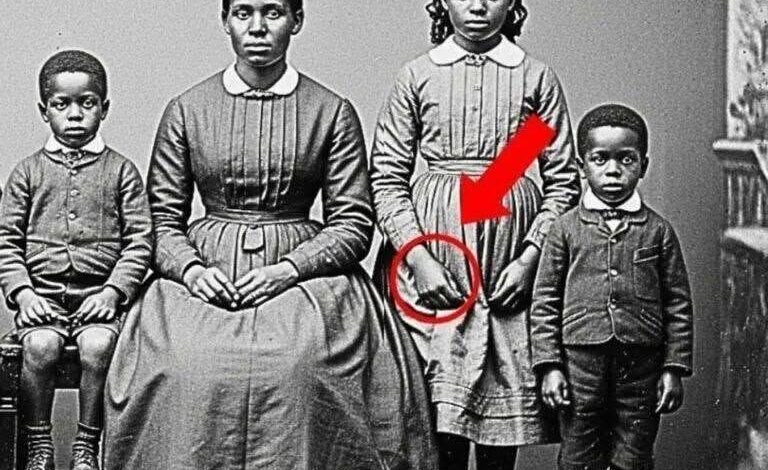
At first glance, the family photograph looks like an ordinary portrait from another century. A mother sits in the center, her three children arranged close beside her. Their clothes are formal, their expressions serious, and their stillness gives the picture the familiar dignity of an old studio photograph. It is presented as dating from 1872, a moment preserved long after the people in it disappeared from living memory.
Then attention shifts to the older daughter’s hand. Near the folds of her dress, a small arrangement of fingers appears difficult to explain. What seemed straightforward becomes strangely ambiguous. Some viewers see a hand that does not seem to belong where it is resting. Others think there may be an extra set of fingers, or an overlap that makes one person’s hand look detached from the rest of the body.
The detail is easy to miss when looking at the whole family. Once someone points it out, however, it becomes the first place the eye returns. The mother’s face, the children’s clothing, and the balanced composition recede into the background. A tiny portion of the photograph begins to determine the way the entire scene is understood.
One possible explanation is simply the arrangement of the family. A mother’s hand resting behind or beside a child can be partly hidden by fabric. The visible fingers may appear separated from an arm that the clothing conceals. A child’s own hand, bent at an unfamiliar angle, can also look unusual when reduced to a small area of a faded photograph.
Light and shadow complicate that reading. Dark material can hide the edge of a wrist, while a brighter patch emphasizes fingers without revealing what connects them. In a monochrome image, the eye cannot rely on skin color and fabric color as easily as it might in a modern photograph. Similar tones can blend together, making a normal overlap seem physically impossible.
The photographic process offers another avenue of explanation. Portrait photography in the nineteenth century could require subjects to remain still for longer than modern viewers expect. Movement during an exposure could blur a hand or soften its edges. Photographers also arranged their subjects carefully, sometimes using supports to help them maintain a pose. These practices can make old portraits look stiff or unfamiliar without suggesting anything sinister.
Some viewers have proposed a double exposure or another photographic artifact. That remains a possibility raised in discussion, not an established finding about this particular image. Without examining an original print, its provenance, and the photographic materials involved, it is difficult to distinguish an exposure effect from damage, reproduction quality, or an ordinary arrangement of hands.
There is also the way human perception works. We are quick to recognize faces and bodies, but we sometimes complete uncertain shapes incorrectly. When part of an arm is hidden, the mind supplies a connection. If that imagined connection does not fit, the result can feel unsettling. A suggestion that something is wrong may make that impression stronger each time the picture is revisited.
The photograph’s reported age adds to its atmosphere, but age is not an explanation. The names of the family members, the location of the portrait, and the history of the original print are not supplied with a documented answer to the hand mystery. Those gaps should remain gaps rather than becoming invented stories about what happened to the family.
For now, the image invites close observation more than certainty. The unusual hand may ultimately have a simple explanation involving position, fabric, light, or the limits of an old photograph. What gives the portrait its lasting fascination is that a family scene can seem entirely familiar until one small detail makes viewers stop, look again, and question their first impression.