He Gave Away His Last Twenty Dollars, Days Later His Own Daughter Came Back to Take Everything
Walter Hensley had lived long enough to understand that life rarely gave without taking something in return. So when he handed over his last twenty dollars to a stranger outside Mason’s Grill, he didn’t expect anything back. Not gratitude. Not recognition. Certainly not what came next.
That night, he returned to his small apartment on Willow Street, where silence greeted him the same way it always did. The place was clean but worn down, like a life that had been slowly reduced to the essentials. A single chair near the window. A heater that barely worked. Cupboards that echoed when opened.
He sat down, feeling the familiar weight of uncertainty settle in. He had just made the coming days harder for himself. But beneath that worry, there was something else—something steady. He hadn’t lost the part of himself that still recognized another person’s pain.
Across town, the biker sat inside the diner, staring at the plate of food he had just ordered. His name was Reed Calloway, though most people called him Stone. He had spent years being judged before he even spoke, labeled by his appearance, his past, his silence. But never in all those years had someone given him something that cost them everything.
He looked down at the twenty-dollar bill in his hand. It wasn’t just money. It was sacrifice.
And he couldn’t keep it.
Instead of eating, Reed boxed the meal and went back outside.
But the old man was gone.
Something in Reed shifted then—a sense of urgency he hadn’t felt in years. He asked around, followed vague directions, and spent hours searching through quiet streets until he finally stood in front of a worn apartment door labeled 4C.
When Walter opened the door, surprise flickered across his face.
“You found me,” he said.
Reed held up the bag of food. “Didn’t feel right letting your story end out there.”
That simple moment became the beginning of something neither of them expected.
Reed stepped inside and immediately noticed the truth Walter had tried to hide. The near-empty shelves. The cold creeping through the cracks in the window. The kind of quiet that didn’t come from peace, but from survival.
Without asking for permission, Reed left and returned with more. Groceries. Supplies. A better heater. And then, something even bigger.
Within hours, the street outside Walter’s apartment filled with motorcycles.
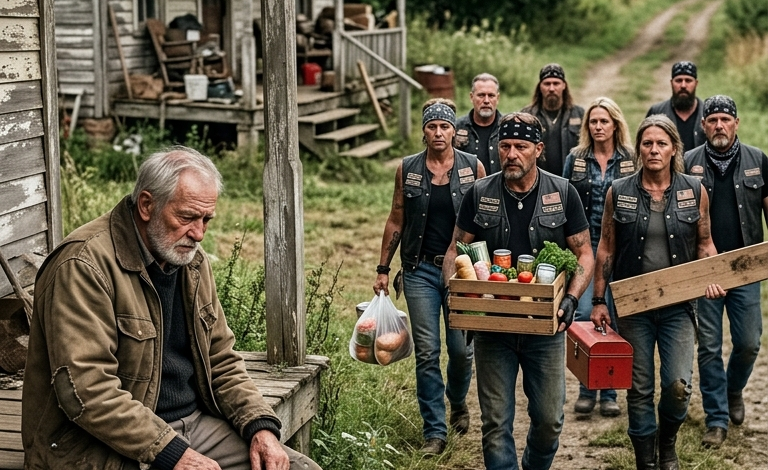
Neighbors peeked through curtains as one biker after another arrived—not with noise or chaos, but with purpose. They carried tools, food, blankets, light bulbs. They fixed broken windows, sealed drafts, stocked shelves. No speeches. No pity. Just action.
Walter sat quietly, watching strangers rebuild pieces of his life he had slowly learned to live without.
“Why are you doing this?” he finally asked.
Reed looked at him, steady and certain. “Because you gave me your last twenty dollars.”
But what started as kindness soon uncovered something darker.
As Reed and his friends continued visiting Walter, they began to notice patterns. Missing money. Confusing bank statements. Payments Walter didn’t remember approving. At first, he brushed it off, blaming age, memory, simple mistakes.
Until the truth could no longer be ignored.
His own daughter had been taking from him.
Not all at once. Not in ways that would draw attention. But slowly, carefully, draining what little he had left while pretending to “help.”
The realization broke something inside him—not loudly, not dramatically, but in a quiet, painful way that only betrayal from family can cause.
The confrontation came days later.
She walked into his apartment angry, defensive, already prepared to argue. But this time, Walter wasn’t alone. Reed stood nearby. So did others who had come to see him not as a burden, but as someone worth protecting.
When Walter placed the bank statements in front of her, the silence said everything.
“You were supposed to help me,” he said, his voice calm but unshakable.
She tried to deny it. To twist it. To turn the blame back on him.
But something had changed.
Walter no longer looked like a man who could be controlled.
“No,” he said quietly. “You were managing me.”
And for the first time in a long time, he chose himself.
What followed spread beyond his apartment, beyond Willow Street, beyond anything either man could have imagined.
Neighbors spoke up. Others shared similar stories. The truth unraveled, exposing not just one betrayal, but a pattern that had been hiding in plain sight. With the help of Reed and his network, legal steps were taken. The stolen money was traced. The pressure from landlords and false “assistance” began to collapse.
But the biggest change wasn’t legal.
It was human.
The diner where it all began launched a simple idea—a community meal to support those in need. People showed up. Then more came. Then even more. What started as one man’s quiet sacrifice turned into something bigger than anyone could control.
They called it Hensley’s Table.
Walter, who once sat alone counting his last dollars, now stood at the center of something alive. A place where no one was invisible. Where meals were shared, stories were heard, and dignity was restored.
Reed stayed close through it all.
Not out of obligation. Not out of debt.
But because somewhere along the way, the stranger who once stood outside a diner window had found something he didn’t realize he had been missing.
A reason to stay.
Months later, Walter sat again on the same bench outside Mason’s Grill. The air was cold, but not as harsh as before. Reed handed him a cup of coffee, and they sat in silence that no longer felt empty.
After a while, Walter reached into his coat and pulled out another twenty-dollar bill.
Reed sighed immediately. “Don’t tell me…”
Walter smiled and placed it quietly beside him.
“For the next person who needs it.”
Because some people lose everything and become bitter.
And some people lose everything—and still choose to give.