A Moment of Terror at Moscow Airport Aeroflot Plane Bursts Into Flames During Emergency Landing 41 People Lose Their Lives
Chapter 1: The Flight That Began Like Any Other — Before Disaster Struck
On the evening of May 5, 2019, passengers boarded an Aeroflot aircraft at Sheremetyevo International Airport in Moscow, Russia. For most of them, it was simply another scheduled journey. Some were returning home, others were traveling for work, and several were looking forward to seeing their families in the northern city of Murmansk.
The aircraft was a Sukhoi Superjet 100, operating as Aeroflot Flight SU1492.
Nothing about the boarding process suggested that the flight would become one of Russia's most devastating aviation accidents in recent years.
Passengers found their seats, placed their belongings in the overhead compartments, and prepared for departure. Flight attendants carried out their normal safety procedures, while the pilots prepared the aircraft for takeoff.
There were 78 people aboard: 73 passengers and five crew members.
Among the passengers were two children.
For the families traveling that evening, the journey was expected to be routine. Nobody could have imagined that within minutes, the aircraft would return to the same airport under emergency conditions.
A Departure That Quickly Turned Into an Emergency
The aircraft departed Sheremetyevo shortly after 6 p.m. local time.
Its destination was Murmansk, a city in northwestern Russia located above the Arctic Circle.
However, the flight did not proceed normally.
According to subsequent investigations and flight data, the aircraft encountered a lightning-related electrical disturbance shortly after departure. Several aircraft systems were affected, and the autopilot disconnected.
The aircraft's flight control system reverted to Direct Mode, meaning the pilots had to control the aircraft under a different set of operating conditions.
Radio communication problems also developed.
The situation was particularly challenging because the pilots were dealing with technical problems shortly after takeoff, when the aircraft was still carrying a substantial amount of fuel.
The crew decided to return to Moscow.
At this stage, the aircraft was still airborne, and the emergency had not yet become the disaster that would later dominate international headlines.
Passengers Begin to Realize Something Is Wrong
Inside the cabin, the atmosphere changed.
Passengers may initially have assumed that the aircraft was experiencing a minor technical problem.
A return to the departure airport is not automatically a sign of an imminent disaster. Aircraft sometimes return because of mechanical warnings, weather conditions, or other operational concerns.
However, as the aircraft turned back toward Sheremetyevo, uncertainty grew.
Some passengers reportedly noticed unusual movements and sounds.
Others became frightened as they realized the flight was returning much earlier than expected.
The cabin crew faced the difficult responsibility of maintaining order while preparing for an emergency landing.
The pilots needed to bring the aircraft safely back to the airport.
They also had to manage the aircraft's handling characteristics after the system malfunction.
The Importance of an Emergency Return
Returning to an airport after a technical problem is a standard safety procedure in aviation.
Pilots are trained to assess the aircraft's condition, communicate with air traffic controllers, and determine whether an immediate landing is necessary.
The decision depends on several factors, including aircraft control, fuel quantity, weather, runway availability, and the severity of the malfunction.
In the case of SU1492, the crew returned to Sheremetyevo.
However, the landing would prove far more dangerous than anyone on board could have anticipated.
The aircraft approached the runway under difficult conditions.
The flight crew had to manage the aircraft manually after the control system had reverted to Direct Mode.
The aircraft also carried a considerable amount of fuel, increasing the potential consequences if a serious landing accident occurred.
A Routine Journey Becomes an International Tragedy
The passengers had boarded expecting to reach Murmansk.
Instead, they were approaching the same airport from which they had departed only minutes earlier.
Outside, airport personnel were preparing to respond to the emergency.
Inside, passengers remained dependent on the pilots and cabin crew.
The aircraft was approaching the most critical stage of the incident.
What happened next would determine whether the passengers could escape safely.
The plane touched down hard.
It bounced.
And within seconds, a violent chain of events began that would turn the runway into a scene of fire, smoke, and desperate evacuation.
The emergency landing had become a catastrophe.
Flightradar24 Blog +2
Chapter 2: The Terrifying Landing — When the Aircraft Suddenly Burst Into Flames
At approximately 6:30 p.m. local time, Aeroflot Flight SU1492 approached the runway at Sheremetyevo Airport.
The aircraft was returning after experiencing serious technical difficulties.
For the passengers, the landing should have represented the end of a frightening emergency.
Instead, it became the most dangerous moment of the entire flight.
The aircraft descended toward the runway, but its touchdown was extremely hard.
It struck the ground and bounced back into the air.
The pilots attempted to regain control and bring the aircraft down again.
But the landing sequence became increasingly violent.
Three Touchdowns Changed Everything
According to the subsequent accident investigation, the aircraft made three significant runway contacts.
The first touchdown produced a powerful impact, and the aircraft bounced.
During the second touchdown, the nose landing gear struck the runway, producing an even more severe impact.
The aircraft bounced again.
During the third touchdown, the landing gear collapsed and structural damage occurred.
The wing structure and fuel tanks were damaged, allowing fuel to escape.
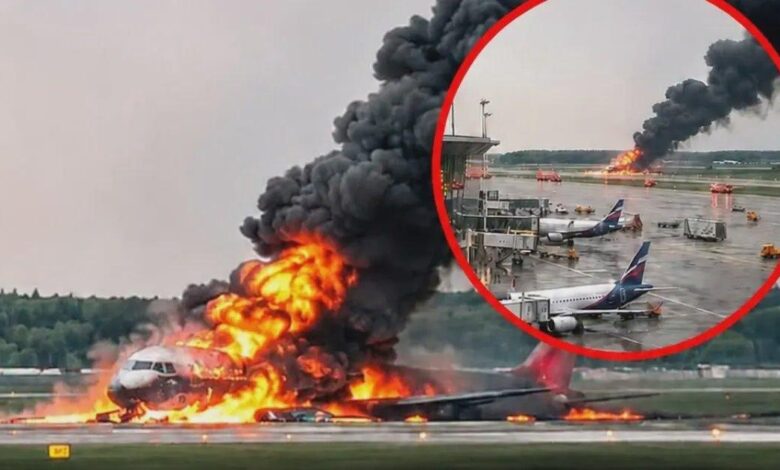
The spilled fuel ignited, producing a rapidly spreading fire.
The aircraft eventually came to a stop beside the runway.
Within moments, flames and thick black smoke surrounded much of the aircraft.
The passengers were no longer simply waiting for an emergency landing to finish.
They were fighting to escape a burning airplane.
Fire Spreads Through the Aircraft
One of the most frightening aspects of the accident was the speed at which the fire developed.
The rear section of the aircraft became particularly vulnerable.
Investigators later determined that fire entered the rear cabin through windows after the aircraft's structure and fuel system were damaged.
The rear emergency exits became unusable.
This meant that passengers seated toward the back faced an increasingly dangerous situation.
The aircraft was no longer a safe environment.
Smoke reduced visibility, flames threatened the cabin, and people had only a limited amount of time to escape.
The front emergency exits became the critical route to survival.
A Race Against Time
When an aircraft catches fire after landing, emergency evacuation procedures become essential.
Cabin crew members are trained to direct passengers toward available exits and help them use emergency slides.
However, real emergencies are unpredictable.
Some exits may become blocked by flames, smoke, or structural damage.
Passengers may also become disoriented by the sudden noise, darkness, and confusion.
On Flight SU1492, the front exits were used to evacuate passengers.
The emergency slides deployed, allowing people to descend rapidly from the aircraft.
Some passengers escaped carrying children.
Others ran away from the burning aircraft as quickly as possible.
Airport emergency crews approached the scene to begin firefighting operations.
The Cabin Crew's Critical Role
During an aircraft emergency, cabin crew members have responsibilities that extend far beyond normal passenger service.
They must assess which exits are safe, give clear instructions, and encourage passengers to leave their belongings behind.
Seconds matter.
A passenger who stops to retrieve a handbag or suitcase may obstruct others trying to escape.
In a rapidly developing fire, even a short delay can have serious consequences.
The investigation later highlighted the danger of passengers retrieving hand luggage during evacuation.
The rear portion of the aircraft was particularly affected, and passengers needed to move toward the front exits.
The evacuation reportedly took approximately 55 seconds, according to contemporary accounts.
However, the speed of evacuation could not prevent every loss of life.
CAPA +2
The Airport Becomes a Scene of Emergency
Firefighters and rescue personnel rushed toward the aircraft.
Airport operations were disrupted as emergency teams worked to control the fire and assist survivors.
Vehicles moved across the airport grounds, while medical personnel prepared to receive injured passengers.
The heavy smoke could be seen rising above the airport.
For people watching from the terminal, the scene was deeply disturbing.
A passenger aircraft that had departed only minutes earlier was now severely damaged and engulfed in flames.
Emergency workers continued their efforts as the fire spread through the rear section.
The rescue operation was complicated by the condition of the aircraft and the presence of burning fuel.
The Human Cost Becomes Clear
As the emergency operation continued, the scale of the disaster became increasingly apparent.
Not everyone had managed to escape.
Families and friends waited desperately for information about those who had been on board.
The initial reports of casualties changed as investigators and emergency authorities established the final figures.
Eventually, Russian authorities confirmed that 41 people had died.
The victims included two children and one member of the crew.
Thirty-seven people survived.
The tragedy was no longer simply an aircraft emergency.
It had become a devastating loss for dozens of families.
Chapter 3: The Desperate Escape — 37 People Survive as 41 Lives Are Lost
As the fire spread through the aircraft, the passengers who remained alive faced an extraordinary challenge.
They had to escape before the flames and smoke made the cabin impossible to survive.
For those seated near the front, the emergency exits offered a possible route to safety.
For people in the rear section, the situation was much more dangerous.
The fire had spread rapidly, and the rear part of the aircraft had suffered extensive damage.
The Emergency Slides Become a Lifeline
The emergency evacuation began almost immediately after the aircraft stopped.
Cabin crew members opened the available forward exits and deployed the inflatable slides.
Passengers moved toward the front of the aircraft.
The slides provided a way to descend quickly from the cabin to the runway.
In a normal evacuation, passengers are instructed to leave their belongings behind and move away from the aircraft as quickly as possible.
That instruction becomes especially important when fire is present.
A suitcase can block an aisle, slow down other passengers, and make an already dangerous evacuation even more difficult.
In this accident, the forward exits became the main escape route.
According to contemporary reports, the evacuation was completed in approximately 55 seconds.
That was a remarkable effort under extremely difficult circumstances.
However, the rapid evacuation could not save everyone.
CAPA +1
Why the Rear Section Was So Dangerous
The final investigation documented the severe effects of the fire on the rear cabin.
The aircraft's rear emergency exits were not available for normal evacuation.
Flames and smoke spread through the damaged section.
Many of the victims were located toward the rear of the passenger cabin.
The investigation also examined the effects of smoke inhalation and toxic combustion products.
In an enclosed aircraft cabin, smoke can become extremely dangerous.
Carbon monoxide interferes with the body's ability to transport oxygen.
Other combustion products can further damage the respiratory system and reduce a person's ability to respond.
As smoke spreads, people may become confused, lose coordination, or become unconscious.
This can happen even before flames physically reach them.
The final report found evidence of exposure to smoke and combustion products among victims.
It also documented the severe thermal damage sustained by the aircraft.
The Passengers Who Managed to Escape
Thirty-seven people survived the accident.
Some suffered serious injuries, while others experienced less severe physical injuries.
For survivors, escaping the aircraft was only the beginning of a difficult experience.
They had witnessed a frightening emergency, lost fellow passengers, and faced the possibility of dying during what should have been an ordinary domestic flight.
Emergency personnel provided medical assistance and transported injured people for treatment.
Families began searching for information about their loved ones.
At the airport, uncertainty and grief spread among those waiting for news.
The survivors had escaped the immediate danger, but the emotional impact of the accident would not necessarily disappear when the physical injuries healed.
The Two Children Among the Victims
Among the 73 passengers were two children, aged 11 and 12.
Both lost their lives.
Their deaths made the tragedy especially painful for the families affected.
An aircraft accident does not only involve statistics.
Every passenger has a personal story, relationships, responsibilities, and people waiting for their return.
The loss of 41 lives left families facing questions that no official investigation could fully answer.
The accident also affected members of the crew.
One cabin crew member was among those killed.
The Firefighters Arrive
Airport firefighters responded as the aircraft burned.
The official investigation documented the movement and arrival times of the emergency vehicles.
The first airport firefighting vehicle reached the accident site at approximately 15:32:07 UTC and immediately began extinguishing the fire.
Additional vehicles arrived over the following minutes.
Their task was difficult because the aircraft had already sustained substantial structural damage and the fire was spreading through the fuselage.
Fire crews needed to control the flames while avoiding additional danger to survivors and rescue personnel.
The operation required coordination among airport emergency services, medical teams, and other personnel.
The Aftermath on the Runway
Once the fire was brought under control, the full extent of the damage became visible.
The rear of the aircraft had been severely destroyed.
The fuselage showed extensive burn damage, and debris was scattered around the accident site.
Investigators began documenting the wreckage.
They needed to determine exactly how the aircraft had struck the runway, how the landing gear had failed, and how the fire had developed.
The aircraft's flight recorders were particularly important.
They contained information about the aircraft's systems, movements, and cockpit communications.
These records would eventually help investigators reconstruct the final moments of the flight.
For the survivors and the families of those who died, however, the most important question remained painfully simple:
How could an aircraft carrying ordinary passengers return from a short flight and end in such a devastating disaster?
Chapter 4: The Investigation Reveals What Happened — Lightning, Flight Controls, and a Devastating Landing
After the immediate rescue operation ended, attention turned toward the investigation.
The authorities needed to establish what had happened during the flight and why the emergency landing resulted in such a severe fire.
Aviation accident investigations are complex.
They involve examining aircraft wreckage, analyzing flight recorder information, interviewing personnel, studying weather conditions, and reconstructing the aircraft's movements.
The objective is not simply to identify one individual to blame.
It is to understand the chain of events and determine what changes might prevent similar accidents.
The Aircraft Had Encountered Lightning
One of the important findings concerned the aircraft's encounter with atmospheric electricity shortly after takeoff.
The investigation established that the electrical disturbance affected aircraft systems.
The aircraft's autopilot disconnected, and the flight control system reverted to Direct Mode.
In this mode, the aircraft's handling characteristics differ from those in its normal operating mode.
The pilots must manage the flight using the available control inputs without some of the assistance provided by the normal flight-control system.
The investigation examined the electrical equipment and identified failures associated with the lightning-related disturbance.
This was a critical part of understanding why the aircraft returned to Moscow.
What Does Direct Mode Mean?
Modern aircraft use sophisticated electronic systems to translate pilot inputs into aircraft movements.
These systems can help stabilize flight and manage certain control functions.
When a system switches into a degraded operating mode, pilots may need to make more direct inputs.
This requires appropriate training and familiarity with the aircraft's handling characteristics.
The final investigation identified shortcomings in the training and preparation provided for certain Direct Mode operations.
In particular, the report found that the training programs did not adequately prepare the flight crew for some of the conditions encountered during the accident flight.
This finding raised important questions about simulator training and the ability of pilots to respond to unusual combinations of technical failures.
The Critical Landing Sequence
The aircraft approached the runway under challenging conditions.
The investigation examined the pilots' control inputs and the aircraft's movement during the final approach.
The flight data showed significant alternating pitch-control inputs.
These inputs affected the aircraft's movement during the flare and landing.
The aircraft made three hard runway contacts.
The impacts placed substantial loads on the landing gear and surrounding structures.
The final report concluded that the captain's uncoordinated pitch inputs during the landing flare and subsequent bounces were central to the accident sequence.
It also identified contributing organizational and operational factors, including training deficiencies and shortcomings in procedures.
This is an important distinction.
The final investigation did not simply describe the accident as an unexplained fire.
It reconstructed a sequence involving an electrical disturbance, degraded flight-control operation, difficult approach conditions, repeated hard touchdowns, structural damage, and fuel ignition.
airlineincidents.com +2
Why the Aircraft Caught Fire
The repeated impacts damaged the landing gear and wing structure.
The final landing impact caused the landing gear to collapse and damaged fuel-containing structures.
Fuel escaped from the damaged system.
The investigation examined possible ignition sources, including hot engine surfaces and sparks created by damaged structural components contacting the runway.
Once ignition occurred, the fire spread rapidly.
The rear section of the aircraft became engulfed in flames.
The report's analysis found that steady combustion developed no later than approximately 15:30:08 UTC.
Within seconds, the rear portion of the aircraft was heavily affected.
After the aircraft stopped, the fire continued moving from the rear toward the front.
The Role of Weather and Wind Conditions
Weather was another important part of the investigation.
The aircraft had encountered atmospheric electricity, and the approach involved challenging conditions.
The final report examined wind conditions and a predictive windshear warning.
Windshear occurs when wind speed or direction changes over a relatively short distance.
It can affect an aircraft's airspeed, lift, and flight path, particularly during takeoff and landing.
The report identified the crew's response to the windshear warning as one of the factors relevant to the accident.
This illustrates why aviation safety depends on several systems working together.
Aircraft technology, weather information, pilot training, operating procedures, and decision-making all contribute to safe flight operations.
The Final Investigation Report
The Interstate Aviation Committee's final report provided a detailed reconstruction of the accident.
The report examined:
The aircraft's technical condition.
The lightning-related electrical disturbance.
Flight-control system operation.
Pilot training.
Weather and windshear.
Landing performance.
Structural damage.
Fire development.
Passenger evacuation.
Emergency response.
The investigation also considered factors affecting survival.
One particularly important finding concerned passengers retrieving hand luggage during evacuation.
Investigators concluded that this behavior likely increased the number of fatalities by slowing movement toward the available exits.
Why the Findings Matter
The investigation demonstrated that major aviation accidents rarely have one simple explanation.
A technical failure may initiate an emergency, but the outcome can depend on how the aircraft is handled, how procedures are followed, how the structure responds to impact, and how quickly passengers escape.
The lessons from Flight SU1492 therefore extend beyond one aircraft or one airport.
They concern the entire aviation safety system.
Chapter 5: Lessons From the Disaster — How One Accident Changed the Conversation About Aviation Safety
The tragedy of Aeroflot Flight SU1492 did not end when the flames were extinguished.
In the months and years that followed, investigators, aviation specialists, airlines, and safety organizations continued examining the accident.
The central question was no longer simply what had happened.
It was what could be learned from the disaster to prevent another aircraft from experiencing the same chain of events.
The accident highlighted several important areas of aviation safety, including pilot training, emergency procedures, aircraft design, fire protection, and passenger behavior during evacuation.
1. Why Pilot Training Became a Major Focus
One of the most important lessons concerned the aircraft's transition into Direct Mode.
The final investigation identified shortcomings in the training provided for pilots dealing with certain degraded flight-control conditions.
A pilot may be highly experienced in normal operations but still face considerable challenges when an aircraft suddenly behaves differently from what is expected.
Emergency situations can require rapid decisions under intense pressure.
Training must therefore prepare crews for unusual combinations of technical failures, difficult weather, and challenging landing conditions.
The investigation highlighted the need for more effective preparation for Direct Mode operations and other abnormal situations.
This does not mean that every accident can be prevented through training alone.
However, better preparation can improve a crew's ability to respond when several problems occur simultaneously.
2. The Importance of Following Emergency Procedures
The accident also demonstrated why aviation procedures are designed to provide pilots with clear guidance during abnormal situations.
During an emergency, pilots must assess the aircraft's condition and decide whether to continue flying, return to an airport, or divert elsewhere.
They must also consider weather conditions, runway availability, aircraft handling, and the possibility of further system failures.
When an aircraft has lost some of its normal flight-control functions, the approach and landing may require additional caution.
The final investigation examined the crew's decisions during the return flight, including the approach and response to weather-related warnings.
These findings reinforced the importance of clear operating procedures and effective decision-making.
3. Why Passengers Must Leave Their Belongings Behind
Another important lesson concerns passenger behavior during emergency evacuations.
When an aircraft catches fire, every second matters.
Passengers may instinctively want to retrieve their phones, handbags, passports, or suitcases.
These belongings may contain valuable personal information and important documents.
However, stopping to collect them can create dangerous delays.
A passenger standing in an aisle to retrieve luggage may prevent several other people from reaching an exit.
Even a short obstruction can become serious when smoke and flames are spreading.
The final investigation of SU1492 identified the retrieval of hand luggage as a factor that likely increased the number of fatalities.
This finding reinforces a basic but critical safety instruction:
Leave everything behind and evacuate immediately when instructed.
Passengers should follow cabin crew directions, move toward available exits, and continue away from the aircraft after reaching the ground.
Flightradar24 Blog +1
4. Airport Fire and Rescue Services Must Be Prepared
Airport firefighting teams have specialized responsibilities.
Their work is different from ordinary building firefighting because aircraft accidents involve additional hazards.
These include:
Large quantities of aviation fuel.
Pressurized aircraft systems.
Rapidly spreading fires.
Toxic smoke.
Damaged aircraft structures.
Limited access to passenger compartments.
Airport fire crews use specialized vehicles and equipment designed to reach aircraft quickly and apply firefighting agents.
The official investigation documented the emergency vehicles involved in the Sheremetyevo response and their arrival times.
The first recorded firefighting vehicle reached the aircraft at approximately 15:32:07 UTC.
Additional vehicles followed.
This information became part of the investigation into emergency response performance.
The accident demonstrated why airport rescue services must maintain effective communication, equipment readiness, and coordinated procedures.
5. The Importance of Aircraft Fire Protection
Aircraft manufacturers must consider what happens not only during normal flight but also when an aircraft experiences severe structural damage.
Fuel tanks, landing gear, electrical systems, engines, and passenger cabin materials all play roles in accident survivability.
In the case of SU1492, the landing impacts damaged the aircraft structure and fuel system.
The resulting fire spread rapidly into the rear cabin.
Investigators examined how the fire started, how it developed, and how the aircraft's structure responded.
These findings are important for evaluating aircraft certification standards and identifying opportunities to improve fire protection.
The goal of aviation safety research is to reduce both the likelihood of an accident and the consequences if one occurs.
6. The Final Report Published in 2025
An important development came in April 2025, when the Interstate Aviation Committee released its final investigation report.
The document provided a detailed technical account of the accident.
It examined the aircraft's systems, flight data, pilot actions, weather conditions, landing sequence, fire development, and evacuation.
The findings also addressed training deficiencies and other contributing factors.
The report was prepared primarily to help prevent future accidents rather than to determine criminal or civil liability.
This distinction is important.
An aviation investigation aims to identify safety problems and recommend improvements.
Separate legal proceedings may address questions of responsibility.
7. Remembering the 41 Victims
Behind the technical findings are the people who lost their lives.
Forty-one people died in the accident.
Among them were 40 passengers and one crew member.
The passengers included two children, aged 11 and 12.
Thirty-seven people survived.
Each of the victims had a life beyond the flight: families, friendships, plans, and personal dreams.
For their loved ones, the tragedy was not an aviation statistic.
It was a loss that changed their lives permanently.
Remembering the victims is an important part of understanding the human consequences of aviation accidents.
It also explains why safety improvements matter so much.
The Lasting Message of Flight SU1492
Aeroflot Flight SU1492 was scheduled to travel from Moscow to Murmansk.
Instead, it became a devastating accident involving a lightning-related systems disturbance, a difficult emergency return, repeated hard landings, structural damage, and a rapidly spreading fire.
The disaster claimed 41 lives and left 37 survivors.
Its investigation revealed important lessons about aircraft handling, pilot training, emergency procedures, fire protection, and passenger evacuation.
The most important lesson for travelers is straightforward.
When an emergency occurs, listen to the cabin crew, leave personal belongings behind, and evacuate as quickly as possible.
For aviation professionals, the message is equally important: safety depends on continuous training, effective systems, clear procedures, and learning from previous accidents.
Aviation has become one of the world's most important forms of transportation.
Millions of people depend on it every day.
The responsibility to make every journey as safe as possible never ends.