My Son Demanded My 68400 Dollar Truck and Later Tried to Claim My Mountain Estate
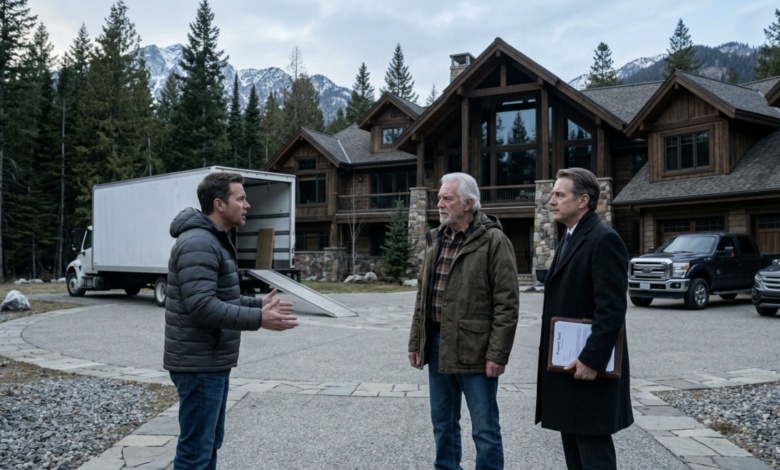
My Son Demanded the $68,400 Truck I Bought With My Own Retirement Savings. When I Refused, He Said, “Then Get Your Own Place Like a Grown Man.” I Was 65. I Packed That Night and Drove to the Northern Mountains. Eleven Years Later, He Arrived at My $4.85 Million Estate With a Moving Truck, Expecting to Inherit Everything. But He Had No Idea Whose Name Was Actually on the Property Title.
My son rolled up to my $4.85 million mountain estate with a heavy luxury SUV, a twenty-six-foot trailer, and a massive moving van shadowing him.
He hadn't dialed my number in eleven years.
Yet the exact moment his boots hit the gravel, he flashed a cold smile at his wife.
“I told you, Tiffany. The old man built a gold mine. We're finally home.”
I stood perfectly still on my porch, gripping the heavy cedar railing.
Garrett honestly thought he had tracked down a weak, aging father sitting on a fortune with absolutely nobody to protect him.
He didn't know I had been waiting in the dark for this exact possibility.
Eleven years earlier, I was a broken widower living in a quiet western town.
My name is Harrison Callahan. I had spent forty-five grueling years building heavy timber-frame homes.
My wife, Clara, and I were married for thirty-eight years. We had completely paid off our house near the local river and planned a quiet, peaceful retirement.
Then Clara passed away.
Two short weeks after we put her in the ground, Garrett and Tiffany started showing up with takeout dinners and masks of deep concern.
“Dad, sell your house and move in with us,” Garrett pressed softly. “We'll take care of you.”
Like a fool, I believed him.
I sold the only home I had left and gave them the entire $640,000.
Every last penny.
They bought a sprawling five-bedroom house in an upscale suburb, promising me a warm, private suite.
Instead, Tiffany walked me down to an unfinished basement storage room.
Cold concrete floor. One naked lightbulb hanging from a wire. A sagging, stained mattress.
Within a matter of weeks, I was mowing their grass, cleaning their heavy gutters, and handing Tiffany $200 every Friday just for groceries and basic utilities.
Once, Garrett actually locked the heavy basement door from the outside during a dinner party because he didn't want his slick business associates to know I lived there.
I sat in the dark downstairs, listening to the clinking glasses and laughter echoing above my head.
My blood and money had purchased every brick of that house.
Yet I was treated like an unwanted disease.
Then I bought my dream truck.
A heavy bronze Ford F-350 King Ranch.
Heated leather seats. A flawless, beautiful interior.
Exactly what Clara and I had mapped out to buy when I finally retired.
I paid $68,400 in cold cash from my pension savings.
That very evening, Garrett cornered me in the driveway.
“Dad, that truck would be much better for my business. Sign the title over.”
“No, Garrett. I'm keeping it.”
His face instantly turned to stone.
“Then take your truck and get your own place like a grown man.”
Tiffany stood silently beside him, her arms folded tight across her chest.
I didn't waste my breath arguing.
While I was quietly packing my bags downstairs, I heard their voices traveling through the metal heating vent.
“He'll come crawling back,” Garrett laughed coldly.
Tiffany replied, “Then make him sign over the truck before letting him stay.”
I picked up Clara's photograph, left my metal key flat on the kitchen table, and drove away into the night.
By morning, I was crossing the state line.
Eventually, I reached the cold northern mountains.
Two days later, I tried calling Garrett's phone.
He had blocked my number entirely.
For eleven agonizing years, absolute silence.
No birthdays. No Christmas calls. Not even a passing question about whether I was alive or dead.
Meanwhile, I bought forty-five acres of raw land in a secluded valley and lived out of a freezing camper.
I started restoring historic, heavy timber homes.
The winters were completely brutal, but wealthy ranch owners began quietly recommending my work.
My business steadily exploded.
Eventually, I built a 4,800-square-foot mountain lodge with massive Douglas fir beams, dark walnut floors, and enormous glass windows overlooking the eastern peaks.
The property was heavily valued at $4.85 million.
And now Garrett was standing right on my porch.
“Dad!” he shouted, moving in to hug me. “I've missed you so much!”
I kept my arms locked firmly at my sides.
Tiffany held out a cheap store-bought apple pie.
“We brought your absolute favorite.”
Her eyes were already wandering hungrily toward the massive house.
Garrett smiled a shark's smile.
“We sold everything back in our home state. We're moving here to take care of you permanently.”
I shot a look toward their heavy trailer.
Black garbage bags. Scratched, damaged furniture. A dented SUV displaying an expired temporary tag.
Tiffany's heavy diamond ring was missing from her finger.
Something was deeply, terribly wrong.
Inside, Garrett wasted no time bringing up the property valuation.
“Four point eight five million,” he said casually, testing the water.
I set down my black coffee.
“You haven't called in eleven years, but you somehow know my exact property value?”
His smile tightened into a thin line.
Then his phone rang in his pocket.
The bright screen displayed a ruthless financial recovery department out of a coastal city.
He quickly silenced the ringer.
“Telemarketers.”
Minutes later, a bright pink document slipped out of Tiffany's handbag.
She snatched it up immediately.
But I had already read the bold heading.
FINAL FORECLOSURE NOTICE.
Now their sudden, desperate arrival made complete sense.
I told them flatly they couldn't move into the main house.
Garrett protested loudly.
“Dad, you've got five empty bedrooms in there!”
I offered them exactly forty-eight hours in my heated guest bunkhouse.
They reluctantly agreed to the hard terms.
That afternoon, I caught Tiffany trying to force open my locked east-wing doors with a sharp metal nail file.
“What's in there?” she demanded.
“Something private.”
She stormed back downstairs.
Through the thick glass window, I watched Garrett whisper something dark into her ear.
Suddenly, she smiled.
That night, my hidden workshop security camera recorded them discussing their crushing debts in the dark outside the bunkhouse.
Garrett produced a thick packet of legal documents.
“Once he signs these, we're completely set.”
“What if he refuses to do it?” Tiffany asked nervously.
Garrett showed her something heavy he pulled from his pocket.
I watched the chilling recording twice.
Then I called my attorney.
The following morning, Garrett cheerfully offered to make my coffee.
Later, he slid a thick legal packet directly in front of me.
“Routine healthcare documents, Pop. Sign these so we can help manage things for you.”
Three bright yellow signature tabs marked the lethal pages.
“Why so many?” I asked quietly.
“Trust me. I'm your son.”
Tiffany stood silently behind my chair.
I picked up his heavy gold pen.
Garrett leaned in closer, his eyes cold.
“That's it, Dad.”
I glanced up at the wall clock ticking in the silence.
1:58 p.m.
Two minutes early.
Then heavy diesel engines rumbled aggressively up my gravel driveway.
Tiffany rushed over to the glass window.
Her face drained of all blood.
Outside stood several heavy vehicles, including a professional moving van and my attorney's silver SUV.
Garrett spun around.
“Dad, what's happening out there?”
I set down the gold pen.
And stood up completely straight.
I wasn't confused.
I wasn't helpless.
“Eleven years ago, you told me to get my own place,” I said, my voice like ice.
“I did exactly that.”
My attorney stepped firmly onto the front porch carrying a blue folder containing certified property records.
She handed Garrett the very first document.
He read it.
Then he read it again.
“Dad… this can't be right.”
Tiffany snatched the page violently out of his hand.
Her smile permanently vanished.
My attorney calmly opened the next document in the stack.
“There is something neither of you understood before arriving in the mountains.”
She pointed directly toward the name formally recorded on the heavy property title.
And when Garrett finally understood exactly who legally controlled the massive estate, he looked at me as though he were seeing his father for the very first time…
PART 2: Garrett stared at the document as though the paper itself had betrayed him. His fingers trembled slightly. Tiffany stood beside him, breathing heavily, her eyes moving from the property records to my face and then back to the attorney. “That's impossible,” Garrett finally whispered. My attorney, Margaret Ellis, adjusted her glasses. “I'm afraid it isn't. These are certified county property records. The forty-five acres, the main residence, the guest bunkhouse, the workshop, and every permanent structure on this property are legally owned by the Harrison Callahan Revocable Living Trust.” Garrett blinked. “A trust?” Margaret nodded. “Yes. And your father is the sole trustee and current beneficiary. He has full authority over the property and its assets.”
PART 3
Garrett slowly turned toward me.
“But… you’re my father.”
I almost laughed.
Not because anything was funny.
But because after eleven years of silence, that was the first thing he had found worth saying.
“Yes, Garrett. I am your father.”
“Then why would you put everything into a trust without telling me?”
I looked at him for several seconds.
“Because I learned something eleven years ago. Being someone’s father doesn’t mean I have to hand over everything I’ve worked for.”
Tiffany stepped forward.
“This is ridiculous. Garrett is your only son. Surely you understand that everything you own will eventually belong to him.”
Margaret closed the blue folder.
“Mrs. Callahan, inheritance is not something you can demand while the owner is still alive. Mr. Callahan has every legal right to decide what happens to his estate.”
Tiffany’s expression hardened.
“Are you saying he can leave his own son with nothing?”
Margaret looked directly at her.
“He can make whatever lawful estate-planning decisions he chooses.”
I watched Garrett’s face.
For eleven years, I had imagined what this moment might look like.
Sometimes I imagined him apologizing.
Sometimes I imagined him crying.
Sometimes I imagined him admitting that what he had done to me was wrong.
But I had never imagined him standing in my living room, furious because he had discovered that my property wasn’t automatically his.
“Dad,” he said, lowering his voice, “we need to talk privately.”
“No.”
His eyebrows tightened.
“Excuse me?”
“You had eleven years to talk to me privately. You chose not to.”
I walked toward the fireplace and picked up a framed photograph.
It was Clara.
She was standing beside our old house, smiling in the afternoon sunlight.
“Your mother would have been ashamed of how you treated me.”
Garrett looked away.
“Don’t bring Mom into this.”
“Why not? She was your mother too.”
Tiffany interrupted.
“Look, we didn’t drive all this way to argue. We came here because we’re family. We need somewhere to live, and you have more space than you could ever use.”
I turned toward her.
“Is that why you brought a moving truck?”
She hesitated.
“We sold our house.”
“Your house?”
Garrett cleared his throat.
“Things have been difficult.”
“How difficult?”
Neither answered.
Margaret opened her folder again.
“Mr. Callahan, before we continue, I think you should know that I received a call from a financial institution this morning. They were attempting to verify whether you had authorized a property-related transaction.”
Garrett’s face changed immediately.
“What transaction?”
Margaret looked at him.
“Apparently, someone submitted paperwork suggesting that Mr. Callahan intended to use this estate as collateral for a substantial loan.”
The room became completely silent.
I watched Garrett.
He didn’t look surprised.
He looked frightened.
I slowly placed Clara’s photograph back on the mantel.
“Garrett, would you like to explain that?”
He shook his head.
“I don’t know anything about that.”
Margaret reached into her briefcase and removed another document.
“This application contains a copy of Mr. Callahan’s identification, his property information, and a signature that appears to have been submitted as his authorization.”
Tiffany immediately grabbed Garrett’s arm.
“Don’t say anything.”
That was when I understood something.
They hadn’t simply come to visit their aging father.
They had come with a plan.
And the plan had started long before their SUV reached my driveway.
That afternoon, I asked Margaret to remain for another hour.
I wanted everything explained in front of Garrett and Tiffany.
Margaret placed the documents across the dining table.
There were three separate issues.
First, the property loan application.
Second, the documents Garrett had asked me to sign that morning.
And third, something much more disturbing.
A proposed durable power of attorney.
Garrett had prepared paperwork that would give him authority over certain financial and property decisions if I became unable to manage my affairs.
The papers were written in complicated legal language.
But their purpose was painfully simple.
They would give my son access to decisions involving my money.
And if I signed the documents, he could potentially use that authority to pursue financial transactions on my behalf.
“Garrett,” Margaret said calmly, “did you prepare these documents?”
He rubbed his forehead.
“I was trying to help my father.”
“Did you explain their contents to him?”
“He doesn’t understand all the legal language.”
Margaret’s expression became colder.
“That wasn’t my question.”
Garrett said nothing.
I sat back in my chair.
“Do you remember the coffee you made this morning?”
He looked at me.
“What?”
“You put that packet in front of me and told me it was routine healthcare paperwork.”
He swallowed.
“I didn’t mean anything bad.”
“Then why did you need me to sign it without reading it?”
Tiffany suddenly stood up.
“This is getting ridiculous. You’re making us sound like criminals!”
I looked at her.
“I haven’t called anyone a criminal.”
“That’s exactly what you’re implying!”
“No. I’m asking why my son brought documents to my home that he refused to explain.”
Margaret quietly collected the papers.
“Until these matters are reviewed, I strongly recommend that neither of you attempt to access any financial accounts, property records, or legal documents belonging to Mr. Callahan.”
Garrett laughed bitterly.
“So that’s it? You’re just going to let your attorney turn you against your own family?”
I looked at him.
“Garrett, nobody turned me against you. You did that yourself.”
His face went red.
Then he slammed his palm against the table.
“You think you’re some kind of millionaire now? You think because you built a fancy house in the mountains, you’re better than everyone?”
I remained seated.
“No. I think I’m a man who worked hard, lost his wife, lost his home, and spent eleven years rebuilding his life.”
I paused.
“And I think you should be grateful I still allowed you through my front door.”
He stared at me.
For a moment, I saw the little boy he used to be.
The boy who followed me around the workshop carrying a toy hammer.
The boy who once fell asleep on my chest during a thunderstorm.
The boy I had carried on my shoulders through the county fair.
Then the memory disappeared.
Because the man standing in front of me was no longer that little boy.
At approximately five o’clock, Margaret received a telephone call.
She stepped into the hallway to answer it.
When she returned, her expression was serious.
“Harrison, I think we need to discuss the moving truck.”
Garrett immediately looked toward her.
“What about it?”
Margaret ignored him and addressed me.
“The company that owns the moving truck contacted my office. They received instructions to deliver the contents of the vehicle to this property. However, the payment authorization appears to be connected to an account currently under financial investigation.”
Garrett jumped up.
“That’s none of your business!”
Margaret didn’t flinch.
“It became my business when someone attempted to use my client’s property information in a financial application.”
Tiffany started crying.
Not loudly.
Just enough to attract attention.
“Garrett, I told you this was a terrible idea.”
He turned toward her.
“Shut up.”
Those two words revealed more than either of them intended.
I looked at Tiffany.
“What’s happening?”
She wiped her cheeks.
“We lost the house.”
Garrett stared at her.
“Tiffany!”
She continued anyway.
“We lost everything. The bank took the house. His business collapsed. We sold our furniture, jewelry, and almost everything we owned.”
I looked toward the missing diamond ring.
“And the ring?”
She lowered her eyes.
“I sold it.”
For the first time since they arrived, I felt something resembling pity.
Not satisfaction.
Not happiness.
Just pity.
Because eleven years earlier, I had been standing in a basement with a stained mattress, wondering how my own son could treat me like an unwanted burden.
Now he was standing in my home, facing the consequences of his own decisions.
I asked one question.
“Why didn’t you call me?”
Tiffany looked at Garrett.
He remained silent.
“Why didn’t either of you call me when things started falling apart?”
Garrett finally answered.
“Because we knew you’d say no.”
I nodded slowly.
There it was.
The truth.
They hadn’t avoided me because they were ashamed.
They had avoided me because they believed I was no longer useful.
That evening, I allowed them to remain in the guest bunkhouse for one final night.
Not because I trusted them.
Because I wanted Margaret to finish reviewing the documents before making any decisions.
At around nine thirty, I went into my workshop.
The smell of cedar and fresh-cut Douglas fir surrounded me.
I had built that workshop with my own hands.
Every beam represented a contract I had completed.
Every tool represented another year of hard work.
On the workbench sat an old wooden toy truck.
I had carved it for Garrett when he was seven.
He had loved it so much that he carried it everywhere.
I ran my fingers across the small wooden wheels.
Then I heard footsteps behind me.
“Dad?”
Garrett stood in the doorway.
He looked smaller than he had that afternoon.
His expensive-looking jacket was wrinkled, and his eyes were red.
“Can we talk?”
I didn’t turn around immediately.
“What do you want to talk about?”
“Everything.”
I placed the toy truck down.
“Then talk.”
He stepped inside.
“I know I made mistakes.”
I remained silent.
“I was under pressure back then. The business wasn’t doing well. Tiffany and I had bills. I thought you could help us.”
“You already had my entire house.”
“I know.”
“You had $640,000.”
“I know, Dad.”
“And you wanted my $68,400 truck.”
He lowered his head.
“I was wrong.”
I finally turned toward him.
“Do you know what hurt the most?”
He shook his head.
“When I left that house, I called you two days later. I wanted to hear your voice. I wanted to know whether you were angry. I wanted to believe that maybe, just maybe, you regretted what happened.”
Garrett’s eyes filled with tears.
“But you had blocked my number.”
He looked down.
“I was angry.”
“You were angry because I wouldn’t give you my truck?”
He didn’t answer.
I walked toward the large workshop window.
Outside, the mountains were disappearing into darkness.
“I spent eleven years wondering whether you were safe. Whether you had children. Whether you were happy. Whether you ever thought about me.”
My voice became quieter.
“And you spent those same eleven years never asking whether I was alive.”
Garrett wiped his face.
“I’m sorry, Dad.”
I closed my eyes.
Those words were ones I had wanted to hear for eleven years.
But hearing them now didn’t erase anything.
“Why did you come here, Garrett?”
He hesitated.
Then he said something that changed the entire conversation.
“Because someone told us you were getting older and that you had no one to inherit your estate.”
I stared at him.
“Who told you that?”
He swallowed.
“A man who used to work with Tiffany’s brother. He said you had become extremely wealthy. He said you were living alone and had never remarried.”
“And?”
Garrett took a breath.
“He said if we came back and made things right, you might leave everything to me.”
I nodded slowly.
“So you came because you thought I was dying?”
“No!”
“Because you thought you could inherit my estate?”
“Dad, that’s not what I—”
“Then tell me what you came for.”
He looked toward the floor.
And for several seconds, he couldn’t speak.
Finally, he whispered:
“We had nowhere else to go.”
I looked at him.
At the son I had once carried on my shoulders.
At the man who had once locked me in a basement.
And I realized something painful.
He hadn’t returned because he missed his father.
He had returned because he needed somewhere to live.
The next morning, Margaret arrived earlier than expected.
She brought a second attorney, a property records specialist, and a thick envelope.
Garrett and Tiffany were waiting outside the bunkhouse.
When they saw the group approaching, Garrett immediately walked toward them.
“Are we finally going to settle this?”
Margaret stopped in front of him.
“We are going to settle one matter today.”
She handed me the envelope.
Inside was a complete copy of the financial application submitted using my property information.
I read through the pages.
Then I reached the final attachment.
It was a photograph of a document containing a signature that looked remarkably similar to mine.
But I had never signed it.
I looked at Margaret.
“Where did they get this?”
She answered carefully.
“That is exactly what we intend to establish.”
Garrett’s face turned pale.
Tiffany began shaking her head.
“No. No, this isn’t happening.”
I looked at both of them.
“What else have you done?”
Neither spoke.
Then Margaret placed one final document on the table.
It wasn’t a loan application.
It wasn’t a power of attorney.
It was a document concerning the ownership of my original $640,000 house proceeds.
And as I read the first paragraph, my hands began to tremble.
Because the money I had given Garrett and Tiffany eleven years earlier had not simply disappeared.
A portion of it had been transferred into an account connected to a company that still existed.
A company whose name I recognized.
Callahan Ridge Holdings.
The company I had created years after arriving in the mountains.
I looked up at Garrett.
“Why is my company’s name connected to your old financial records?”
He took one step backward.
And for the first time since arriving at my estate, my son looked genuinely terrified.
Because the biggest secret had not yet been revealed.
PART 4
Garrett took another step backward.
For several seconds, nobody spoke.
The only sound was the wind moving through the tall pine trees outside my workshop.
I held the document in my hands.
“Garrett, I’m going to ask you one more time. Why is my company’s name connected to your old financial records?”
He looked at Tiffany.
She looked away.
Margaret quietly placed another folder on the table.
“Harrison, before you make any decisions, I think you should understand what we discovered.”
She opened the folder.
“Callahan Ridge Holdings was established seven years ago. Your son appears to have attempted to use the similarity between your company name and his previous business records to support a financial application.”
I frowned.
“Are you saying he used my company’s name?”
“That’s what the preliminary documents suggest. However, we will need the appropriate authorities to investigate the signatures, transfers, and communications before reaching a final conclusion.”
Garrett suddenly raised his voice.
“I never stole anything from him!”
Margaret looked at him.
“Nobody has asked you to confess to anything. But you will have an opportunity to explain the documents through the proper legal process.”
I slowly sat down.
I was sixty-five when I left my old home.
I was seventy-six now.
I had spent eleven years rebuilding my life, and somehow, my son had found a way to bring the same old pain directly to my doorstep.
“Garrett,” I said quietly, “do you remember the $640,000?”
He nodded.
“That was the money I received when I sold the house your mother and I worked our entire lives to pay off.”
“I know.”
“I gave it to you because I believed you would give me a home.”
His eyes filled.
“I know, Dad.”
“No, I don’t think you do.”
I pointed toward the enormous windows overlooking the mountains.
“Everything you see here was built with what I had left. My hands, my tools, my experience, and a few thousand dollars I managed to save.”
I paused.
“I didn’t inherit this estate. Nobody handed it to me. I built it.”
Garrett lowered his head.
“And now you want it because you have nowhere else to go?”
He started crying.
“I’m sorry.”
This time, I didn’t respond.
Because apologies were easy.
Taking responsibility was much harder.