My sister said I was charging family for dirt so on the morning of her wedding I left Grandpa s name in the hay behind her altar
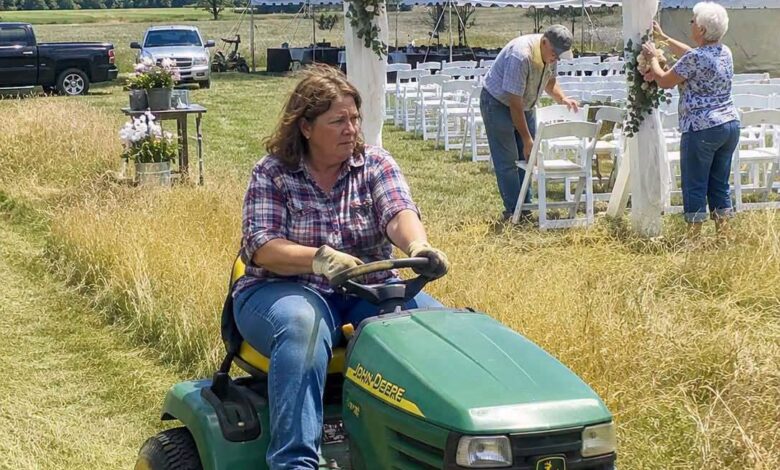
Grandpa left me the eighty-acre farm my sister wanted for her wedding. I gladly offered her the field, cleared the space, and sacrificed my first hay cutting. But when I asked her to cover the $1,400 tent rental, she told our mother I was making family pay to use the land. I covered the bill myself. Then, before sunrise on her wedding day, I mowed four enormous letters into the hay behind her altar. When she arrived in her wedding dress, the entire crowd was already staring.
I started mowing at four that morning.
The dew soaked my jeans almost to my thighs.
June timothy grass stood knee-high, its golden tips bending in the darkness.
I lowered the mower deck and drove slowly.
Behind me stood the white wedding arbor.
Two hundred folding chairs waited in damp rows, with two rental tents near the field's edge.
At two that afternoon, my sister Megan would marry Scott there.
Grandpa Earl had farmed those eighty acres for fifty-one years.
After our father abandoned us, Grandpa raised Megan and me.
When he died, he left the land to me because he trusted me to continue growing hay.
Megan had never been interested in farming.
But when she asked to hold her wedding there, I agreed immediately.
I cleared the ceremony area twice with the bush hog.
I also gave up the entire first cutting so the field would be ready for her guests.
I never expected payment for using Grandpa's property.
The only substantial expense was the tents.
The local rental company wanted $1,400.
"Could you and Scott handle that bill?" I asked Megan.
She frowned.
"Since we're using your farm, shouldn't that be your contribution?"
"Megan, I'm already providing the land. The tents are for your wedding. Just think about it."
"Fine," she answered.
But her tone told me she wasn't pleased.
Two days later, Mama called.
"Why are you making your sister pay to get married on the farm?"
I couldn't believe it.
"I'm not charging her for the property. I only asked her to pay the rental company for two tents."
Mama sighed.
"Megan called me in tears. She says you're charging your own family for dirt."
Dirt.
I sat down on the kitchen step.
That soil had fed our family after Dad left.
Grandpa had spent fifty-one years working it with his own hands.
And now Megan was calling it dirt.
"Maybe you should be generous," Mama suggested. "You're the one who inherited everything."
I didn't raise my voice.
That evening, I paid the $1,400 myself.
I refused to let two rental tents destroy my sister's wedding.
But I wasn't willing to pretend her words hadn't hurt.
Being kind didn't mean I had to accept being treated like a doormat.
And I knew exactly how to express what I felt.
The field itself could do the talking.
Behind the altar, tall hay remained standing.
It would appear in nearly every wedding photograph.
Two hundred guests would be facing it.
I didn't want to write anything insulting.
There was only one name I believed belonged on that land.
Four letters.
Each one forty feet high.
I began by cutting the rough outlines with the little Ford tractor.
Then I switched to the green lawn mower to sharpen the edges.
I wore Grandpa's old barn coat against the early morning chill.
Wet hay kept blocking the mower chute.
I had to stop repeatedly to clear it.
Before long, my fingers were stained green.
As the sun rose, its light fell across the enormous E and A already visible in the field.
By 7:45, I was finishing the final letter.
I made one long pass, backed up, and turned off the mower.
Then I walked into the center of the word to examine my work.
At one o'clock, the wedding guests began arriving.
Cars lined the road.
People walked from the parking area toward the ceremony.
A woman wearing a blue dress stopped suddenly.
She covered her mouth with one hand.
Then other guests looked in the same direction.
Soon, the entire crowd had turned toward the hillside.
Phones began rising.
From the slope where everyone entered, the four letters were perfectly visible.
Then Megan appeared from behind the house in her wedding gown.
Jeff was escorting her because our father wasn't there to walk her down the aisle.
She noticed the guests looking toward the field.
Then she raised her eyes.
At four in the morning, Laney Tidwell climbed onto her grandfather’s old tractor and began mowing the hayfield. Her sister, Megan, was getting married that afternoon on the family farm in Tennessee. But Laney had a special surprise planned for the wedding guests, one that would reveal a family story nobody expected.
Laney had inherited eighty acres from Grandpa Earl, who had raised her and Megan after their father abandoned the family. While Laney spent her childhood working beside him in the fields, Megan stayed inside with their mother. Laney believed her sister simply disliked farm work. She never understood why Megan had been excluded.
When Grandpa died, he left the farmland to Laney because he trusted her to preserve it. Megan received his savings and treasured gold watch. Although Laney never complained, Megan secretly felt that their grandfather had loved her sister more. Still, when Megan requested to hold her wedding on the farm, Laney happily agreed. She even sacrificed her valuable first hay cutting to keep the field beautiful.
The disagreement began when the rental company requested $1,400 for the wedding tents. Laney asked Megan and her fiancé to cover the expense. Megan complained to their mother, accusing Laney of charging family for using the farm’s dirt. Their mother pressured Laney to pay, and she eventually agreed. However, she decided to make sure everyone understood the significance of that land.
Before sunrise on the wedding morning, Laney carefully mowed four enormous letters into the standing hay: EARL. When two hundred guests arrived, they were stunned by the sight. Megan eventually appeared in her wedding dress, wearing their grandfather’s gold watch. Seeing his name across the field, she burst into tears.
When Laney approached, Megan revealed the truth: she had suffered severe allergies and asthma as a child, so Grandpa had forbidden her from entering the hayfield. She had always watched her grandfather and sister working together from the kitchen window, secretly longing to join them.
Megan then revealed a letter Grandpa had written before his death. He explained that he loved both granddaughters equally and had protected Megan because he feared losing her. He had even hoped she would marry on the farm someday. The sisters embraced and walked together through the field before the ceremony.
Afterward, Megan began helping Laney with the farm work. They eventually purchased a memorial bench beside Grandpa’s grave, engraved with the words: “From the girl in the field and the girl at the window. We both belonged.”