I saw something strange in the grass and thought it was just a rope but when I looked closer I screamed in horror
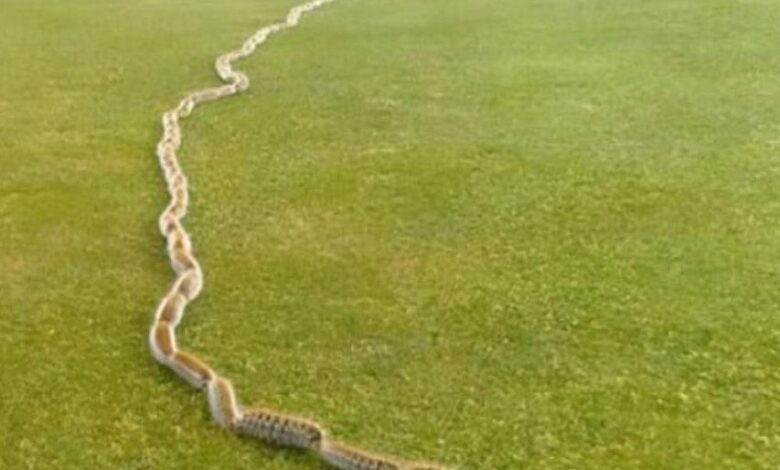
While walking in my yard, I noticed something that looked like a long, coiled rope on the grass. A wave of fear swept over me as I wondered if it might actually be a snake. My heart pounded as I slowly approached, holding my phone tightly to snap a photo. Each step felt heavy with anxiety, expecting the worst.
To my surprise, what I had mistaken for a rope or a snake turned out to be a line of about 150 caterpillars crawling in a straight line. I was fascinated—I had never seen caterpillars behave like that before. They were tightly packed, moving as if following an invisible guide. I couldn’t help but wonder about their purpose or destination.
Curious, I later learned that some scientists believe this behavior helps caterpillars protect themselves from predators, conserve energy, or forage more efficiently. Whatever the reason, witnessing this in my own backyard was both surprising and oddly mesmerizing.
In contrast to that moment of wonder, another experience with my friend turned a pleasant evening into a nightmare. We were dining at a popular restaurant when she noticed tiny black specks on her salad. We assumed they were chia seeds, until they started to move. Alarmed, we called the waiter and rushed to the hospital.
At the hospital, we were treated and given medication as a precaution. Though the restaurant blamed spoiled ingredients, the incident left us shaken. Ever since, seeing chia seeds reminds me of that terrifying dinner—and what might have been crawling on our food.
I stood still for a moment, trying to reconcile what I had expected with what was actually in front of me. From a distance, the shapes had blended into one continuous line. Up close, every small movement belonged to a separate caterpillar. The thing that had frightened me had not changed at all; only my understanding of it had changed. I kept the phone raised, wanting to remember the pattern rather than simply the surprise.
There was something almost orderly about the procession. I watched the line move through the grass, each small body part of a much longer shape. My first instinct had been to decide quickly whether I was facing danger. Now I could take in the details I had missed when fear was doing the looking for me. I had gone outside expecting an ordinary walk around the yard and found myself absorbed by a scene I would once have walked straight past.
The restaurant memory felt entirely different. There, looking more closely had taken us from confidence to alarm. Something that seemed familiar on a plate had suddenly become something neither of us wanted near our food. The contrast stayed with me: in the yard, a second look had relieved my fear, while at dinner it had brought the fear into focus.
Those two experiences made the smallest details unusually memorable. I still remembered the line moving through the grass and the moment my friend leaned toward her salad. Neither began as a remarkable occasion. Both became stories because something ordinary looked different when we finally paid attention.