My Son Gave His Savings to an Elderly Neighbor Then Our Yard Filled with Piggy Banks and Police Cars
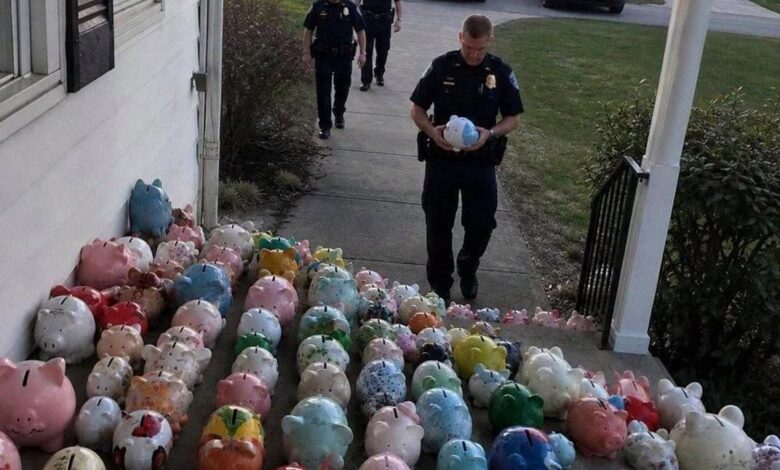
I woke up the next day to sunlight and birdsong—the kind of peaceful morning that makes you forget the world is on fire half the time. I made coffee. I opened the front door to grab the newspaper.
And I froze.
Our entire porch was covered in piggy banks. Dozens of them. Ceramic pigs, plastic cows, glass globes, old tin banks shaped like churches and trains and elephants. Every size, every color. Arranged in neat, careful rows from the welcome mat all the way down the porch steps.
No note. No footprints (strange, because there had been dew overnight). Just piggy banks.
And at the end of our driveway, idling in the middle of the quiet street, were two police cars. Red and blue lights off. Engines running.
My heart did something weird—a half-skip, half-squeeze. I hadn’t called the police. Neither had Oliver.
An officer was already walking toward me. Mid-forties. Kind eyes but a tight jaw. He introduced himself as Sergeant Miller.
“Ma’am,” he said quietly, “we need you to break one of these open. Right now.”
I stared at him. “Why? What’s inside?”
He looked at the piggy banks, then back at me. His expression was unreadable—not alarm, exactly. Something closer to disbelief.
“That,” he said, “is what we need you to confirm.”
What Scattered Across the Porch
My hands were shaking as I picked up the nearest piggy bank—a small ceramic one shaped like a smiling pig wearing overalls. I raised it over the edge of the porch step. Sergeant Miller nodded once.
I brought it down hard.
The pig shattered into three pieces. What spilled out didn’t clink or rattle. It scattered silently across the concrete, white and delicate and completely unexpected.
Not coins. Not cash.
Notes.
Tiny, folded pieces of paper. Some yellowed with age. Some crisp and new. All of them tied with red thread or ribbon. I knelt down, my knees hitting the cold concrete, and unfolded the nearest one.
The handwriting was shaky, elegant, and unmistakably old.
“For the man who gave me his coat when I had none. 1987.”
Another note, tied with a faded blue ribbon:
“For the nurse who stayed past her shift so I wouldn’t die alone. 2003.”
I opened a third. Then a fourth. Sergeant Miller knelt beside me, reading over my shoulder.
“For the boy who mowed my lawn every summer and never took a dime. 1995.”
“For the stranger who paid for my prescription at the pharmacy. 2011.”
I looked up at the porch. Dozens of piggy banks. Dozens of notes inside each one, I realized—because when I shook the shattered pig, more notes kept falling. A cascade of kindness, preserved in paper and thread.
Oliver came to the door in his pajamas, rubbing his eyes. He looked at the broken piggy bank, then at the rows of untouched ones, then at the police cars.
“Mom,” he said slowly, “did Mrs. Adele’s lights come back on?”
I didn’t know how to answer. Because I was starting to understand something terrible and beautiful all at once.
What the Police Knew (That I Didn’t)
Sergeant Miller stood up and brushed dirt off his knees. He told me to sit down. So I did, right there on the porch steps, surrounded by pieces of ceramic and paper.
Here’s what he explained.
Mrs. Adele had been found early that morning. Not dead—thank God, not dead. But sitting in her rocking chair in the dark, surrounded by her own piggy banks. Dozens of them. Same as ours.
She wasn’t confused. She wasn’t scared. She was smiling.
When officers asked her why she’d been living without electricity when she had all those piggy banks, she told them the truth.
“Those aren’t for me,” she said softly. “Those are for the people who were kind to me. Everyone who ever helped me when I had nothing. I wrote down what they did and put it in a bank for them. I was going to give them back one day. I just… never got around to it.”
She’d been saving gratitude. Not money. Not valuables. Just memories of human decency, preserved in ceramic and paper, waiting to be returned.
When Oliver gave her his savings the night before, she said it broke something open in her. She realized she’d been hoarding the wrong thing.
So she spent the night walking—despite her bad hip, despite the cold—to every house on every street where kindness had once found her. She left a piggy bank on each porch. Then she went home and called the police herself.
“I need you to make sure they open them,” she told the dispatcher. “They won’t understand otherwise.”
The Quiet Justice of a Six-Year-Old
Here’s what gets me. Oliver didn’t know any of this when he handed over his piggy bank. He didn’t know Mrs. Adele had been collecting gratitude for forty years. He didn’t know she was waiting for someone to remind her that kindness isn’t something you keep—it’s something you pass on.
He just saw a dark house and a cold old woman and did the only thing that made sense to him.
That’s the quiet justice in this story. Not police cars or shattered ceramic. Just a first-grader who understood something most adults forget: you give because someone needs it. Not because you expect anything back.
And sometimes, when you give without expectation, the whole universe leans over and whispers, “Watch this.”
What Happened After (And What I’ll Never Forget)
We spent the rest of that morning opening piggy banks with Sergeant Miller and two other officers. Every single one was filled with notes. Hundreds of them. Decades of kindness, written in shaky handwriting, tied with ribbons and thread.
We found notes addressed to a firefighter who’d rescued Mrs. Adele’s cat in 1999. To a teenager who’d changed her tire in a grocery store parking lot. To a librarian who’d let her read in the library after hours when her husband was sick.
And one note—this one made me cry so hard I couldn’t see—addressed to “the little boy across the street who will change the world without even trying.”
Oliver still has that note in his nightstand drawer. He reads it sometimes when he can’t sleep.
Mrs. Adele’s electricity was back on by noon. The power company sent a supervisor personally after Sergeant Miller made a phone call. Her porch light came on that evening—and stayed on.
As for the piggy banks? We cleaned them up. Replaced the broken ones. And last week, Oliver and I drove around town leaving them on porches of people who’d been kind to us.
Because that’s the thing about gratitude. It’s not a debt to be repaid. It’s a fire to be passed.
Frequently Asked Questions (From My Confused Friends and Family)
Is Mrs. Adele okay now?