Snake Bite Dont Panic Do the Following
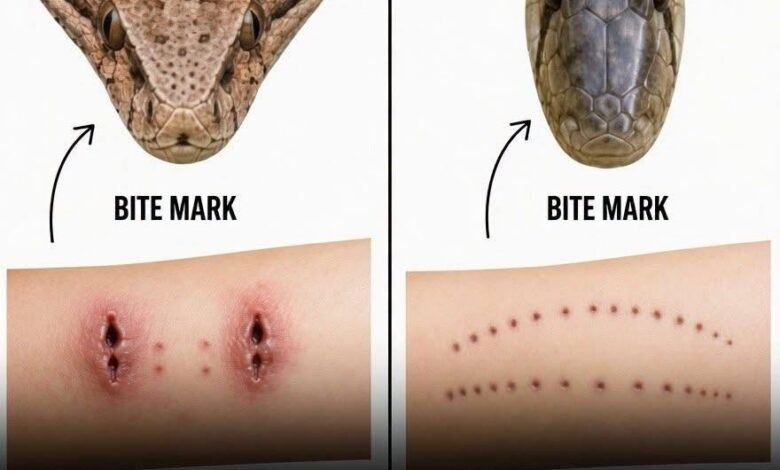
A snakebite is frightening, especially when no one can immediately identify the snake. Viral pictures often claim that two punctures prove a venomous bite while rows of small marks mean a harmless one. Real bites are far less predictable, and the wound’s appearance cannot safely rule venom in or out.
Fang marks vary with the species, angle of the strike, number of strikes, depth of penetration, and the person’s skin. A venomous snake may leave two punctures, several marks, scratches, or injuries too subtle to see. A nonvenomous snake can also create a dramatic wound.
The most important response is to treat any suspected venomous bite as a medical emergency. Move away from the snake and call emergency services. Do not spend valuable time comparing the wound with internet photographs or waiting for symptoms to become obvious.
Do not approach, catch, or kill the snake. A frightened or injured snake can strike again, and even a snake that appears dead should not be handled. If identification may help and a photograph can be taken from a genuinely safe distance, it can be useful, but no picture is worth another bite.
Once safely away, remain as calm and still as possible. Sit or lie down in a comfortable position. Unnecessary movement can increase circulation, so avoid running or walking when someone can bring help or transport.
Have another person call for assistance and arrange transport. A bite can cause dizziness, weakness, or loss of consciousness, so the injured person should not drive. Follow the emergency dispatcher’s instructions because first-aid details can vary by location and snake species.
Remove rings, watches, bracelets, tight shoes, or restrictive clothing from the affected limb before swelling develops. Do this gently without squeezing or manipulating the wound. Items that fit comfortably at first can become dangerous as tissue expands.
Keep the bitten area still in a neutral position of comfort. If advised and practical, loosely support the limb without creating pressure. Cover the bite with a clean, dry dressing after gentle washing when local emergency guidance recommends it.
Several traditional responses can make the injury worse. Do not cut the wound. Slashing the skin does not reliably remove venom and can add bleeding, tissue damage, and infection.
Do not suck the venom by mouth or with an improvised device. This method does not remove a useful amount and can contaminate the wound. Do not apply electric shock, burn the skin, or use folk substances.
Do not place ice on the bite or immerse the limb in ice water. Extreme cold can damage tissue that may already be injured. A tight tourniquet is also dangerous because it can stop blood flow and cause severe damage.
Avoid alcohol. It can impair judgment and complicate care. Do not take aspirin, ibuprofen, naproxen, or other medication unless a medical professional advises it, because some venom affects blood clotting and some drugs can increase bleeding risk.
Symptoms depend on the snake and venom. Pain, swelling, bruising, weakness, nausea, abnormal bleeding, vision changes, difficulty breathing, or neurological symptoms may occur. Some effects begin quickly while others take time.
Feeling well immediately after the bite does not prove that no venom was injected. The absence of visible fang marks is not reassuring enough to skip evaluation. Medical teams assess the wound, vital signs, symptoms, and laboratory results over time.
Antivenom may be required for particular venomous bites. It is administered by trained professionals who can determine whether it is indicated and monitor for reactions. Hospital care can also support breathing, circulation, pain control, clotting problems, and tissue injury.
If the snake disappears, tell clinicians what you remember without returning to search for it. Approximate size, color, markings, location, and behavior may be helpful. Local experts can combine those details with the clinical picture.
An infographic can teach one or two ideas, but it cannot capture every bite. Neat diagrams create false confidence when nature produces messy wounds. The correct decision depends on emergency assessment, not on whether the skin matches a drawing.
The safest sequence is clear. Get out of striking range, call emergency services, remain still, remove constricting items, and follow professional instructions. Do not cut, suck, freeze, shock, or tightly bind the bite.
Outcomes depend on the species, amount of venom, bite location, underlying health, and how quickly appropriate treatment begins. The greatest mistake is assuming that a quiet-looking wound is harmless. Until medical professionals determine otherwise, take every suspected venomous snakebite seriously.