Pata Seca The 7 Foot Tall Enslaved Man Whose Life Became a Story of Exploitation Survival and an Extraordinary Legacy
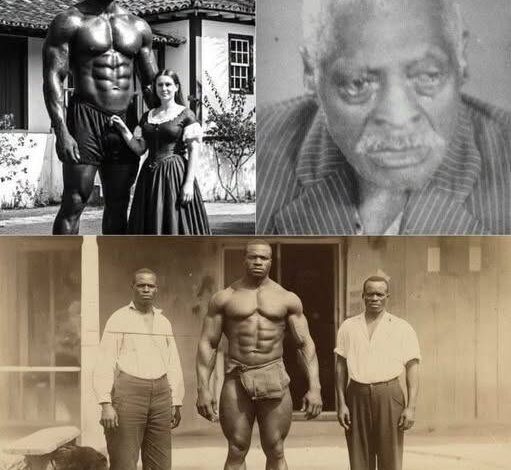
In nineteenth-century Brazil, a man named Roque José Florêncio became known for his extraordinary height and a disturbing story about how slaveholders sought to exploit him. More than a century later, his life remains a powerful reminder of what happens when human beings are reduced to their physical characteristics—and why their humanity must never be forgotten.
The Man Behind the Legend
In the middle of the nineteenth century, in the Brazilian province of São Paulo, a young Black man stood out in a way that made it almost impossible for others to overlook him.
He was extraordinarily tall. His shoulders were broad, his physical presence imposing, and his unusually slender lower legs created a striking contrast with the rest of his body.
According to accounts passed down through generations, he measured approximately seven feet two inches tall, or 2.18 meters—an exceptional height even by modern standards.
But his stature was not what made his story so disturbing.
It was the way other people chose to interpret it.
His name was Roque José Florêncio, although he would become far better known by a nickname that followed him for much of his life: Pata Seca, commonly translated as “Dry Leg.”
Behind that unusual name lies a troubling story about slavery, exploitation, superstition, family, and the struggle to preserve human dignity in a society that systematically denied it.
Roque's life has been described in local histories, family recollections, and accounts preserved in the Santa Eudóxia region of São Paulo. Some versions portray him as a man deliberately selected by a wealthy landowner because of his unusual physical characteristics. According to these stories, slaveholders believed he could father large numbers of children who would eventually become part of the enslaved workforce.
The allegations are disturbing, not only because of the exploitation they describe, but also because they reveal how completely the institution of slavery could intrude into the most personal aspects of someone's existence.
Even the possibility of building a family could be transformed into an economic calculation.
Today, his story is often accompanied by astonishing claims: that he fathered more than 200 children, that his descendants eventually represented a substantial portion of a community, and that he lived for approximately 130 years.
These details have helped turn Pata Seca into a legendary figure.
Yet historical research has also identified significant gaps and inconsistencies in his biography. The Pinacoteca de São Paulo's presentation of artist Nádia Taquary's work on Roque explicitly acknowledges that much of his history survives through oral accounts rather than comprehensive documentation.
Google Arts & Culture
That uncertainty matters.
Because Roque José Florêncio deserves something more meaningful than another sensational legend.
He deserves to be remembered as a human being.
His story is not simply about an unusually tall man who allegedly fathered an astonishing number of children. It is about the society that claimed ownership over his body, the family memories that survived after that society changed, and the difficult process of recovering the identity of someone whose life was shaped by forced labor.
To understand the man called Pata Seca, we must first understand the world into which he was born.
A Childhood in a Country Built on Enslaved Labor
Roque is commonly said to have been born around 1827 or 1828 in the Sorocaba region of São Paulo.
The precise date remains uncertain, reflecting a larger problem confronting historians who attempt to reconstruct the lives of enslaved people.
For much of Brazil's history, the experiences of enslaved Africans and their descendants were recorded primarily by institutions concerned with ownership, labor, taxation, or property.
Their individual thoughts, relationships, ambitions, and personal histories were rarely preserved with the same attention given to wealthy landowners or political leaders.
This imbalance created an enormous historical silence.
A plantation owner might leave behind letters, financial ledgers, land deeds, and detailed records of business transactions. An enslaved worker might appear in surviving documents only as a first name, an estimated age, or a description of physical characteristics.
Sometimes even those fragments disappeared.
For people born into slavery, legal identity was severely restricted by the institution itself.
They could not freely decide where to live, whom to work for, or whether their families would remain together. Enslaved people could be transferred between properties, sold to different owners, or separated from loved ones.
For children, this meant growing up with uncertainty as a constant companion.
A familiar home could disappear after a sale. A parent could be taken away. A community of relatives and friends could be scattered by decisions made elsewhere.
And behind every such decision was a system that treated human beings as property.
Brazil's dependence on enslaved labor extended across centuries. Millions of Africans were forcibly transported across the Atlantic to Brazil, where their labor supported agricultural production, mining, domestic service, and other economic activities.
By the nineteenth century, coffee was becoming particularly important in southeastern Brazil.
Large plantations required extensive labor forces. Landowners invested heavily in production and transportation, and the wealth generated by coffee helped shape the political and economic development of São Paulo.
The suffering behind that prosperity was immense.
Enslaved workers faced exhausting schedules, harsh discipline, limited autonomy, and the constant threat of punishment or separation.
Yet they were never merely passive figures in this history.
They formed families, maintained cultural traditions, developed communities, preserved religious practices, resisted exploitation, and sought opportunities to protect themselves and one another.
It was within this complicated world of coercion and endurance that Roque grew up.
His extraordinary physical appearance would eventually make him memorable.
But before he became Pata Seca, before his name entered local legend, he was a child living under the same fundamental denial of freedom experienced by countless others.
The Body That Attracted the Attention of Slaveholders
As Roque grew older, his height reportedly became increasingly remarkable.
Accounts describe him as unusually tall during adolescence and eventually reaching approximately 2.18 meters as an adult.
At that height, he would have towered above most men of his era.
His body became the defining feature by which others identified him.
But what attracted attention was not height alone.
According to traditional accounts, Roque had relatively thin lower legs compared with his broad upper body. This physical characteristic contributed to the nickname Pata Seca.
To modern readers, the nickname may sound strange or even harmless.
Within the historical context, however, it illustrates how an enslaved person's identity could be reduced to an anatomical observation.
Instead of being recognized for his personality, intelligence, preferences, or individual experiences, Roque became known for the way his body looked.
More disturbing still was a belief reportedly held by certain slaveholders.
Some accounts claim that tall men with slender legs were thought to be especially likely to father male children.
The reasoning was neither scientific nor medically valid.
A man's height and leg proportions do not establish that he will father more sons.
Nevertheless, such ideas could appeal to people whose economic interests encouraged them to regard reproduction as a means of expanding their labor force.
Male children were often valued for the physical work they might later be forced to perform, although enslaved women and girls were also exploited through agricultural, domestic, and other forms of labor.
Within this system, the ability of enslaved people to have children could be treated not as an intimate aspect of family life but as an opportunity to increase an owner's wealth.
The idea that any person's reproductive capacity could be managed for financial gain represents one of slavery's most invasive forms of exploitation.
It transformed the body into a resource.
It transformed parenthood into an instrument of ownership.
And it transformed children into potential additions to an inventory.
For Roque, the consequences of these beliefs would allegedly become central to his life.
The Purchase That Changed His Future
Traditional accounts place an important turning point around 1849, when Roque was approximately twenty-two years old.
He is said to have been purchased in Sorocaba by Francisco da Cunha Bueno, the landowner associated with the estate that would become known as Fazenda Santa Eudóxia.
Some later retellings identify this landowner by his noble title, the Viscount of Cunha Bueno.
The specific circumstances of the purchase are not established in the sources available, and dramatic descriptions of conversations or negotiations should be understood as narrative reconstructions rather than documented testimony.
Nevertheless, the broader claim remains central to Roque's remembered story.
He was reportedly acquired because his physical characteristics were thought to make him particularly valuable for reproduction.
A wealthy slaveholder looking at an enslaved young man could see much more than immediate labor.
He could imagine decades of work, possible resale value, and even future generations who might be compelled into the same system.
Under slavery, such calculations were made possible by the legal treatment of human beings as property.
Ownership created financial claims over people's labor and profoundly restricted their choices.
For enslaved women especially, pregnancy and childbirth could take place within conditions where owners claimed economic interests in the children they bore.
For men like Roque, stories of reproductive exploitation reveal another dimension of the same institution.
The person at the center of these calculations had little meaningful power to reject the role imposed upon him.
This is what makes the traditional account of Pata Seca so unsettling.
It is not simply that a slaveholder allegedly wanted him to have many children.
It is that the desires, consent, feelings, and relationships of the people involved were subordinated to the interests of ownership.
Whatever the exact details of Roque's experience, the system surrounding him was one in which freedom could be denied at every level.
His extraordinary body did not protect him from exploitation.
It may have made him a more specific target of it.
And in that sense, the trait that distinguished him from everyone around him also became part of the mechanism by which others sought to control his life.
Life at Santa Eudóxia: Privilege Without Freedom
According to accounts preserved in the region, Roque's life on the estate differed in certain respects from that of other enslaved workers.
Some retellings suggest that he did not spend all his time working in the coffee fields. Instead, he reportedly performed duties involving animals, transportation, and errands between the estate and nearby settlements.
Other descriptions suggest that his physical presence and the particular role assigned to him gave him a degree of mobility not available to everyone on the plantation.
Such details require caution because they are drawn largely from recollections and stories that developed long after the events themselves.
Yet they raise an important question.
What did different treatment mean to an enslaved person?
An individual might receive better food, different accommodation, or less exhausting work while remaining legally unfree.
Such differences could make daily survival easier, but they did not eliminate the basic relationship of domination.
A person who could be ordered to leave one place, perform a particular task, or enter a relationship without meaningful freedom to refuse was still living under coercion.
Material comfort was not the same as personal autonomy.
This distinction is essential when examining Roque's story.
The claim that he may have performed duties outside the fields should never be mistaken for evidence that his circumstances were acceptable.
A person could be given special treatment precisely because an owner believed that person possessed unusual economic value.
What appeared to be privilege could therefore be another expression of exploitation.
For Roque, whose body was allegedly viewed through the lens of reproduction, that possibility is particularly disturbing.
To the people who controlled the estate, he may have represented an unusual form of property.
But to himself, he was something no system of ownership could fully define.
He was a man with memories, relationships, feelings, and experiences.
He possessed an inner life that no plantation record could measure.
We do not know the private conversations he had with other workers. We do not know what he thought about the nickname imposed upon him, or how he understood his own unusual height.
We do not know whether he dreamed of leaving the plantation, reuniting with relatives, owning land, or living somewhere beyond the reach of his owner.
The absence of these details does not mean those experiences did not exist.
It means the surviving historical record has preserved only fragments of a much larger human life.
And perhaps that is one of the most important lessons of his story.
Sometimes history tells us far more about the people who held power than about those who endured its consequences.
The Disturbing Allegations About His Children
The most widely circulated claim concerning Pata Seca is that he fathered an extraordinary number of children.
Some versions suggest more than 200. Others place the figure above 250.
The numbers are startling, which helps explain why the story continues to attract attention.
But they also demand careful examination.
Family oral traditions, regional histories, and popular retellings have preserved the claim that Roque became the father of a very large number of children during slavery.
However, a complete, independently verified genealogical record establishing the exact total has not been demonstrated in the sources reviewed here.
Research involving interviews with descendants, including recollections from Roque's grandson Nelson Florêncio, shows that his history has been transmitted substantially through family memory.
agendapos.fclar.unesp.br
This does not mean those memories should be dismissed.
Oral history is an important source of knowledge, especially for communities whose experiences were excluded from official archives.
Family stories can preserve names, relationships, places, and events that written records overlooked.
But oral traditions and documented facts are not always the same thing.
Numbers can change as stories pass between generations. Different family branches may preserve different versions of events. The distinction between children, grandchildren, and later descendants can become blurred in popular retellings.
For these reasons, the extraordinary number associated with Roque should be presented as a reported claim, rather than an established biological record.
Yet the uncertainty surrounding the precise figure does not diminish the ethical significance of the story.
What matters is the allegation that Roque's reproductive life was deliberately exploited.
The stories suggest that his owner viewed him as a way to increase the number of enslaved people on the estate.
If such arrangements were imposed, they would represent a profound violation of the autonomy of everyone involved.
The women would not have been simply participants in an economic plan. They were people with their own lives, feelings, relationships, and desires.
Their experiences deserve consideration just as much as Roque's.
Indeed, this is one of the weaknesses of popular versions of the Pata Seca legend.
They often focus almost entirely on the unusually tall man and the astonishing number of children attributed to him.
The women disappear into the background.
They are rarely named.
Their stories are seldom explored.
And the difficult realities of pregnancy, childbirth, motherhood, and family separation under slavery become secondary to the numerical spectacle.
Such storytelling risks reproducing the same dehumanization it seeks to condemn.
If the goal is to understand historical exploitation, the children cannot be viewed merely as proof of a remarkable man's fertility.
They were individual human beings.
Their mothers were individual human beings.
Their families, whether preserved or separated, were more than entries in someone else's economic calculations.
There is no way to recover every private experience hidden behind the legend.
But recognizing that absence is itself an important act of historical honesty.
Roque's story is not meaningful because he may have fathered an extraordinary number of children.
It is meaningful because his alleged exploitation reveals the extent to which slavery could claim authority over human relationships and family life.
The Women Whose Stories Were Left Untold
The history of slavery is often told through a limited number of memorable figures.
Some were leaders of rebellions. Others escaped captivity, became abolitionists, challenged the courts, or survived extraordinary circumstances.
These stories are valuable because they help modern audiences connect with a past that can otherwise seem distant.
But every widely remembered figure existed within a community of people whose lives were no less important.
In the case of Pata Seca, the absence of detailed information about the women associated with his alleged reproductive role is especially striking.
If many children were born through relationships shaped by an enslaver's demands, those pregnancies would have involved women whose bodies and choices were also subject to coercive power.
The physical consequences of pregnancy and childbirth would have been borne by them.
So would much of the everyday responsibility of caring for their children, often under exhausting working conditions.
Enslaved mothers could face the fear of separation from their children. They might have to work while pregnant, care for infants with limited resources, or endure circumstances in which decisions about their families were controlled by other people.
These experiences were not identical for every woman or every plantation.
Nevertheless, the institution of slavery created conditions in which intimate family life was profoundly vulnerable to the demands of owners.
Any examination of Roque's story must therefore look beyond the familiar image of an exceptionally tall man.
It must make room for the people whose names were not preserved.
There is also a deeper historical issue.
When a story describes an enslaved man as having been used for reproduction, it can unintentionally create the impression that he was acting freely or exercising power over the women involved.
That interpretation may obscure the central problem: the system of enslavement itself.
Both men and women could be placed under coercive pressures that fundamentally restricted their autonomy.
The responsibility for such coercion lay with the institution and those who enforced it, not simply with the people whose bodies were exploited.
Understanding this distinction makes the story more difficult, but also more truthful.
It reminds us that slavery did not merely exploit labor.
It interfered with the fundamental human right to determine the course of one's own life.
The Long Road Toward Freedom
As Roque grew older, Brazil began changing.
The institution that had shaped his childhood and adult life faced growing political, legal, economic, and social pressure.
But the movement toward abolition was neither simple nor immediate.
For centuries, slavery had been deeply embedded in Brazil's economy.
Powerful landowners relied on enslaved labor, and political debates about emancipation were frequently influenced by their financial interests.
Change came through a combination of resistance by enslaved people, organized abolitionist campaigning, legislative developments, and shifts in the broader economy.
In 1850, Brazil passed the Eusébio de Queirós Law, which targeted the transatlantic slave trade.
Although the law represented an important development, it did not end slavery within the country.
People already held in bondage remained enslaved, and the domestic slave trade continued.
In 1871, the Free Womb Law declared that children born to enslaved mothers after its enactment would be legally free, though its provisions allowed continued control over many children's labor and lives.
In 1885, another law addressed the status of elderly enslaved people, but it also contained conditions that limited its practical effect.
These measures reflected the gradual weakening of slavery's legal foundations.
Yet they were far from sufficient.
Freedom was not simply handed down from above.
Enslaved people themselves played a central role in making the system increasingly difficult to sustain.
Escapes, collective resistance, refusal, community organization, and alliances with abolitionists all contributed to the pressure for change.
By the late 1880s, mass escapes from plantations in São Paulo were creating serious difficulties for slaveholders, while political support for abolition continued to strengthen.
Arquivo Nacional
+1
For someone like Roque, these developments unfolded over the course of decades.
If the commonly reported birth year of 1827 is approximately correct, he would have been in his early sixties when Brazil finally abolished slavery.
That meant most of his adult life had already passed.
His youth, his physical strength, and many of the opportunities that freedom might have offered had been consumed under a system he had no meaningful choice to enter.
But the final collapse of slavery would still mark a profound turning point.
On May 13, 1888, Princess Isabel, acting as regent of Brazil, signed the Lei Áurea, or Golden Law.
It abolished slavery throughout the country.
The law was remarkably short, containing only two articles.
Yet its significance was immense.
Brazil, the last independent country in the Americas to abolish slavery, had finally brought legal recognition of human ownership to an end.
Arquivo Nacional
For formerly enslaved people, freedom opened possibilities that had long been denied.
But it also introduced new struggles.
The law did not provide a comprehensive program of land redistribution, education, housing, or economic support.
Many newly emancipated people had little money, limited access to property, and few opportunities for independent employment.
They were legally free, but the inequalities produced by slavery remained deeply embedded in Brazilian society.
For Roque José Florêncio, freedom was therefore not the end of the story.
It was the beginning of another chapter.
A New Life Beyond the Plantation
According to regional accounts, Roque remained connected to the Santa Eudóxia area after abolition.
Some versions of his biography report that he received a parcel of land from his former owner, although details about the circumstances and size of the property differ across retellings.
The land reportedly became associated with the name Sítio Pata Seca.
For a man who had spent much of his life under the authority of others, access to land could represent a dramatic change.
Land meant the possibility of cultivating food for one's own household.
It meant building a home, establishing routines, and pursuing work whose benefits were not automatically claimed by an enslaver.
It also created the possibility of leaving something behind for future generations.
But ownership and economic security were not the same thing.
Formerly enslaved people frequently faced serious obstacles when attempting to establish themselves as independent farmers.
Land required tools, seeds, buildings, maintenance, and sometimes money for legal or administrative expenses.
Without savings or reliable access to credit, even a modest property could be difficult to maintain.
Some accounts suggest that Roque lost part of the land associated with him after emancipation.
Others describe him supporting himself through small-scale agriculture and the production or sale of household items.
Such reports offer a different picture from the familiar legend of the exceptionally tall man.
Instead of being remembered primarily for his body, he appears as a person navigating the challenges of economic independence.
The details may be incomplete, but the larger significance is clear.
A life once defined by someone else's legal ownership was now shaped, at least in principle, by the possibility of personal decisions.
The ability to work for one's own household, cultivate land, and establish a recognized family was enormously meaningful.
For someone who had lived through decades of bondage, ordinary activities could carry extraordinary importance.
A garden was no longer merely a place where labor was demanded.
A home could become a place of belonging.
A family could create and preserve relationships beyond the formal power of an owner.
None of this erased what had happened before.
Freedom could not restore lost years or undo the effects of coercion.
But it created space for new forms of dignity and self-determination.
The Family That Carried His Name Into the Future
Accounts of Roque's life after emancipation describe a marriage to a woman named Palmira.
The couple are often said to have had nine children together.
These details appear frequently in popular biographies, although the full documentary basis for every aspect of the family history remains unclear.
What matters here is the possibility of seeing Roque not simply through the allegations surrounding his years of enslavement, but through the family relationships associated with his later life.
Family could become a source of stability, memory, and continuity after generations of disruption.
For formerly enslaved people, the recognition of family relationships had special significance because slavery had so often undermined their security.
Marriage and household life did not automatically remove poverty or discrimination.
But they could help establish social ties that endured across generations.
In Roque's case, those ties became part of the way his story survived.
His descendants and members of the Santa Eudóxia community continued telling stories about him long after his lifetime.
Some accounts claim that a substantial proportion of the district's population could trace ancestry to Pata Seca.
The precise percentage sometimes quoted in popular retellings should not be treated as an established demographic finding without comprehensive genealogical evidence.
Nevertheless, the persistence of that claim illustrates something important.
Roque became a figure around whom a community organized part of its historical memory.
His name connected people to a shared past.
In families, history often survives through repeated stories rather than official monuments.
A grandparent remembers what an older relative said.
A parent passes a story to a child.
A nickname becomes attached to a place, a household, or a family branch.
Over time, these recollections become part of a community's understanding of itself.
They may contain errors, exaggerations, and conflicting details.
But they can also preserve experiences that otherwise would disappear.
Research concerning Roque and Santa Eudóxia has emphasized precisely this importance of family recollection, including memories concerning emancipation, land, education, and Black community life.
agendapos.fclar.unesp.br
His descendants therefore carry a legacy that extends beyond biological ancestry.
They are connected to a history of enslavement, survival, emancipation, and the difficult effort to build lives afterward.
That is a far more meaningful legacy than any unverified numerical claim.
The Extraordinary Claim That He Lived for 130 Years
Another astonishing part of the Pata Seca story concerns his age.
Many biographies claim that Roque José Florêncio died on February 17, 1958, at approximately 130 years old.
If his reported birth year of 1827 were accurate, that would place his lifespan far beyond the age reliably documented for almost all human beings.
It would mean that he had lived through the Brazilian Empire, the abolition of slavery, the establishment of the Brazilian Republic, two world wars, and dramatic changes in transportation, communication, medicine, and everyday life.
A man born into a world where enslaved people were legally treated as property would have survived into the age of commercial aviation, television, and modern cities.
It is an extraordinary image.
But extraordinary claims require careful evidence.
Birth records from the early nineteenth century were often incomplete, especially for people born into slavery.
Even when later documents recorded someone's age, they could rely on estimates, family recollections, or information that had never been independently verified.
Consequently, the claim that Roque lived for approximately 130 years should be understood as part of his reported biography, not as a scientifically established longevity record.
His extraordinary alleged age nevertheless reveals something about the way communities remember remarkable people.
Over time, a man already known for unusual physical characteristics and an extraordinary family history can become associated with additional stories of exceptional endurance.
His legend grows beyond the surviving documentation.
For historians, the challenge is to respect those memories while remaining honest about uncertainty.
Roque does not need to have lived for 130 years to deserve recognition.
Nor does he need to have fathered hundreds of children.
His importance is grounded in something more substantial: the historical experience of a person whose life crossed the boundary between slavery and freedom.
That experience alone is worthy of remembrance.
Why His Story Refuses to Disappear
More than a century after the abolition of slavery in Brazil, the name Pata Seca continues to appear in discussions of the country's difficult past.
His life has inspired articles, local histories, family investigations, and artistic interpretations.
One particularly meaningful example is the work of Brazilian artist Nádia Taquary, whose 2020 piece Roque José Florêncio e Filhos do Apagamento forms part of a project dedicated to recovering and representing Black historical figures whose stories have been marginalized or forgotten.
The work is associated with the Pinacoteca de São Paulo and the Enciclopédia Negra project.
Its title invokes the idea of erasure—a particularly appropriate theme for a man whose name survived, but whose complete personal history remains elusive.
Google Arts & Culture
The artistic recognition of Roque reflects a wider change in how history can be told.
Traditional accounts often concentrated on rulers, landowners, military figures, and wealthy families.
The lives of enslaved workers appeared mainly as background to economic or political developments.
Today, researchers, artists, and descendants increasingly seek to reverse that perspective.
Instead of asking only how much wealth a plantation produced, they ask who performed the labor.
Instead of focusing exclusively on powerful owners, they investigate the lives of the people those owners controlled.
Instead of treating enslaved populations as statistics, they seek to recover individual identities.
This shift is especially important for someone like Roque.
His unusual height may have made him visible during his lifetime, but visibility did not necessarily mean recognition.
People noticed his body.
They remembered his nickname.
They passed down extraordinary stories about his alleged reproductive role.
Yet the details that would allow modern readers to understand his individual personality are far less clear.
That imbalance is itself revealing.
It shows how a person can be widely remembered for characteristics that served the interests or curiosity of others while much of their actual humanity remains hidden.
Recovering Roque's story therefore involves more than repeating the legend.
It requires asking what the legend leaves out.
Who were his friends?
What traditions did he preserve?
How did he experience the arrival of freedom?
What did he teach the children he helped raise?
How did he understand his place in the changing world around him?
We may never know the answers to many of these questions.
But asking them changes the way we remember him.
It allows us to see something beyond the physical spectacle.
It allows us to recognize a person.
The Difference Between Being Remembered and Being Understood
There is an uncomfortable irony at the center of Pata Seca's story.
During slavery, according to traditional accounts, powerful men looked at him and saw the possibility of increasing their wealth.
Generations later, popular audiences sometimes look at the same story and see a sensational historical curiosity.
In both cases, attention can become focused on the extraordinary measurements and numbers associated with his body.
Seven feet two inches tall.
More than 200 alleged children.
Approximately 130 reported years of life.
These claims are memorable.
They are also incomplete.
They tell us little about what Roque wanted, what he feared, what he valued, or how he understood himself.
And when a person's historical importance becomes inseparable from astonishing statistics, there is a danger of repeating the same pattern of reduction that defined his treatment under slavery.
He becomes remarkable primarily because of what his body supposedly accomplished.
But human dignity is not dependent on physical exceptionalism.
Roque would have deserved freedom if he had been an ordinary height.
He would have deserved respect if he had never fathered a child.
His life would have mattered even if he had left no identifiable descendants.
The injustice of slavery was not that it exploited an extraordinary man.
It was that it denied freedom and autonomy to human beings, regardless of their abilities, appearance, or economic value.
This distinction brings the story into sharper focus.
Roque's unusual physical characteristics explain why his name may have survived in popular memory.
They do not explain why his suffering matters.
His suffering matters because he was human.
And his later life matters because, despite the restrictions imposed upon him, he became part of a family and community whose memories endured.
The Legacy of Roque José Florêncio
Today, the most powerful way to remember Pata Seca is not as an extraordinary biological phenomenon.
It is to remember him as Roque José Florêncio.
A man whose reported life began in a society that legally permitted one person to own another.
A man whose unusual physical appearance became associated with degrading beliefs about reproduction.
A man whose experience illustrates the extent to which slavery could interfere with personal choices, relationships, and family life.
And a man whose name continued to be spoken long after the institution that had confined him was abolished.
His biography remains surrounded by uncertainties.
The precise year of his birth is not securely established. The full circumstances of his purchase and treatment are incompletely documented. The extraordinary number of children attributed to him has not been conclusively verified. His reported lifespan should not be confused with a confirmed longevity record.
These uncertainties do not make his story meaningless.
They remind us of the difficult conditions under which histories of enslaved people must often be reconstructed.
The gaps in the records are themselves part of the historical legacy of slavery.
For generations, powerful institutions preserved detailed information about land, wealth, production, and ownership while failing to document the full lives of the people whose labor sustained those systems.
Much of what was most meaningful to those individuals was never written down.
Yet not everything disappeared.
Names survived.
Family stories survived.
Local memories survived.
Descendants continued asking questions.
And through those efforts, people who had once been described primarily as property began to reappear in history as individuals.
Roque's story belongs to that process of recovery.
It also reminds us that the abolition of slavery was not a magical dividing line between suffering and equality.
Freedom in 1888 did not immediately erase poverty, racial discrimination, unequal access to land, or the consequences of generations of forced labor.
Those who emerged from slavery still had to build their lives in a society profoundly shaped by it.
For Roque and countless others, emancipation was both a historic achievement and the beginning of new struggles.
Their experiences deserve to be understood in all their complexity.
In the end, Pata Seca's legacy is not measured by his extraordinary height, the number of children attributed to him, or the remarkable age he reportedly reached.
It is measured by the humanity that endured behind the legend.
A nickname that once reduced him to a physical characteristic has become part of a larger conversation about remembrance and historical justice.
But his real name deserves equal prominence.
Roque José Florêncio.
Behind that name stood a man who lived through one of the most consequential transformations in Brazilian history.
A man whose life reminds us that no person's worth can be calculated through measurements, productivity, ancestry, or profit.
And a man whose story asks us to consider not only what history remembers, but what history has forgotten.
Because the greatest tragedy of slavery was never simply that human beings were exploited for their labor.
It was that entire societies attempted to redefine human beings as things.
Things that could be bought.
Things that could be sold.
Things whose bodies, relationships, and futures could supposedly belong to someone else.
Roque's story challenges that way of thinking across the distance of time.
His life was more than the role assigned to him.
His identity was more than a nickname.
His existence was more than a collection of astonishing claims.
And although many details may remain forever beyond our reach, one truth needs no extraordinary statistic to support it:
Before he was a legend, before he was called Pata Seca, and before others attempted to define his worth through his body, Roque José Florêncio was a human being who deserved freedom, dignity, and the right to live his own life.
That is the story worth remembering.