Some People Are Only Now Realizing What the WC Sign Stands For on Washrooms
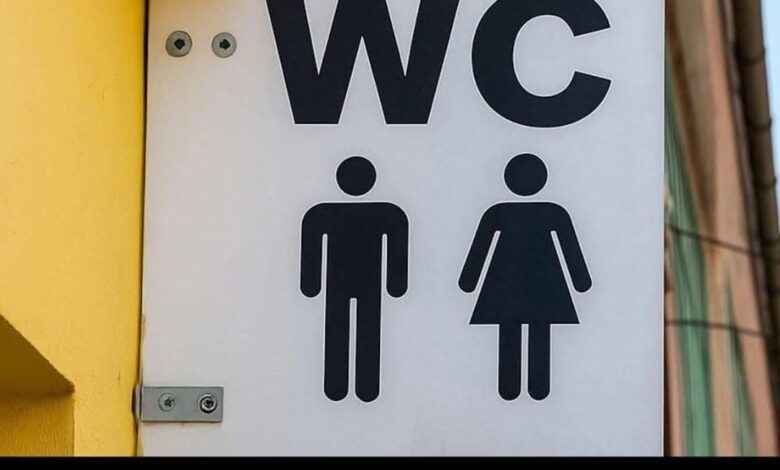
The letters “WC” appear on toilet doors in train stations, restaurants, airports and hotels across much of Europe and other parts of the world. They stand for “water closet,” a term that developed when indoor flushing toilets were still a new feature and needed to be distinguished from rooms used primarily for bathing.
Before modern plumbing became common, bathing and toilet functions were often separated. A household might have a room containing a portable bath, while waste was handled through chamber pots or an outdoor privy. As piped water and sewer systems entered buildings during the nineteenth century, a flushing toilet could be installed in a small enclosed room resembling a closet.
“Water closet” described both the fixture and the private compartment containing it. “Water” distinguished the flushing system from older dry arrangements, and “closet” referred to a small private room rather than a wardrobe. The abbreviation was convenient on architectural plans, plumbing diagrams and public signs.
Language evolved differently across countries. In the United States, “bathroom” and “restroom” became polite general terms even when no bath was present. In Britain, people commonly say “toilet” or “loo,” while “lavatory” remains familiar in formal and transport settings. Canada often uses “washroom.” None of these terms describes every fixture literally.
The persistence of WC is partly practical. Two letters fit easily on a small sign and are recognized across several languages. Travelers may not understand the local word for toilet, but a WC symbol beside familiar male, female or accessible icons usually communicates the purpose. Hotels also use the abbreviation on maps and room plans.
In modern real-estate descriptions, a WC can mean a small room containing only a toilet and perhaps a hand basin, separate from the main bathroom. This arrangement allows one person to use the toilet while another bathes. In some regions, “cloakroom” is used for a similar small downstairs space.
The history is not a story of people suddenly wondering where to place a toilet after bathrooms already existed everywhere. Indoor sanitation developed unevenly, and building design varied by wealth, location and available infrastructure. The simple social-media explanation captures the broad idea but compresses a long transition involving municipal water, sewers, engineering and public-health reform.
Early flushing devices existed centuries before Victorian plumbing, but reliable water supply and sewage removal were essential for widespread adoption. A toilet connected to inadequate drainage could move waste without solving the health problem. Cities gradually built networks that made indoor fixtures practical for larger populations.
Public language often preserves old technology. People still “dial” a phone number even though phones no longer have rotary dials, and a computer “folder” resembles its paper ancestor only symbolically. WC survives in the same way. The fixture has changed, rooms have grown and terminology has diversified, but the compact label remains useful.
So the next time a traveler follows a WC sign, the letters offer a small piece of plumbing history. They do not encode a mysterious service or modern brand. They simply mean water closet: an old name for the private room built around one of the most important public-health technologies in everyday life.
The abbreviation also demonstrates how international travel depends on shared visual conventions. A word that sounds old-fashioned in conversation can remain ideal on a station wall because it is brief, neutral and widely recognized. Its survival is not an accident; it is a useful linguistic fossil that still performs the job for which it was created.
Knowing its meaning will not change the room, but it turns an ordinary sign into a reminder of how engineering, language and public health quietly shape daily life.