If your eggs have a green ring around the yolk it means that See more
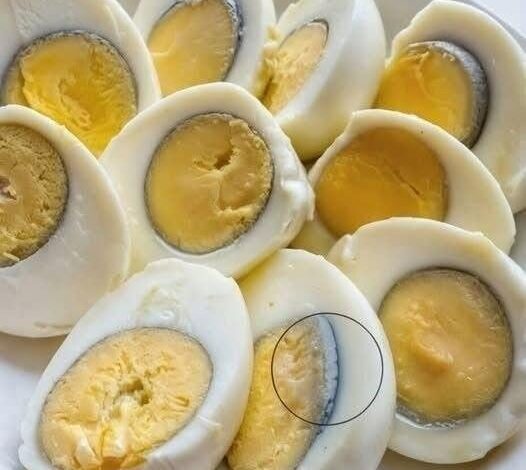
The Green Ring Mystery: Why Hard-Boiled Eggs Turn Gray—and How to Prevent It
A gray-green ring around a hard-boiled egg yolk may look unappetizing, but it’s usually harmless. Here’s why it happens, what it means, and the simple tricks that can keep your eggs looking perfect every time.
Few kitchen disappointments are as common as peeling a hard-boiled egg, cutting it open, and discovering a gray-green ring surrounding the yolk.
Many people immediately assume the egg has spoiled, been overcooked beyond saving, or somehow become unsafe to eat. Fortunately, none of those assumptions are usually true.
In most cases, the greenish-gray ring is simply the result of a natural chemical reaction that occurs during cooking.
What Causes the Gray-Green Ring?
The discoloration forms when sulfur from the egg white reacts with iron found in the yolk.
As eggs cook, proteins in the white release sulfur-containing compounds. When exposed to high heat for too long, these compounds migrate toward the yolk and react with iron, forming a substance called ferrous sulfide.
This reaction creates the familiar gray-green layer around the outer edge of the yolk.
Although the appearance may not be appealing, the egg remains perfectly safe to eat.
Why Does It Happen More Often in Some Eggs?
Several factors can increase the likelihood of developing the ring:
Overcooking the eggs
Boiling at excessively high temperatures
Leaving eggs in hot water after cooking
Slow cooling after boiling
Using older eggs, which can be more prone to the reaction
The longer the yolk remains exposed to heat, the more opportunity sulfur and iron have to interact.
4
How to Prevent the Green Ring
The good news is that avoiding the discoloration is surprisingly simple.
One of the most effective methods is to remove the eggs from heat as soon as they finish cooking and immediately place them into an ice bath.
Rapid cooling stops the cooking process and greatly reduces the chance of sulfur and iron continuing to react.
A common technique involves:
Bringing eggs to a gentle boil.
Removing the pot from direct heat.
Covering the pot and letting the eggs sit for the desired cooking time.
Transferring them immediately to ice water.
This method often produces firm whites and bright yellow yolks without the unwanted ring.
Does the Ring Affect Taste or Nutrition?
Generally, no.
The discoloration has little impact on flavor and does not significantly reduce the egg’s nutritional value. Most people who notice the ring are reacting primarily to its appearance rather than any change in taste.
However, severely overcooked eggs may develop a slightly drier texture and a stronger sulfur smell.
For this reason, many cooks aim to avoid overcooking not only for appearance but also for improved texture and flavor.
7
The Science Behind a Common Kitchen Mystery
The gray-green ring is one of the most misunderstood features of hard-boiled eggs. What looks like a warning sign is actually a predictable chemical reaction caused by heat and timing.
Once you understand the science behind it, preventing the problem becomes much easier.
So the next time you spot a gray ring around a yolk, there’s no need to throw the egg away. A few small adjustments to your cooking method can help you achieve beautifully cooked eggs with bright golden centers every time.