The Meaning Behind a Blue Stop Sign
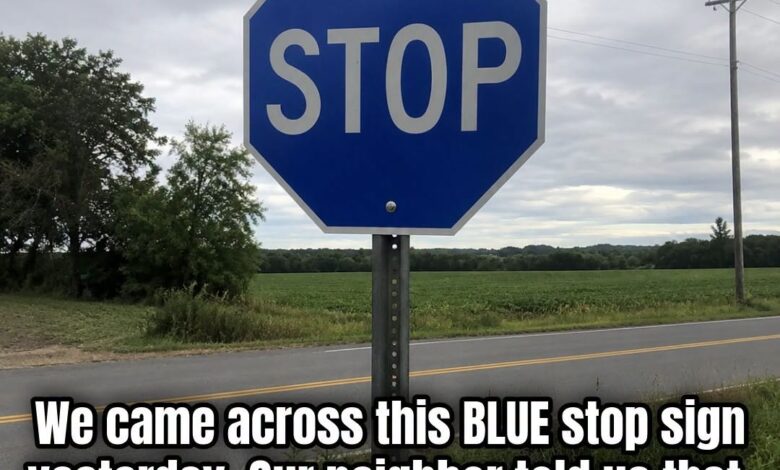
A blue stop sign creates an immediate mental conflict. Drivers learn from childhood that a stop sign is a red octagon with white letters, so the command becomes recognizable before the word is consciously read. When the same shape appears in blue, it looks official enough to demand attention but unfamiliar enough to create doubt. That moment of hesitation explains why photographs of blue stop signs prompt so many questions.
The standard red design exists for safety and consistency. Color, shape, lettering, placement, and reflectivity work together so drivers can understand the instruction quickly in daylight, darkness, rain, or heavy traffic. A government-regulated stop sign follows established traffic-control standards. Its appearance is not a matter of decoration. Uniformity allows someone traveling far from home to respond correctly without learning a new visual language.
Blue stop signs usually appear outside that regulated public-road system. They may be installed in gated communities, private parking areas, business campuses, resorts, or other property controlled by an owner rather than a transportation department. The owner wants vehicles to stop at an intersection or pedestrian crossing but chooses a nonstandard color, sometimes to match a local design scheme or distinguish private signs from municipal ones.
Because the sign is on private property, its legal status may differ from that of a standard roadside sign. A traffic citation based solely on the blue sign may not work in exactly the same way as one issued for ignoring an official red sign. Laws vary by location, and other rules about reckless driving, right of way, or property safety can still apply. The unusual color should never be interpreted as permission to continue without looking.
The safest response is straightforward: treat the sign as a stop. Bring the vehicle to a complete halt, check for pedestrians and cross traffic, and proceed only when the route is clear. The few seconds required are minor compared with the risk of a collision. Even if the sign lacks official authority, it was probably placed at that spot because vehicles or people regularly cross there.
Shape remains important. An octagon is strongly associated with stopping, and property owners often rely on that recognition even when they change the color. A blue rectangular sign with information would communicate something different, but a blue octagon carrying the word STOP still expresses a clear request. Drivers should respond to the combined message rather than focusing on whether the color is technically correct.
Private communities sometimes use customized signs to preserve a particular appearance. Decorative lighting, coordinated street names, and nonstandard colors can make the environment feel distinct. The tradeoff is reduced clarity for visitors. A resident may understand the local system, while a delivery driver or guest encounters it for the first time. Good design should never make a safety instruction harder to recognize.
A blue stop sign can also appear because of fading, unusual materials, a temporary replacement, or a creative installation that was never intended as official traffic control. Context helps identify the likely explanation. Signs beside public streets, especially near complex intersections, should be reported to the responsible authority if their appearance seems incorrect. Officials can determine whether the sign is authorized, damaged, or potentially confusing.
The fascination surrounding these signs comes from the strength of learned symbols. People do not merely read STOP; they recognize a complete pattern. Changing one part makes the familiar object feel almost unreal, like a word spelled correctly in an unexpected alphabet. That reaction is useful because it draws attention, but attention must be followed by a safe driving decision rather than prolonged confusion.
Ultimately, a blue stop sign usually means that the road or lot is privately managed and the sign does not follow normal government standards. It does not signal a secret rule, an international code, or permission to ignore the intersection. Stop, observe, and continue carefully. On any property, the practical purpose remains the same: preventing two paths from becoming one accident.