The Viral Image That Proves We Have Lost The Ability To Distinguish Fact From Our Own Political Fantasies
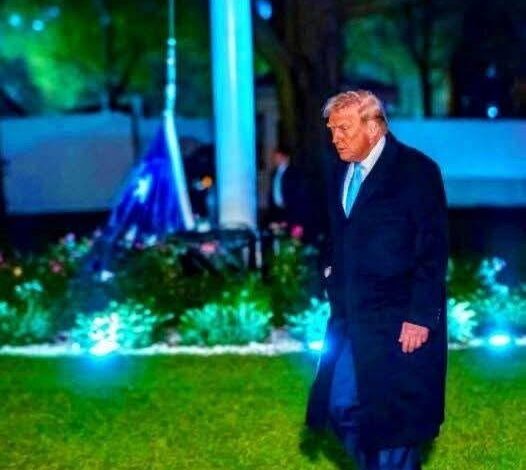
A grainy photograph of Donald Trump holding an unidentified object became a perfect example of how quickly political audiences can replace missing facts with whatever story they already want to believe. The image offered very little reliable information. The lighting was poor, the object was unclear, and no immediate context explained what had been captured. Yet within minutes, social media users were treating their guesses as established truth.
For Trump’s strongest critics, the photograph appeared to confirm something sinister. Some described the object as evidence of a hidden plan, a secret message, or an alarming development. Supporters looked at the same pixels and reached the opposite conclusion. To them, it represented strength, strategy, or proof that Trump was privately fighting on behalf of his followers. The image itself had not changed, but the meaning attached to it depended almost entirely on the viewer’s political loyalties.
Even people who saw nothing important in the photograph were pulled into the argument. Their refusal to speculate was interpreted by one side as blindness and by the other as disrespect. Neutrality became almost impossible because every reaction, including the decision not to react, was transformed into political ammunition.
The picture effectively became a Rorschach test. Comment sections revealed far more about the people studying it than about the object in Trump’s hand. Users zoomed, cropped, brightened, and filtered the image until the details became less clear, not more. Paradoxically, the blurrier it became, the more confident many people sounded about what they believed it showed.
Cable news and online programs helped extend the speculation. Panels discussed the angle of Trump’s hand, the dimensions of the object, and the possible meaning of his posture. Analysis that should have begun with verification instead began with theories. The demand for immediate content turned an ambiguous photograph into hours of debate even though the most basic question—what was he actually holding?—had not been answered.
That reaction exposed a larger problem in modern political culture. Facts increasingly arrive after audiences have already selected a narrative. People no longer wait for enough evidence to form an opinion; they form the opinion first and then search the image for supporting clues. Each group creates a version of reality that strengthens its existing fears or hopes.
The object was probably ordinary: perhaps a phone, folded paper, a personal item, or simply a visual effect caused by shadow and compression. But ordinary explanations struggle online because they offer less emotional reward. A mundane answer cannot compete with claims of conspiracy, danger, heroism, or betrayal.
Social-media platforms encourage this behavior by rewarding speed and engagement. The first dramatic interpretation often travels farther than a correction published hours later. Users want to be the first to solve the mystery, and political communities reward members who produce interpretations that fit the group’s worldview. Admitting “I do not know” receives far less attention than declaring that the photograph proves everything.
The consequences extend beyond one viral picture. Democratic debate requires at least some shared agreement about observable reality. When every image, statement, and gesture is filtered through partisan fantasy, people begin living in separate informational worlds. They may see the same event but argue from entirely different sets of assumed facts.
Critical thinking requires patience, especially when visual evidence is unclear. Useful questions include who captured the image, when it was taken, whether an uncropped version exists, and whether reliable witnesses provided context. Without those answers, certainty is not analysis; it is projection.
The most revealing part of the incident was never the item in Trump’s hand. It was the public’s eagerness to transform ambiguity into proof. The photograph eventually disappeared from the news cycle, but the habit it exposed remains. We are losing the ability to wait, to tolerate uncertainty, and to acknowledge that a political opponent may be neither the monster nor the hero imagined in a viral post.
The next time a mysterious image begins circulating, the most responsible response may also be the least exciting: pause, verify the source, and accept that the available evidence does not yet support a conclusion. In today’s political environment, simply saying “we do not know” has become a surprisingly radical defense of truth.